


If you’re hunting for a wood-framed maximalist entryway mirror, you’re the target of one of retail’s favorite markups: “statement” mirrors that are mostly MDF, veneer, and branding. The irony is brutal. The very mirror that should feel substantial and special is often the flimsiest thing in the room.
Here’s the good news: once you understand what you actually need in a wood-framed maximalist entryway mirror—shape, size, frame, and presence—it becomes very obvious when custom beats retail on both price and impact.
What makes a wood-framed maximalist entryway mirror actually work?
Maximalist doesn’t mean messy. A good mirror in a layered hallway has a job: anchor the wall, bounce light, and stand up to a lot of visual noise without getting lost.
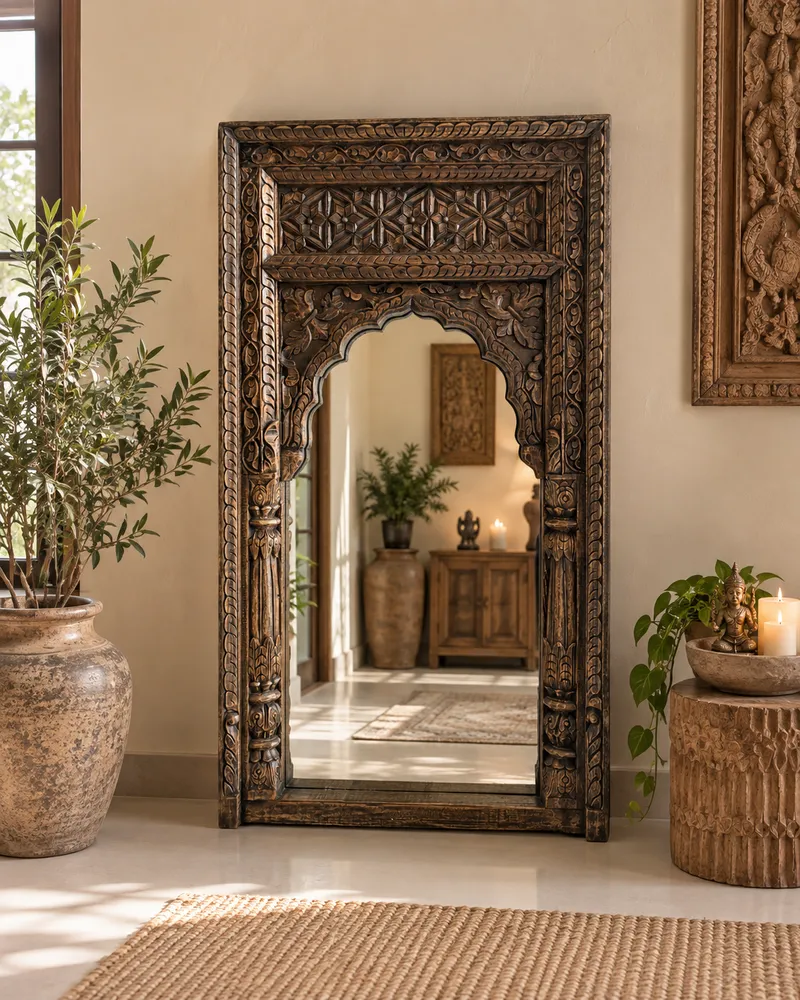
For a maximalist foyer, focus on four things:
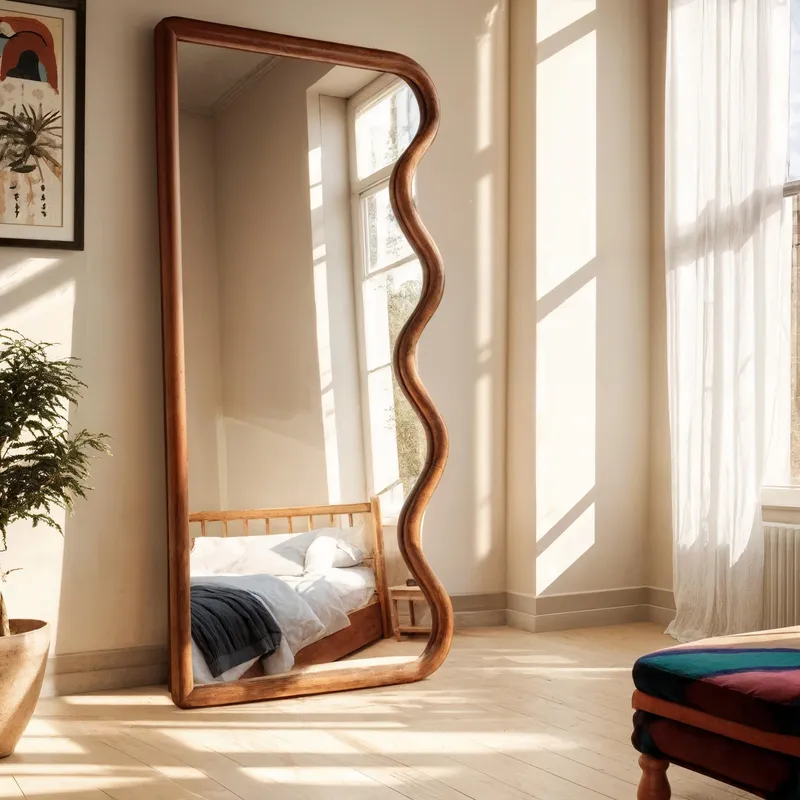
Shape: Maximalist mirrors need some attitude. Arched, oval, wavy, or irregular silhouettes immediately read more decorative than a basic rectangle. Arches soften tight hallways; squiggle or wavy shapes push things into playful, almost sculptural territory, which works well with colorful eclectic hallway design.
Frame material: Warm, real wood is non-negotiable if you want vintage wood frame mirror styling. Solid wood or good-quality rubberwood looks and feels richer than metal or painted MDF. It also grounds layered entryway wall decor so the wall doesn’t feel like chaos. Faux “vintage” resin frames look fine in photos and cheap the second you walk up to them.
Visual detail: Carving, fluting, texture, or honest wear give you that “collected over time” look maximalism relies on. A carved arch, a chunky wavy edge, or a slightly distressed solid wood frame can hold its own under bold art, patterned runners, and lamps. Fake factory distressing, on the other hand, is exactly what makes an entry feel like a catalog set.
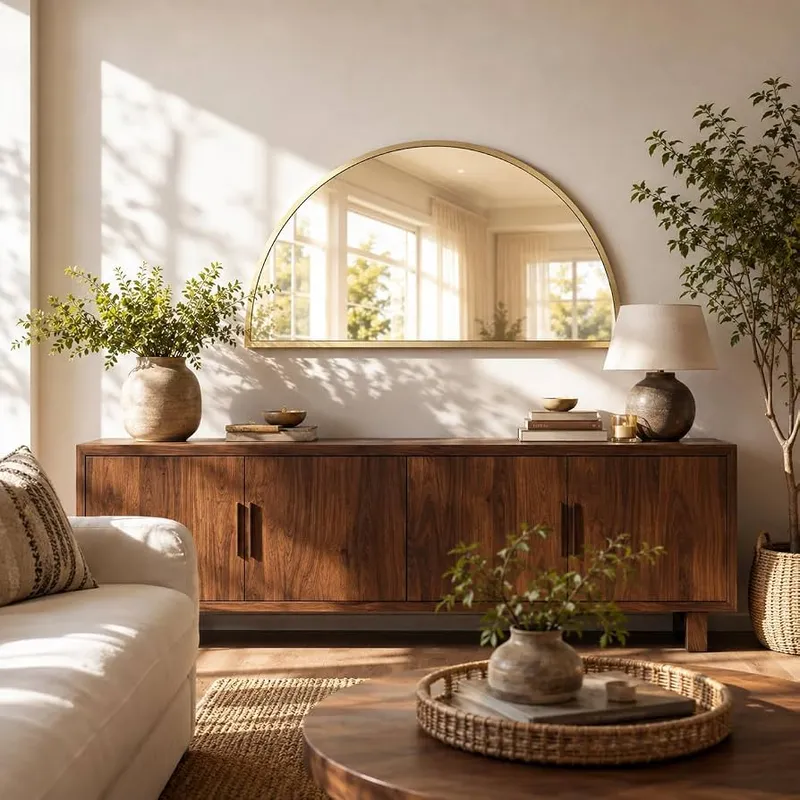
Size: In a small entryway, a mirror that’s too small is worse than none. You want a piece that’s large enough to see yourself from at least mid-thigh up, while visually enlarging the hallway. As a rule, aim for 75–80% of the console width if you’re centering the mirror above it, or go dramatically larger and treat the mirror as the primary element with smaller decor orbiting around it.
Retail vs custom: why “statement” wood-framed mirrors are overpriced
Retail knows you’ll splurge on something you see every time you walk in the door. That’s why entry mirrors get padded margins. The pattern is always the same: the minute a mirror is oversized, arched, or wavy, the price shoots up, even if the materials are bargain-bin.

Here’s what you’re usually paying for in big-box or trendy online shops:
Marketing photos, not construction. Most “statement” mirrors at chain stores are MDF with veneer, sometimes hollow-backed, and finished fast. They photograph beautifully and feel alarmingly light and fragile in person. I’ve seen supposedly “hero” wavy mirrors chip at a gentle bump from a tote bag.
A shape premium. Rounded arch? 20–40% more. Wavy edge? Add another chunk. Not because shaping wood is impossibly hard, but because retailers know you’ll pay extra for something that looks different on Instagram. They call it “design”. It’s a quirky tax.
An arbitrary size jump. The real scam is scale. Move from a 30 x 40 in mirror to something closer to 36 x 72 in, and retail pricing can double or triple. Glass and wood do not magically get three times more expensive at that size. You’re just bumping into a “large item” pricing tier.
Meanwhile, a decent local glass shop and a straightforward carpenter can build you a solid wood frame with real glass for the same or less than a mid-range catalog piece. Especially once you cross into “oversized statement mirror for a small entryway” territory.
When custom wood beats retail on price—and by how much
Custom sounds expensive until you actually run the numbers against the kind of mirrors people pin for maximalist foyers.
| Scenario | Typical Retail Reality | Custom Potential |
|---|---|---|
| Oversized arched entry mirror (around 36–40 in wide, 70–80 in tall) | High markup; often MDF frame; “oversized” shipping fees | Local glazier + woodworker can often match or undercut price with solid wood |
| Wavy or squiggle wood-framed maximalist entryway mirror | Quirky tax on irregular shape; fragile finishes; limited sizes | One-off wavy template that can be reused; sturdier frame for similar cost |
| “Vintage-style” carved mirror with faux distressing | Factory distressing that feels fake in person; MDF or resin core | Simple real wood carving or routed detail that ages better and looks authentic |
If you’re already looking at mirrors above the lowest budget tier, custom is competitive fast. You’re shifting money from branding and shipping into actual wood, time, and glass.
How to spec a custom maximalist foyer mirror that doesn’t blow your budget
The reason people get scared off custom is vague scope. “Make me something beautiful” will always be pricey. “Make this specific thing” is not.

Here’s a simple rule set to brief a local millworker or carpenter once you’ve picked your maximalist foyer mirror ideas:
- Measure your entry wall and console (if you have one). Note total wall width and ceiling height. Decide if the mirror floats on the wall or centers over a console.
- Pick the overall size. For most entries, 30–36 in wide is a sweet spot; height can run 40–70 in depending on your ceiling. Leave at least 6–8 in between console top and mirror bottom.
- Choose your shape. Arch, full rounded top, or a subtle irregular/wavy profile. Show 1–2 reference photos and mark what you like: thickness, curve, edge detail.
- Select wood and finish. Ask for solid oak, ash, or another local hardwood; choose a warm mid-brown or natural finish that plays nicely with your flooring and door.
- Specify edge detail, not ornate carving. A routed profile, fluting, or chunky frame reads maximalist without hours of hand carving. Depth of 1.5–2 in looks substantial.
- Source the glass smartly. Get a price from a local glazing shop for the mirror panel (standard silvered glass is fine for an entry). Have them coordinate with the carpenter or provide exact dimensions.
- Plan mounting. Tell them it’s for an entry; ask for sturdy cleats or French cleat hardware rated for the mirror’s weight.
That’s it. No mood board, no drama. Just clear sizing and a few key style notes. Most tradespeople are relieved by this level of direction because they’re not stuck guessing your taste, and you’re not paying for endless back-and-forth.
Retail still useful: when to buy off-the-shelf
Retail isn’t always the villain. There are times it wins:
Low-stakes rental or first apartment. If you’re not staying long, a lighter, cheaper mirror that you can hang without major anchors is fine. Just avoid paying top-tier prices for MDF. Look at the product weight and materials; if the frame is suspiciously light for its size, it’s not heirloom quality.
Basic rectangles behind a loud wall. If your maximalist entry is coming from wallpaper, art, and lighting, you can get away with a simpler framed rectangle and keep custom dollars for other pieces. Still, choose wood over plastic or flimsy metal.
Very tight timelines. Custom takes coordination and lead time. If you have guests coming in three weeks and a blank wall, retail is your only realistic route. Just don’t confuse urgency with justification for overpaying long-term.
Styling a wood-framed maximalist entryway mirror: how to avoid chaos
Maximalism fails in entryways when everything competes and nothing leads. Your wood-framed maximalist entryway mirror should be the leader.

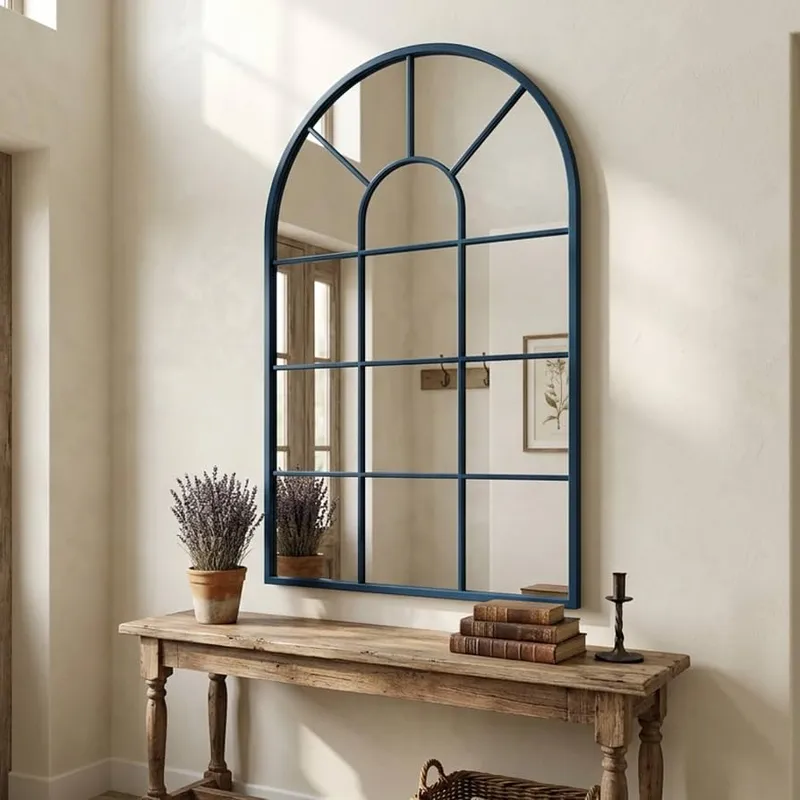
Here’s how to style around it so it actually looks intentional:
1. Treat the mirror as the anchor. Hang it first, at a practical height for everyday use. The center of the mirror should sit roughly 150–160 cm (59–63 in) off the floor. Then add layered entryway wall decor around it: a smaller painting overlapping a corner, a sculptural sconce on one side, maybe a textile piece or basket on the other. The mirror remains visually dominant; everything else feels secondary.
2. Use contrast wisely. Warm wood frames love strong backdrops. Deep greens, inky blues, even paprika or terracotta walls make the frame pop. That same frame on a beige wall with beige floor and beige console will look tired, no matter how “maximalist” your accessories claim to be.
3. Let the console breathe. If the mirror has carving, fluting, or a dramatic wavy outline, don’t bury it in clutter. A lamp, a tray, a single bold vase or bowl is enough. You want negative space so the frame can read as sculptural, not lost in knick-knacks.
4. Reflect something worth seeing. Stand where your guests enter and check what the mirror is reflecting. Best case: light from a window, a plant, or a strong color moment from the opposite wall. Worst case: a messy coat rack or the inside of a storage niche. Move the mirror if you have to. The reflection is part of your decor.
Why “vintage-style” retail frames cheapen layered decor
I’m blunt about this because I’ve seen it ruin otherwise good maximalist entries. Factory-distressed, “vintage-style” frames almost always look wrong up close. The distressing is too even, the grooves too shallow, and the color too flat. On an empty wall, you might get away with it. Surrounded by real objects—ceramics, woven baskets, well-used wood—it stands out as the one fake thing in the room.

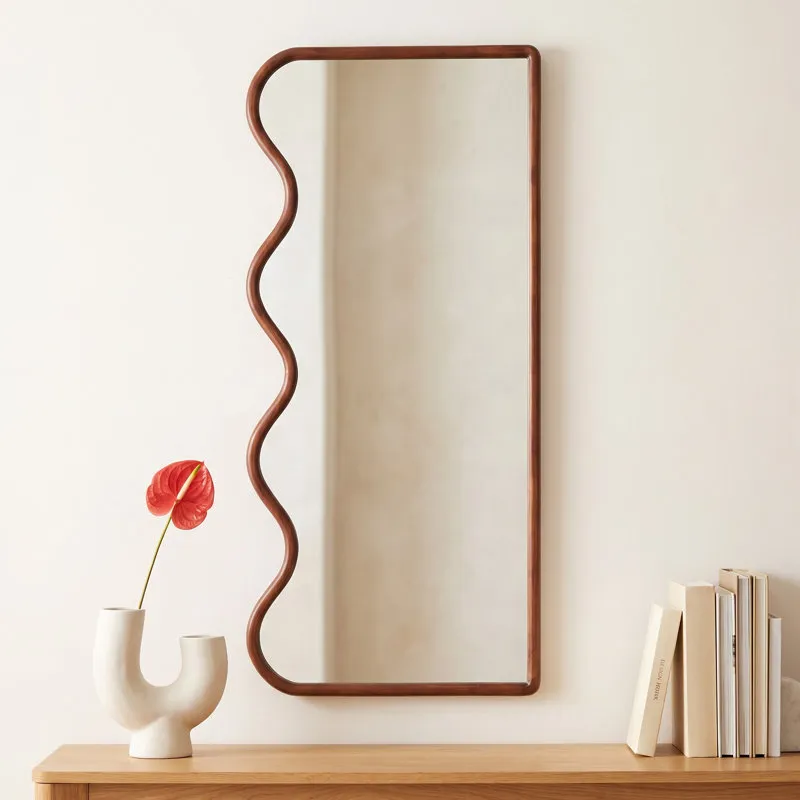
In a colorful eclectic hallway design, authenticity matters more than perfection. A simple, solid wood frame with honest grain and a clean arch looks far more expensive and intentional than a faux-antique resin piece with spray-on wormholes. This is exactly where custom quietly wins. The subtleties of real carving, even if it’s just a routed contour, read as quality and hold their own against bold rugs and art.
Stop buying “almost right” mirrors
The most expensive way to build a maximalist foyer is by buying two or three “almost right” mirrors that never really work—too small, wrong shape, frame feels cheap—then giving up and living with them. I’ve seen people spend more on that cycle than they would have on one properly sized, solid wood-framed maximalist entryway mirror made to their wall and console.
So if you already know you want a real statement mirror for a small entryway, with a warm wood frame and a confident shape, skip the endless scroll. Get your measurements, pull a couple of reference images, and talk to a woodworker and a glass shop. You end up with something heavy, real, and sized to your entry—basically the look magazines stage with props—without paying a premium for a logo and a photo shoot.
Mini FAQ: wood-framed maximalist entryway mirrors
How big should a maximalist entry mirror be above a console?
Aim for 75–80% of the console width. So if your console is 120 cm (about 47 in) wide, a mirror around 90–95 cm (35–37 in) wide feels proportionate. Height can run 90–150 cm (35–59 in) depending on ceiling height and how dramatic you want it.
Is a wavy mirror practical for an entry, or just decorative?
It’s practical as long as the main portion of the glass is flat and large enough that you can see your upper body without distortion. Keep the waves mostly at the edges and avoid extreme curves cutting into the central viewing area.
Do I need a damp-rated mirror for an entry near the front door?
Usually no. Unless your entry behaves like a mudroom with constant moisture or open exposure to rain, standard interior mirror glass and a sealed wood frame are fine. Focus more on frame quality and secure mounting than on wet-location ratings.