


You’re standing in the finished bathroom. The fittings look great, the glass is spotless, and yet something feels off. In one version of this story, you’re staring at blotchy microcement walls that already look tired. In the other, you’re scrubbing pink grime out of grout lines and wondering if you should have gone “seamless”. That’s the real tile vs microcement bathroom walls question: which set of problems are you willing to live with?
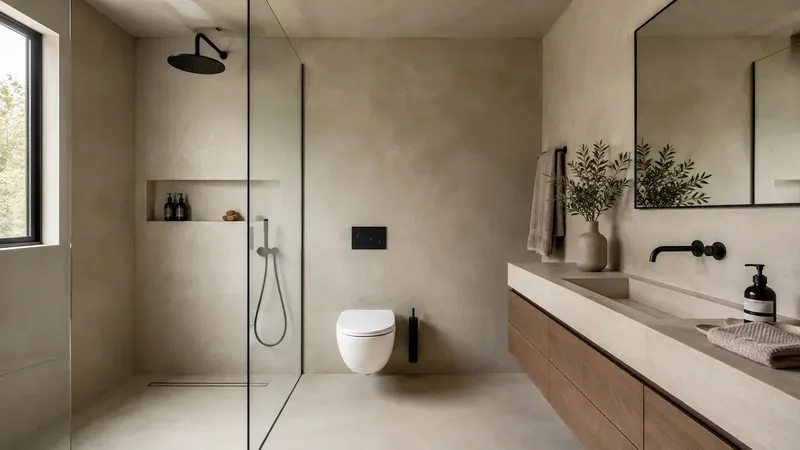
If this is a real, daily-use shower that needs to stay good-looking without specialist babysitting, tile wins. Microcement only makes sense when the seamless look is absolutely central to the design and you are genuinely prepared for higher install cost, stricter waterproofing, and ongoing sealer maintenance.
| Metric | Ceramic / porcelain tile bathroom walls | Microcement bathroom walls |
|---|---|---|
| Durability | Typical decorative wall tile can be PEI I abrasion class for wall use only [1] | Not established |
| Moisture / water resistance | Standard porcelain wall tile: water absorption < 0.5% by weight (impervious) [2][3] | Monolithic surface that, when sealed properly over a waterproof membrane, can form a waterproof shower wall [4][5] |
| VOC emission level (g/L) | Porcelain stoneware collection reported as containing no VOCs and GREENGUARD GOLD certified [6] | Not established |
| R-value / thermal resistance | Not established | Not established |
| Maintenance interval (years) | Not established | Sealers on shower and wet-area walls recommended for recoating every 3–5 years [7] |
| Cost per unit (material only) | $5–$15 per sq ft (mid‑grade porcelain bathroom wall tile) [8] ≈ $53.82–$161.46 per m² [8] | $10–$20 per sq ft for microcement bathroom wall material, including primer and sealants [9] ≈ $107.64–$215.28 per m² [9] |
| Cost per unit (installed) | Not established | $65–$108 per sq ft installed for bathroom walls [10] ≈ $699.66–$1,162.32 per m² [10] |
Ceramic and porcelain tile bathroom walls
If you want your shower to survive teens, guests, and cleaners who don’t read labels, tile is your friend. It’s not glamorous or edgy, but there’s a reason every hotel and rental ends up here.

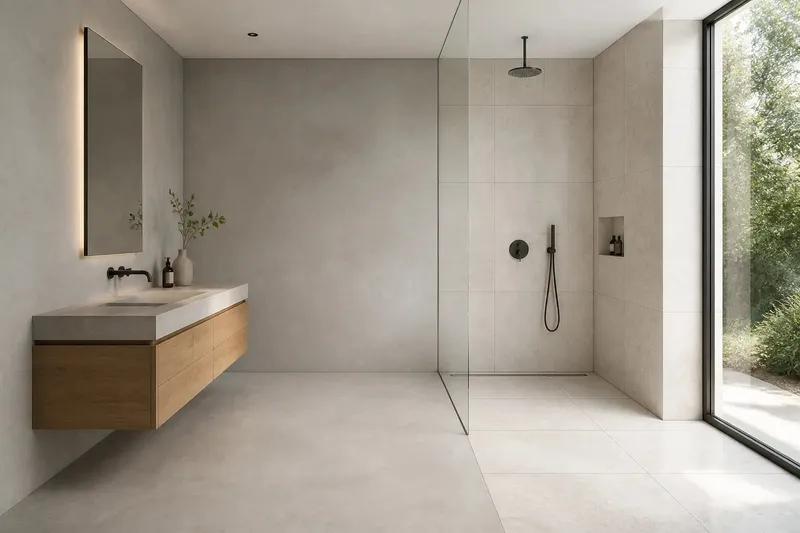
On paper, standard wall tile can be quite “soft” – a basic glazed wall tile might be just PEI I, the least abrasion‑resistant class, and intended only for walls or decorative use [1]. That sounds alarming until you remember you’re not walking on the walls. In a shower, impact and wear on the face of the tile are rarely the problem; water is.
Porcelain does very well on that front. Standard porcelain wall tile has a water absorption of less than 0.5% by weight, classed as impervious [2][3]. That’s about as low as it gets, and it’s why porcelain is the go‑to in wet rooms. Just remember the uncomfortable truth: the tile surface isn’t your waterproofing. The Tile Council of North America is blunt that grout joints are not waterproof and the shower method and substrate must do the real protecting [11][12].
So what does that mean in practice?
Behind a tiled bathroom wall you should see a backer board or approved gypsum‑based assembly that meets an ASTM product spec, like a fiber‑reinforced gypsum panel complying with ASTM C1278 [13]. If a cement board is used, the TCNA advises you check that it complies with ANSI A118.9 [14]. In some wet‑area assemblies, gypsum‑based substrates are permissible, but only when they’re explicitly approved and prepped as part of a tested method [15]. In other words: “tile on drywall” in a shower is only safe when it’s part of a documented system, not a shortcut.
When tiled showers fail, it’s rarely because the tile itself gave up. Typical failure modes are cracked grout, loose or hollow‑sounding tiles, or water intrusion behind the finish when the method and substrate haven’t been designed to keep adjoining areas dry [11][12]. You usually see it first at corners, around fixtures, or where the waterproofing was interrupted. The good news is that these are mostly localised failures. A few tiles and some grout can often be replaced without tearing the entire bathroom apart.
From a health and air‑quality angle, fired tile itself is about as inert as finishes get. One porcelain stoneware collection is explicitly reported as containing no VOCs and carrying GREENGUARD GOLD certification [6]. You still have to vet thinsets, grouts, and sealants individually, but the tile isn’t off‑gassing in your steamy shower.
Cost is where tile quietly wins most tile vs microcement bathroom walls cost comparisons. Mid‑grade porcelain bathroom wall tile runs about $5–$15 per square foot for the material alone [8]. That’s roughly $53.82–$161.46 per square metre [8]. Installation labour obviously adds a lot, but even without an installed figure, you can see how the material sits well below microcement in the next section.
Is tile perfect? No. You will clean grout. You will eventually redo silicone in corners. You may one day chase a leak that turns out to be a tiny failure at a niche or valve. But I’d still much rather troubleshoot isolated grout lines and individual tiles than a continuous coating that fails as one giant piece.
For safety and code compliance, always confirm with a local tile professional or inspector that your chosen backerboard, membrane, and method are approved where you live; US standards (ASTM, ANSI, TCNA methods) don’t automatically match what’s enforced in your city.
Microcement bathroom walls
Microcement is the minimalist’s siren song: one continuous skin from floor to ceiling, no grout, no layout, just a calm box of colour. On Instagram, it’s flawless. In real showers, it’s touchier than most owners are led to believe.

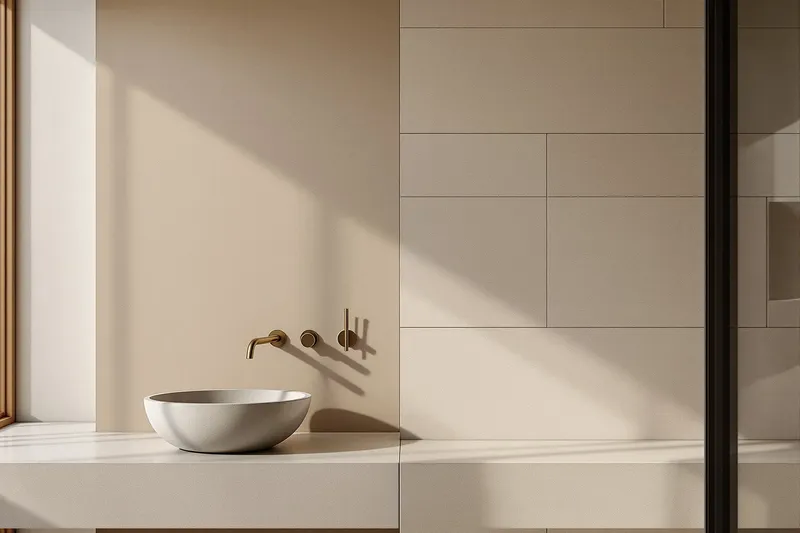
Technically, a microcement system can form a waterproof shower wall – but not by magic. A typical wet‑area build‑up uses a liquid waterproofing membrane, followed by two hand‑trowelled microcement layers and a final sealant that together form an impermeable finish [5]. When that sealed monolithic surface is applied over a proper waterproofing membrane, the assembly can create a waterproof shower wall [4].
Notice the “when”. Every weak link below that thin coating telegraphs through. Poor substrate preparation can cause cracking, delamination, bubbling, and inconsistent finishes in microcement [16]. If the substrate moves, hairline movement reflects straight into the coating as cracks [17]. That’s the hidden problem most people only see after renovation: the surface looks seamless, but structurally it’s brutally honest.
Installation over existing tile is the classic pitch. Yes, it’s possible, but only under pretty strict conditions: all ceramic or vitrified tiles must be firmly bonded, the glaze needs to be abraded, grout lines must be filled, and primer and mesh should be applied first to create a sound, level, reinforced substrate [18]. Every missing step here is a future crack or ridge waiting to appear in your “minimal” wall. Anyone quoting a bargain microcement bathroom wall installation price per square foot is likely skipping some of this unglamorous prep.
The maintenance story is where expectations really collide with reality. In a shower or high‑moisture area, the sealer on microcement is usually recommended for recoating every 3–5 years [7]. That’s a real interval, not a theoretical one. If you scrub with the wrong cleaner, leave standing bottles trapping moisture, or ignore early dull patches, you’re eating into that margin fast. Think of microcement as a decorative coating you actively maintain, not a set‑and‑forget surface.
Cost-wise, microcement is not the thrifty alternative many people imagine. The material system – microcement plus primer and sealants – runs about $10–$20 per square foot [9], or about $107.64–$215.28 per square metre [9]. Installed, bathroom walls in the US are reported in the range of $65–$108 per square foot [10], roughly $699.66–$1,162.32 per square metre [10]. That’s before you get into any heroic substrate repairs. If someone tells you it’s cheaper than tile, they’re comparing it to fantasy tile, not the numbers above.
And durability? There’s no neat “PEI class” or water‑absorption percentage published the way there is for tile. We know that, when sealed properly over a membrane, a microcement wall can be part of a waterproof system [4][5], but we don’t have an equivalent, standardised abrasion or service‑life rating for bathroom walls. In practice, the system lives or dies on that thin sealer coat and on how perfect the prep was. Once it cracks, delaminates, or discolours [16][17], you’re usually talking about refinishing a large area, not swapping a couple of pieces.
One more practical point: repairing microcement invisibly is almost a myth. Matching colour, texture, and sheen on a hand‑trowelled, aged surface is a specialist art, and even then the patch often reads like a scar. With tile, a bad chip usually means a handful of replacement tiles. With microcement, “small repair” and “looks like nothing happened” rarely belong in the same sentence.
As with tile, you should confirm locally which waterproofing membranes and microcement systems are approved in your jurisdiction. Many US inspectors will focus more on the underlying membrane’s compliance than on the visible coating, so make sure the whole system – not just the finish – meets the relevant standards where you live.
Which one should you choose?
This is where we stop being neutral.

For a hard‑working family shower
Choose tile. You get porcelain that barely absorbs water [2][3], a long track record, and a finish most local tilers know how to fix. Yes, you’ll clean grout and refresh silicone, but failures tend to be localised, and replacement parts are standard. Microcement asks you to protect a thin sealer in the wettest, roughest room in the house and to reseal every 3–5 years [7]; that’s not a family‑proof spec.
For a small, design‑led bathroom where the look is everything
If you absolutely need a continuous, joint‑free box – same finish on walls, niches, maybe the floor – and you’re prepared for specialist cost ($65–$108 per sq ft installed [10]) and regular sealer maintenance [7], then microcement earns its place. But in most small rooms, I’d still lean to large‑format tile: visually calm, cheaper material ($5–$15 per sq ft [8]), and far less anxiety every time someone drops a bottle.
For tight budgets
Tile wins, full stop. The material alone is roughly half the price per square foot of a microcement system [8][9], and the installed microcement range of $65–$108 per sq ft [10] is squarely “luxury finish” territory. If someone is presenting microcement as the cost‑saving option, walk away.
For renovations over existing tile
Both can go over old tile, but microcement is far fussier. To install microcement, all existing tiles must be solid, glaze abraded, grout lines filled, and primer and mesh applied [18]. Miss one step and the old layout ghosts through or cracks the new surface [16][17]. Tiling over tile has its own rules, but there’s a bigger pool of trades willing and able to do it right. Unless you have a very trusted microcement installer, tile is the safer bet.
For owners who don’t want to think about maintenance
Tile again. Fired ceramic and porcelain themselves are stable and non‑reactive [1][2][3], and VOC‑free options exist [6]. Your maintenance surface is grout and sealant, which is annoying but forgiving. Microcement binds you to a resealing schedule [7] and kinder cleaning habits for as long as you own the room.
Key facts
Show all 15 rows ▾Hide table ▴
| What it covers | Value | Source |
|---|---|---|
| Typical abrasion class for ceramic wall tile | PEI I, used primarily as wall tile or decoration [1] | Tile manufacturer |
| Porcelain tile water absorption (impervious) | < 0.5% by weight; impervious tiles 0.5% or less [2][3] | ASTM C373 test, manufacturers |
| Tile water absorption classes for wet areas | Vitreous 0.5–3%; Semi‑vitreous 3–7% [19][20] | Tile manufacturer |
| Porcelain VOC emissions | No VOCs; GREENGUARD GOLD certified collection [6] | Panariagroup USA |
| Microcement water resistance in showers | Monolithic sealed surface over membrane can form waterproof shower wall [4][5] | Designing Idea; SEMCO Surfaces |
| Microcement sealer maintenance interval | Recoating recommended every 3–5 years in showers/wet areas [7] | LA Microcement |
| Installed microcement bathroom wall cost (US) | $65–$108 per sq ft [10] | Designing Idea |
| Tile material cost (mid‑grade porcelain) | $5–$15 per sq ft [8] | Oakwood Remodel |
| Microcement material cost (bathroom wall system) | $10–$20 per sq ft [9] | Wellbuilt Florida |
| Backerboard thickness example for tiled walls | Tile backer board 0.50 in thick before thinset and tile [21] | Johns Manville |
| Tile backerboard standards | Fiber‑reinforced gypsum panels to ASTM C1278; cementitious backer to ANSI A118.9 [13][14] | USG; TCNA |
| Tile grout joints are not waterproof | Shower method and substrate must protect adjoining areas [11][12] | Tile Council of North America |
| Microcement over existing tile requirements | All tiles bonded; glaze abraded; grout filled; primer and mesh required [18] | Hagerstone |
| Microcement failure from poor prep or movement | Cracking, delamination, bubbling, inconsistent finish, and hairline movement [16][17] | SEMCO Surfaces; SolidRock Coatings |
| Gypsum‑based substrates in wet areas | Permitted only as approved assemblies with specific prep [15] | Vancoast Tile and Stone |
Quick answers
Is tile cheaper than microcement for bathroom walls?
Yes. Mid‑grade porcelain bathroom wall tile costs about $5–$15 per sq ft for material [8], while microcement bathroom wall systems cost about $10–$20 per sq ft in materials [9] and around $65–$108 per sq ft installed [10]. That makes tile the clear winner on upfront cost in most projects.
Are microcement bathroom walls really waterproof?
They can be: a microcement system that uses a liquid waterproofing membrane beneath two microcement layers and a final sealant can form an impermeable shower finish [5], and when the sealed monolithic surface is properly installed over a membrane it can create a waterproof shower wall [4]. The catch is that the system depends heavily on correct substrate prep, waterproofing, and ongoing sealer maintenance.
How often do microcement bathroom walls need resealing?
Microcement shower and wet‑area wall sealers are typically recommended for recoating every 3–5 years [7]. If you use harsh cleaners or let wear go too far, you may need to reseal sooner to avoid staining or damage to the coating.
What’s more durable on bathroom walls: tile or microcement?
For walls, even low‑abrasion PEI I ceramic tile is suitable as a decorative wall surface [1], and standard porcelain is impervious with less than 0.5% water absorption [2][3]. Microcement can form a waterproof, monolithic surface when sealed over a membrane [4][5], but documented failures include cracking, delamination, bubbling, and movement when prep or substrates are poor [16][17], so tile is generally the more forgiving long‑term option.
Can you put microcement over existing bathroom tile?
Yes, but only if strict conditions are met: all existing ceramic or vitrified tiles must be firmly bonded, the glaze abraded, grout lines filled, and primer and mesh applied before the microcement [18]. Skipping these steps increases the risk of cracking, delamination, and visible telegraphing of old grout lines [16][17].
Do grout joints make tiled showers leak?
Grout joints themselves are not waterproof, so they are not the primary barrier keeping water out [11]. In a correctly built tiled shower, the specified method, waterproofing, and substrate behind the tile are what protect adjoining areas from water [12].
Sources
Facts last verified 2026-11-05.
- PEI I rated ceramic tile has the least durable surface and is used primarily as wall tile or decoration. — Ivy Hill Tile, retrieved 2026-11-05.
PEI I |Has the least durable surface and is not intended to be used on floors. Used primarily as wall tile or decoration
- Standard porcelain tile has water absorption of less than 0.5% by weight when tested under ASTM C373. — The Home Depot, retrieved 2026-11-05.
Impervious tile has water absorption of less than 0.5%. Indoor or outdoor use. PORCELAIN TILES meet this threshold.
- Impervious Tiles have the lowest water absorption, 0.5% or less, and are suitable for all applications. — Ivy Hill Tile, retrieved 2026-11-05.
Impervious Tiles have the lowest absorption, 0.5% or less. These are suitable for all applications.
- Microcement is a cementitious application that creates a monolithic surface which, when sealed properly, forms an impervious surface, and along with a waterproofing membrane (depending on the type of substrate), it can create a waterproof shower wall. — Designing Idea, retrieved 2026-11-05.
The cementitious application creates a monolithic surface, which creates an impervious surface when sealed properly. Along with a waterproofing membrane (depending on the type of substrate), it can cr…
- A microcement bathroom system can require a liquid waterproofing membrane beneath two hand-troweled microcement layers and a final sealant to form an impermeable finish. — SEMCO Surfaces, retrieved 2026-11-05.
The application process, devised by our experienced surfacing engineers, involves applying a liquid waterproofing membrane to form a watertight barrier, followed by two hand-troweled layers of microce…
- The Panariagroup USA Playlist porcelain stoneware collection is reported as containing no VOCs and having GREENGUARD GOLD certification. — Panariagroup USA, retrieved 2026-11-05.
The product contains no VOC (volatile organic compounds) and has obtained the GREENGUARD GOLD certification.
- Microcement shower-wall and wet-area sealers are recommended for recoating every 3 to 5 years. — LA Microcement, retrieved 2026-11-05.
Sealer recoat recommended every 3–5 years.
- Mid-grade porcelain bathroom tile costs about $5 to $15 per square foot for the tile material alone in the cited US cost guide. — Oakwood Remodel, retrieved 2026-11-05.
|Porcelain|$5 – $15|$12 – $25|Shower walls, floors (low absorption)|
- Microcement bathroom material, including primer and sealants, costs about $10 to $20 per square foot in the cited US cost guide. — Wellbuilt Florida, retrieved 2026-11-05.
|Material Cost|$10 – $20 per square foot|Microcement purchase price including primer and sealants|
- The initial cost for microcement on bathroom walls can range from $65 to $108 per square foot, which can be more expensive compared to traditional wall finishes when not taking into account demolition costs to achieve the rustic finish. — Designing Idea, retrieved 2026-11-05.
When not taking into account demolition costs to achieve the rustic finish , microcement can be more expensive compared to traditional wall finishes. Price can range from $65 to $108 per square foot.
- Grout joints in wet-area tile installations are not waterproof, so the shower method and substrate must protect adjoining areas from water. — Tile Council of North America, retrieved 2026-11-05.
Remember that grout joints are not waterproof. If you are doing a wet-area (such as a shower), rely on the method and substrate to protect adjoining areas from water.
- For wet areas such as showers, tile installations should rely on the specified method and substrate to protect adjoining areas because grout joints are not waterproof. — Tile Council of North America, retrieved 2026-11-05.
Remember that grout joints are not waterproof. If you are doing a wet-area (such as a shower), rely on the method and substrate to protect adjoining areas from water.
- Tile backerboard used behind bathroom tile should meet the applicable ASTM product specification, such as ASTM C1278 for fiber-reinforced gypsum panels. — USG, retrieved 2026-11-05.
Fiberock® panels meet or exceed ASTM C1278 Specification for Fiber Reinforced Gypsum
- For US tile work, homeowners should ask whether the specified cementitious backer unit complies with ANSI A118.9. — Tile Council of North America, retrieved 2026-11-05.
A118.9 American National Standard Specifications for Test Methods and Specifications for Cementitious Backer Units – 2023
- For standard residential bathroom wall tile installations in wet areas, gypsum-based assemblies can be used as substrates if they are approved and meet specific preparation requirements. — Vancoast Tile and Stone, retrieved 2026-11-05.
Cement board, foam backer board, mortar beds, and certain approved gypsum-based assemblies may each have specific preparation requirements.
- Poor substrate preparation can cause microcement cracking, delamination, bubbling, and inconsistent finishes. — SEMCO Surfaces, retrieved 2026-11-05.
No matter how high-quality the coating system is, poor substrate preparation can lead to failures such as cracking, delamination, bubbling, or inconsistent finishes.
- If the substrate moves, hairline movement can occur in microcement. — SolidRock Coatings, retrieved 2026-11-05.
Hairline movement can occur if the substrate moves — preparation matters
- Microcement can be installed over existing ceramic or vitrified tiles when all tiles are bonded, the glaze is abraded, grout lines are filled, and primer and mesh are applied first. — Hagerstone, retrieved 2026-11-05.
Existing ceramic or vitrified tiles|Often|All tiles bonded, glaze abraded, grout lines filled, primer and mesh
- Vitreous Tiles have a low water absorption of 0.5-3% and are suitable for wet areas and outdoor applications. — Ivy Hill Tile, retrieved 2026-11-05.
Vitreous Tiles have a low absorption, .5- 3%. These are suitable for wet areas and outdoor application
- Semi-Vitreous Tiles are moderately absorbent, with 3-7% water absorption, and can be used in most areas in the house. — Ivy Hill Tile, retrieved 2026-11-05.
Semi-Vitreous Tiles are moderately absorbent, 3-7%. These can be used in most areas in the house
- A Johns Manville GoBoard LT tile backer board used for walls is available in 0.50-inch thickness, before adding thinset and tile. — Johns Manville, retrieved 2026-11-05.
Thickness (inches) ASTM C473 0.25 0.50