


You’re standing in the showroom with two quotes in your hand. One is a sensible-looking stainless steel sink, the other a darker “granite composite” beauty the client loves. The prices aren’t miles apart, the sales rep swears both are “commercial grade”, and you know that if the wrong one cracks six months after opening, it’s your phone that rings.
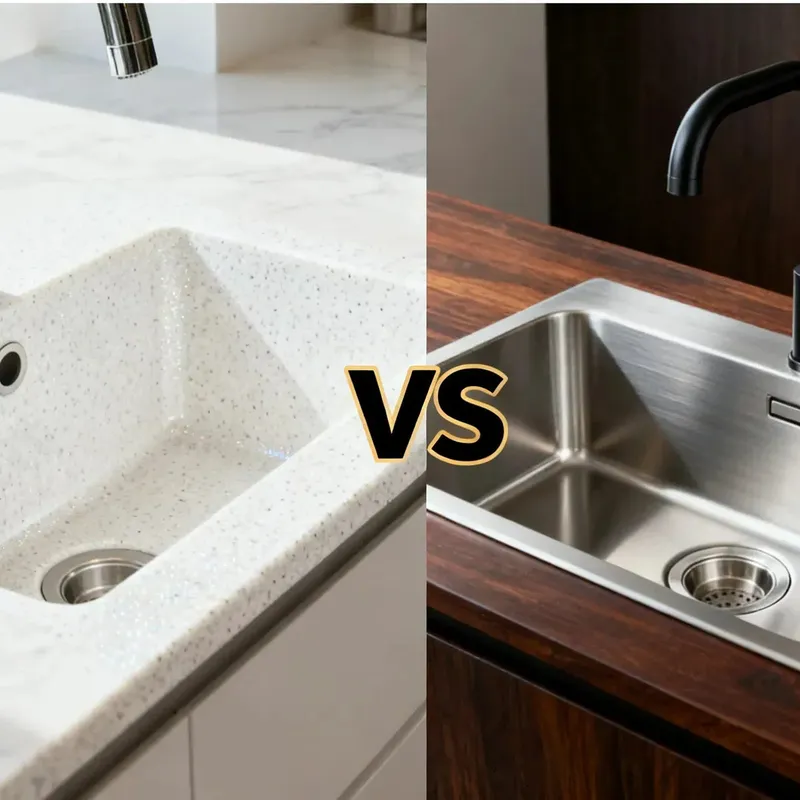
For heavy commercial uselight-use office pantries and front-of-house areas where the sink is more furniture than equipment — and only if you can trust the users and the cleaning products.
| Metric | Stainless steel sink | Granite / quartz composite sink |
|---|---|---|
| Durability | Expected service life 15–25 years in use; usually replaced for renovation rather than failure [1] | Scratch resistant (Crystallite Series granite composite) [2]; can withstand 200–300°F (93–149°C) without visible damage (quartz composite) [3] |
| Moisture / water resistance | Resists organic chemicals, dyestuffs, and a wide variety of inorganic chemicals (Type 304 stainless) [4] | Non-porous granite composite [5]; quartz composite has a smooth, non-porous, stain- and chip-resistant finish [6] |
| VOC emission level (g/L) | Not established | Not established |
| R-value / thermal resistance | Thermal conductivity 16.2 W/(m·K) at 100°C (212°F) [7] | Not established |
| Maintenance interval (years) | Not established | Daily cleaning with gentle cloth and soap recommended [8] (no long-term interval stated) |
| Cost per unit (material only) | Single-basin: $75–$250 per sink [9]; double-basin: $200–$600 [10]; triple-basin: $800 [11]; farmhouse: $400–$600 [12] | Example prices: $259.95 for 33″ composite granite double-bowl [13]; $495.00 for 34″ quartz composite undermount double-bowl [14]; $477.00 for 34″ quartz composite drop-in double-bowl [15] |
Stainless steel sinks
If you’re designing anything that feels like a real kitchen rather than a photo shoot, stainless steel is the default for a reason. A decent 304 stainless sink will quietly do its job for 15–25 years, and in practice it usually gets ripped out for a renovation long before the material gives up [1]. That’s exactly what you want in a restaurant back-of-house or a staff kitchen where pans, trays, and cleaning chemicals all hit the bowl hard.

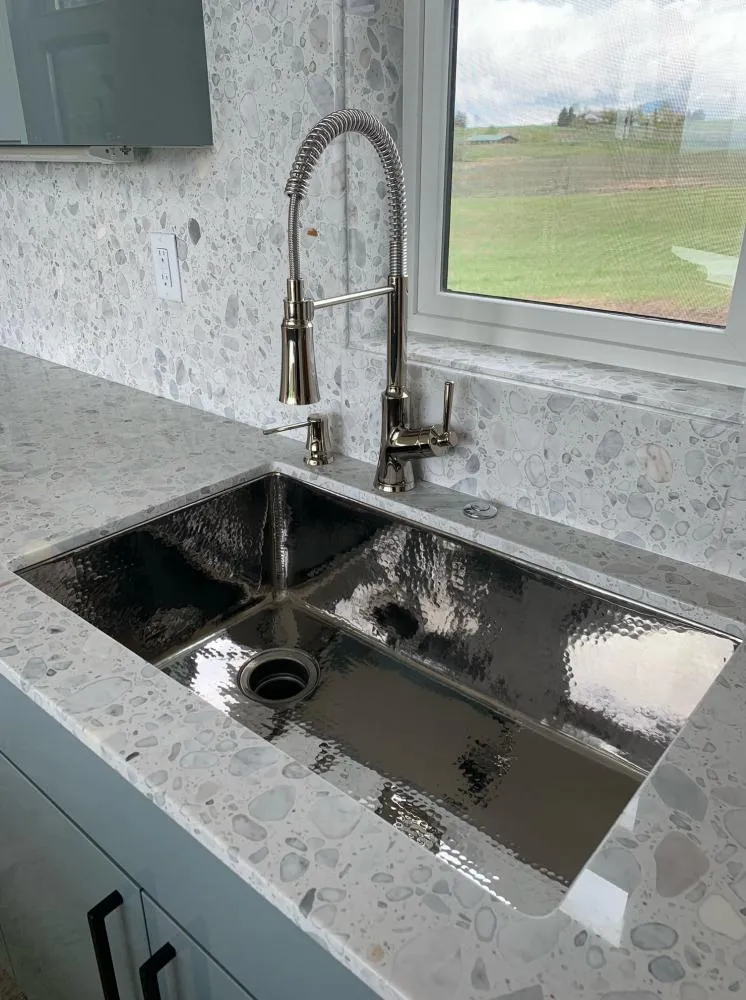
On durability, stainless behaves honestly. It resists “organic chemicals, dyestuffs, and a wide variety of inorganic chemicals” [4], which in your world means most everyday food and cleaning agents aren’t going to eat it alive. When it’s mistreated, it dents and scratches rather than quietly cracking under the surface. I’d rather walk into a site and see a visibly battered but watertight sink than a composite bowl that looks fine until you spot the hairline fracture around the waste.
Thermally, 304 stainless conducts heat well — its thermal conductivity is 16.2 W/(m·K) at 100°C (212°F) [7]. Translation: it doesn’t “hold warmth” in any cosy sense, but it shrugs off hot water and sudden temperature swings. Staff can empty boiling stock into a cold basin and, assuming the plumbing can cope, the sink itself rarely complains. That abuse is exactly what quietly destroys some composites.
Acoustically, cheap stainless is noisy. The good news is that manufacturers know this: systems like Elkay’s Sound Guard use pads and undercoating to improve sound deadening [16], and some models get “full spray coating on the sides and bottom plus side and bottom pads” [17]. That turns the horrible drum-roll into a duller thud. It’ll never be as hushed as composite, but in an actual commercial kitchen nobody’s complaining about a bit of ping over the extractor roar.
Cost is where owners often underestimate how rational stainless is. Material-only, you can specify a perfectly serviceable single-basin stainless sink between $75 and $250 [9], a double-basin between $200 and $600 [10], and even large triple-basin or farmhouse configurations in the $400–$800 band [11][12]. Those numbers are per sink, not per square metre, but they anchor your budget so you’re not gambling half the fit-out cost on a fragile showpiece bowl.
Installed cost for the sink itself typically lands in the same broad bracket whether you choose steel or composite — U.S. guides cluster around $400–$1,000 per installation with “typical” values like $520 [18], $600 [19], or $438 [20] including labour. Always verify with local trades and current rates; labour and code requirements move faster than manufacturer brochures.
Living with stainless is about managing expectations, not babying the material. It is not “maintenance free”. It still shows mineral deposits, especially in hard water, and it will absolutely pick up swirl marks and scratches. But you can use aggressive cleaning routines within reason; that chemical resistance to “a wide variety of inorganic chemicals” [4] is exactly why janitorial crews like it. When clients complain their new sink doesn’t look like the brochure after three months, the problem isn’t the steel — it’s the fantasy of a mirror-finish bowl in a working kitchen.
The bigger traps I see are bad installations: flimsy cabinets that let the bowl flex, undermounts relying on adhesive instead of solid support, seals applied to damp edges, and plumbers yanking on waste fittings that were never properly braced. The material tolerates a lot; the details around it often don’t. But even then, the steel itself usually isn’t what fails.
For commercial kitchens, staff break areas that see real cooking, and any sink you expect to survive cleaners with bleach and no training, stainless isn’t just the safe choice — it’s the only sane one.
Granite and quartz composite sinks
Composite sinks — the “granite” and “quartz” bowls every showroom is pushing — exist for one reason: they look good. Matte surfaces, dark colours, coordinated tone with the worktop. In an office pantry or front-of-house bar, that matters. But you cannot treat “composite” as one uniform magic material; performance varies, and it’s far easier to ruin than the marketing suggests.

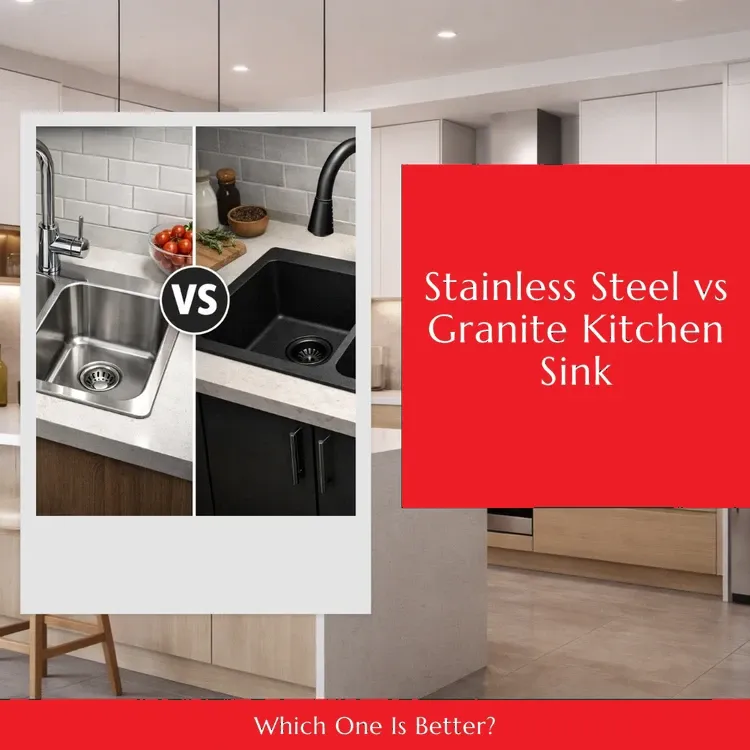
On paper, the material sounds fantastic. A granite composite like the Crystallite Series is marketed as “scratch resistant” [2]. Quartz composite is described as able to withstand 200–300°F (93–149°C) without visible damage [3]. Both are pitched as non-porous: granite composite is explicitly “nonporous” and doesn’t trap bacteria [5], and quartz composite combines quartz with acrylic resins to create a “smooth, non-porous finish… stain-resistant and chip-resistant” [6]. Those are all real advantages for hygiene and everyday wiping in an office pantry.
The problem is how people actually use sinks. Manufacturers also warn that granite and quartz composite can develop surface discoloration when hot items from the stove or oven are placed straight in [21]. One guidance note for granite composite tells you to avoid leaving hot objects on the surface for too long, even though it claims heat resistance up to 350°F [22]. Quartz sink literature talks about potential “surface discoloration, cracking or splintering due to thermal shock, and degradation of resin from repeated excessive heat,” leading to chipping or a dulled surface [23]. That’s not rare edge-case abuse; that’s exactly how staff treat equipment when nobody is standing over them.
Heat isn’t the only discipline required. To “maintain the surface” of a granite composite sink, the recommendation is daily cleaning with a gentle cloth and soap to avoid water deposits and streaking [8]. Quartz guidance is even clearer: wipe spills, grease, and discolouration as soon as the sink is used, because it is “not entirely immune to stains from extended exposure to food particles or hot grease” [24]. And to protect quartz from heat damage, you’re told to use trivets and pads, avoid drastic temperature changes, let cookware cool or rest on a pad, limit prolonged heat exposure, and even invest in a sink protector [25].
Read that list again and ask yourself whether the night shift in a bar, or the Monday lunchtime crew in a staff canteen, will follow it. They won’t. In a law firm coffee station that sees a few mugs and a sandwich plate each day, sure. In a restaurant prep area, absolutely not.
Maintenance isn’t about some future resealing campaign. The manufacturers pushing non-porous formulations are clear: you don’t treat these like porous stone. You keep on top of daily cleaning instead [5][6][8]. The catch is that a composite sink punishes you if you don’t — stains, mineral outlines, and heat shadows show up in ways that are very hard to reverse without changing the sheen or colour.
On cost, composites sit in the same ballpark as mid- to upper-range steel. Real product numbers: a 33″ composite granite double-bowl is $259.95 [13], a 34″ quartz composite undermount double-bowl is $495.00 [14], and a 34″ quartz composite drop-in double-bowl is $477.00 [15]. You can absolutely spend stainless-steel money on a composite sink; this is not a discount hack, it’s a design choice. Combined with the same installation cost bands — roughly $400–$1,000 with typical midpoints in the $438–$600 range [18][19][20] — that means you’re not saving cash, you’re trading resilience for appearance.
Where composite works: a moderately used office pantry, executive kitchen, or front-of-house bar where staff are trained, cleaners are supervised, and the sink is part of the furniture. The non-porous surface is excellent for hygiene and cleaning [5][6], the matte finish hides fine scratches better than polished steel, and the heavy, quiet bowl does feel “premium” to the end user.
Where it fails badly: anywhere the users treat the sink like a rented car. Boiling pasta water into a cold basin? You’re right in the thermal shock zone that manufacturers flag for cracking and resin degradation [3][21][23]. Aggressive bleachy cleaners left to sit? You’re attacking the very resins that make it smooth and non-porous [6][23]. Hot trays parked on the drainer while service is in full swing? Exactly the scenario where “avoid leaving hot objects lingering on the surface” comes back to bite you [22].
The other, less obvious risk is replacement. When a stainless bowl is scarred or dented, you can usually live with it until the next refit. When a composite undermount cracks around the waste, you are often into worktop disruption, not just a new sink. Every time you specify composite in a busy environment, you’re effectively betting that nobody will abuse it or clean it wrong for the next decade. That’s a bad bet.
Which one should you choose?
This isn’t a “both are great” situation. Stainless and composite sink materials behave very differently in the real world. Here’s where each one genuinely makes sense.
Restaurant back-of-house and heavy commercial kitchens
Choose stainless steel. You need a bowl that survives boiling liquids, pan abuse, unpredictable cleaners, and staff turnover. Stainless has an expected service life of 15–25 years in use [1], resists a wide range of chemicals [4], and deforms instead of quietly cracking. Composite manufacturers openly warn about discoloration, cracking, and resin degradation under exactly the kind of thermal and chemical abuse your sink will see [21][22][23]. In real commercial kitchens, stainless wins every time.
Office pantry – light to moderate use
For a true coffee station or light pantry — think legal office, small design studio — a well-chosen composite sink is reasonable. You gain a non-porous, easy-wipe surface [5][6] and a quieter, matte look that blends with worktops. But you are signing up to daily gentle cleaning [8] and fast wipe-down of spills and grease [24], plus heat discipline with trivets and pads [25][22]. If you know the pantry will be hammered at lunchtime, revert to stainless.
Front-of-house restaurant bars and show kitchens
If the sink is a visible part of a carefully finished bar or open kitchen and use is moderate, composite can earn its keep visually — non-porous, stain-resistant claims help with hygiene messaging [5][6]. But only specify it if you can train bar staff not to drop hot vessels in it or park oven-hot items on the rim [21][22], and you trust cleaning teams not to go nuclear with heat and chemicals [25][23]. If you can’t control users or cleaners, use stainless and own the honest “working bar” look.
Budget-driven refurbishments
If cost is tight and downtime is expensive, pick a sensible stainless steel sink. You can work within a material-only range from $75–$250 for single bowls [9] and $200–$600 for doubles [10], and you’re paying into a 15–25-year expected service life [1]. Compare that with composite options at $259.95–$495+ [13][14][15] that can be knocked out early by heat or cleaning abuse [21][22][23]. The “cheap now, replace later” play belongs to steel, not composite.
High-hygiene environments (healthcare, labs, food prep)
Both stainless and modern composites are non-porous or resistant by design, but only stainless arrives with a long track record of resisting a “wide variety of inorganic chemicals” [4]. If cleaning involves strong disinfectants or if regulations are strict and changeable, stainless steel is the safer, more defensible specification. Always cross-check with local codes and infection-control policies before locking in a material.
Key facts
Show all 11 rows ▾Hide table ▴
| What it covers | Value | Source |
|---|---|---|
| Expected service life of stainless steel sinks | 15–25 years in use; often replaced due to renovation, not material failure [1] | BNP Media (trade) [1] |
| Chemical resistance of Type 304 stainless | Resists organic chemicals, dyestuffs, and a wide variety of inorganic chemicals [4] | BNP Media (trade) [4] |
| Thermal conductivity of 304 stainless | 16.2 W/(m·K) at 100°C (212°F) [7] | Cleveland-Cliffs (manufacturer) [7] |
| Porosity of granite composite | Non-porous; does not trap bacteria [5] | Pelican Int’l (manufacturer) [5] |
| Porosity of quartz composite | Smooth, non-porous finish; stain- and chip-resistant [6] | Megan Cera (manufacturer) [6] |
| Heat tolerance of quartz composite | Can withstand 200–300°F (93–149°C) without visible damage [3] | Megan Cera (manufacturer) [3] |
| Granite composite heat exposure caution | Heat resistant up to 350°F but hot objects should not linger on surface [22] | Pelican Int’l (manufacturer) [22] |
| Composite sink heat-related risks | Hot items can cause surface discoloration [21]; thermal shock and repeated excessive heat can cause cracking, splintering, resin degradation, chipping, and dulling [23] | Kraus; Megan Cera (manufacturers) [21][23] |
| Recommended cleaning for granite composite | Daily cleaning with gentle cloth and soap to prevent water deposits and streaking [8] | Pelican Int’l (manufacturer) [8] |
| Recommended care for quartz composite | Use trivets and pads, avoid drastic temperature changes and prolonged heat, handle hot cookware carefully, use sink protector [25]; wipe spills, grease, and discoloration quickly to prevent staining [24] | Megan Cera (manufacturer) [25][24] |
| Sound-deadening for stainless steel sinks | Full spray coating plus side and bottom pads [17]; pads and undercoating to enhance sound-deadening performance [16] | Elkay (manufacturer) [17][16] |
Quick answers
Is stainless steel more durable than composite for commercial sinks?
Yes: stainless steel sinks have an expected service life of 15–25 years, and they are usually replaced for renovations rather than material failure [1], while composite manufacturers warn that thermal shock and repeated excessive heat can cause discoloration, cracking, and resin degradation in quartz and granite composites [21][23]. In a hard-working kitchen, that makes stainless the more dependable long-term choice.
How heat resistant are composite sinks compared with stainless steel?
Quartz composite sinks can withstand 200–300°F (93–149°C) without visible damage [3], and some granite composites are rated heat resistant up to 350°F but still require you to avoid leaving hot objects on the surface [22]. By contrast, 304 stainless has a thermal conductivity of 16.2 W/(m·K) at 100°C (212°F) [7] and is not subject to the same manufacturer warnings about thermal shock and resin degradation [21][23].
Are composite sinks really non-porous and stain resistant?
Yes, modern granite composite is described as non-porous and not trapping bacteria [5], and quartz composite has a smooth, non-porous finish that is stain- and chip-resistant [6]. However, manufacturers still recommend daily cleaning with gentle cloth and soap [8] and fast wipe-down of spills and grease because quartz is not entirely immune to stains from extended exposure [24].
What does a stainless steel sink cost compared with a composite sink?
Material-only, single-basin stainless steel sinks typically cost $75–$250 per sink [9] and double-basin models $200–$600 [10], while example composite double-bowl sinks range from $259.95 to $495.00 and above [13][14][15]. Installed kitchen sink costs in the U.S. usually fall between $400 and $1,000 including labour [19], so local labour rates will narrow or widen the gap — always confirm current pricing for your project.
How often do composite sinks need maintenance?
Granite composite manufacturers recommend daily cleaning with a gentle cloth and soap to keep water deposits and streaks under control [8], and quartz sink guidance calls for wiping spills and grease as soon as they occur plus careful heat management with trivets and pads [25][24]. There is no stated multi-year maintenance interval, so plan for ongoing daily care rather than occasional deep treatments.
Which sink material is better for hygiene?
Both can be hygienic: granite composite is explicitly non-porous and prevents bacteria from being trapped [5], quartz composite has a smooth, non-porous, stain-resistant finish [6], and 304 stainless steel resists organic chemicals, dyestuffs, and many inorganic chemicals used in cleaning [4]. The deciding factor is usually cleaning practice and chemical regime, so match the material to the products and routines your facility team will actually use — and verify any hygiene claims against your local codes.
Sources
Facts last verified 2026-11-05.
- Stainless steel sinks have a published expected service life of 15 to 25 years, with replacement more often occurring because of renovations or upgrades than sink degradation. — BNP Media, retrieved 2026-11-05.
Stainless steel sinks last 15 to 25 years and are most often replaced because of interior renovations or upgrades rather than degradation of the sink itself.
- Granite composite sinks, specifically the Crystallite Series, are scratch resistant. — Pelican Int’l, retrieved 2026-11-05.
Scratch & Stain Resistant
- Quartz composite sinks can withstand temperatures of up to 200°F to 300°F (93°C to 149°C) without incurring visible damage. — Megan Cera, retrieved 2026-11-05.
Quartz sinks can withstand temperatures of up to 200°F to 300°F (93°C to 149°C) without incurring visible damage.
- Type 304 stainless steel resists organic chemicals, dyestuffs, and a wide variety of inorganic chemicals. — BNP Media, retrieved 2026-11-05.
It resists organic chemicals, dyestuffs, and a wide variety of inorganic chemicals.
- Granite composite is nonporous, preventing it from trapping bacteria. — Pelican Int’l, retrieved 2026-11-05.
Because granite composite is nonporous, it doesn’t trap bacteria.
- Quartz is combined with acrylic resins to have a smooth, non-porous finish, which also helps to make the sink stain-resistant and chip-resistant. — Megan Cera, retrieved 2026-11-05.
Quartz is combined with acrylic resins to have a smooth, non-porous finish. Such resins make the sink stronger and also help to make the sink stain-resistant and chip-resistant.
- 304 stainless steel has a thermal conductivity of 16.2 W/(m·K) at 100°C (212°F). — Cleveland-Cliffs, retrieved 2026-11-05.
Thermal Conductivity, BTU/hr./ft./°F W/(m•K) 212 °F (100 °C) 932 °F (500 °C) 9.4 (16.2) 12.4 (21.4)
- To maintain the surface of a granite composite sink, it is recommended to use a gentle cloth and soap daily to eliminate water deposit buildup and streaking. — Pelican Int’l, retrieved 2026-11-05.
Keep the surface sparking by using a gentle cloth and soap daily. This eliminates water deposit build up and streaking.
- Single basin stainless steel kitchen sinks typically cost between $75.00 and $250.00 USD for the material only. — Deslaurier Custom Cabinets, retrieved 2026-11-05.
Single Basin $75.00 – $250.00
- Double basin stainless steel kitchen sinks typically cost between $200.00 and $600.00 USD for the material only. — Deslaurier Custom Cabinets, retrieved 2026-11-05.
Double Basin $200.00 – $600.00
- Triple basin stainless steel kitchen sinks typically cost $800.00 USD for the material only. — Deslaurier Custom Cabinets, retrieved 2026-11-05.
Triple Basin $800.00
- Farmhouse stainless steel kitchen sinks typically cost between $400.00 and $600.00 USD for the material only. — Deslaurier Custom Cabinets, retrieved 2026-11-05.
Farmhouse $400.00 – $600.00
- A Rene 33" Composite Granite Kitchen Sink, 50/50 Double Bowl costs $259.95 in the U.S. as a material-only price. — The Sink Boutique, retrieved 2026-11-05.
Rene 33" Composite Granite Kitchen Sink, 50/50 Double Bowl, Pewter, R3-2007-PWT-ST-CGS Sale price $259.95 Regular price $779.85
- A Latoscana Plados 34" Quartz Composite Undermount Double Bowl Kitchen Sink, Titanium, AM8620ST-42UG costs $495.00 in the U.S. as a material-only price. — The Sink Boutique, retrieved 2026-11-05.
Latoscana Plados 34" Quartz Composite Undermount Double Bowl Kitchen Sink, Titanium, AM8620ST-42UG Sale price $495.00 Regular price $850.00
- A Latoscana Plados 34" Quartz Composite Drop-in Double Bowl Kitchen Sink, Silver, AM8620-42UG costs $477.00 in the U.S. as a material-only price. — The Sink Boutique, retrieved 2026-11-05.
Latoscana Plados 34" Quartz Composite Drop-in Double Bowl Kitchen Sink, Silver, AM8620-42UG Sale price $477.00 Regular price $800.00
- Elkay describes its Sound Guard system for stainless steel sinks as pads and undercoating that enhance sound-deadening performance. — Elkay, retrieved 2026-11-05.
Sound Guard®: Pads and undercoating enhance sound-deadening performance for a quieter time at the sink
- Elkay stainless steel sinks use full spray coating on the sides and bottom plus side and bottom pads for sound deadening. — Elkay, retrieved 2026-11-05.
Sound Deadening|Full spray sides and bottom with Sides and Bottom pads
- The typical installed cost for kitchen sink installation in the US, including labor, is $520. — Koira, retrieved 2026-11-05.
Kitchen sink installation usually runs $310 to $830. A typical job lands near $520. Replacing a kitchen sink, with the faucet, drain and disposal reconnected.
- Fixr estimates kitchen sink installation to cost between $400 and $1,000, with $600 being typical. — Koira, retrieved 2026-11-05.
Fixr puts it at $400 to $1,000, with $600 typical.
- HomeAdvisor’s average for sink installation is $438. — Koira, retrieved 2026-11-05.
HomeAdvisor’s sink installation average is $438.
- Granite and quartz composite sinks may develop surface discoloration when hot items taken directly from a stove or oven are placed into them. — Kraus, retrieved 2026-11-05.
Although Kraus granite and quartz composite sinks are highly heat resistant, placing hot items right from the stove or oven directly into the sink may cause surface discoloration.
- When using a granite composite sink, precautions should be taken to avoid leaving hot objects lingering on its surface for too long, despite its heat resistance up to 350°F. — Pelican Int’l, retrieved 2026-11-05.
While you should take precautions (like with any sink) and not leave hot objects lingering on its surface for too long, it’s truly formidable.
- Potential risks of heat exposure for quartz sinks include surface discoloration, cracking or splintering due to thermal shock, and degradation of resin from repeated excessive heat, which can lead to chipping or dulling of the surface. — Megan Cera, retrieved 2026-11-05.
Although quartz sinks are heat-resistant, prolonged neglect can lead to unwanted consequences. Here are some potential risks worth noting: Surface Discoloration: Exposing quartz sinks to frequent high…
- For quick maintenance, spills, grease, and discolorations should be wiped down as soon as the quartz sink is used, as it is not entirely immune to stains from extended exposure to food particles or hot grease. — Megan Cera, retrieved 2026-11-05.
Wipe down spills, grease, and discolorations as soon as the sink is used. Although resistant to heat, a quartz basin is not entirely immune to stains caused by extended exposure to food particles or h…
- To protect quartz sinks from heat damage, it is essential to use trivets and heat pads, avoid drastic temperature changes, handle hot cookware carefully by letting it cool or using a durable countertop pad, limit prolonged heat exposure, and invest in a sink protector. — Megan Cera, retrieved 2026-11-05.
To maintain the quality and aesthetics of your quartz bathroom sink, it’s essential to follow practices that prevent heat-related harm. Here are some practical tips: Use Trivets and Heat Pads: Never s…