You’re standing in a showroom, hand on a slab of oak, squinting at a tiny square of stain and wondering if stained wood kitchen cabinet fronts are going to feel warm and modern…or like a 1990s bar. The sales rep says, “Stain is low maintenance, it just wears in,” but you’ve also seen swollen sink doors and weird greasy halos around handles.
This choice really comes down to how you feel about patina and reality. If you want a warm, modern kitchen that can take hits and still look intentional, stained wood wins. If you want a perfectly uniform catalogue image that never changes, you’re shopping in the wrong aisle. For a “warm modern” kitchen that feels like a real room, not a stage set, stained wood kitchen cabinet fronts are the right call—especially in a busy household.
| Metric | Stained solid hardwood fronts (factory finish) | Veneered wood fronts on MDF/plywood (factory finish) |
|---|---|---|
| Durability | Tested to 25,000 door/drawer operation cycles under ANSI/KCMA A161.1, plus 24‑hour household liquid exposure on finished surfaces [1] | Tested under ANSI/KCMA A161.1 “lifetime of use” protocol when KCMA certified [2] |
| Moisture / water resistance | Finish must survive 24 hours in a 120°F (49°C), 70% RH hotbox without blistering or discoloration for KCMA certification; suitable for high‑humidity kitchen environments when certified [3][4] | Same KCMA finish requirements apply; must tolerate 24 hours at 120°F (49°C) and 70% RH without finish failure when certified [3][4] |
| VOC emission level (g/L) | Not established | Formaldehyde limits for substrates: 0.05 ppm hardwood plywood, 0.09 ppm particleboard, 0.11 ppm MDF, 0.13 ppm thin MDF under CARB Phase 2; TSCA Title VI compliance required in the US [5][6] |
| R‑value / thermal resistance | Not established | Not established |
| Maintenance interval (years) | Not established | Not established |
| Cost per unit (m² and sq ft) | Not established | Not established |
Stained solid hardwood kitchen cabinet fronts
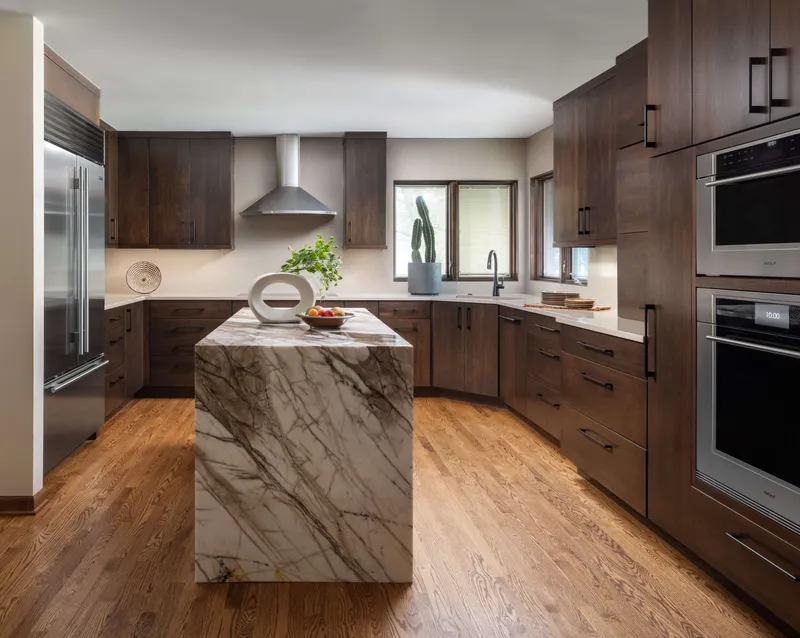
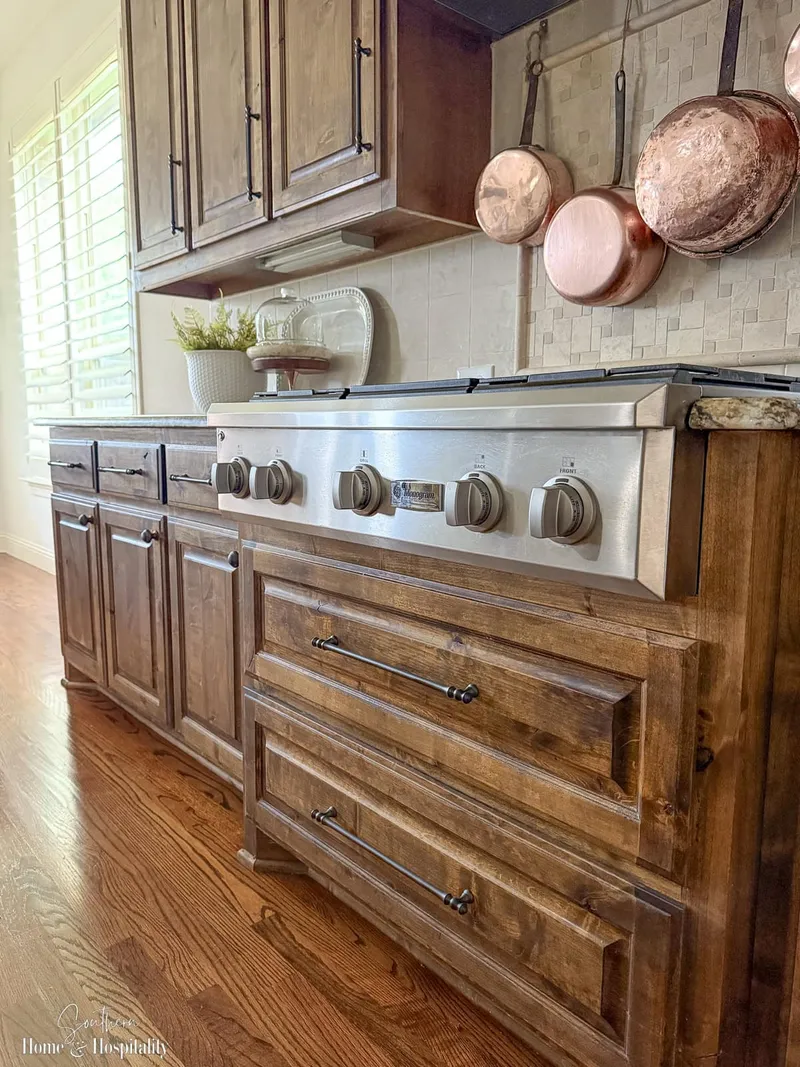
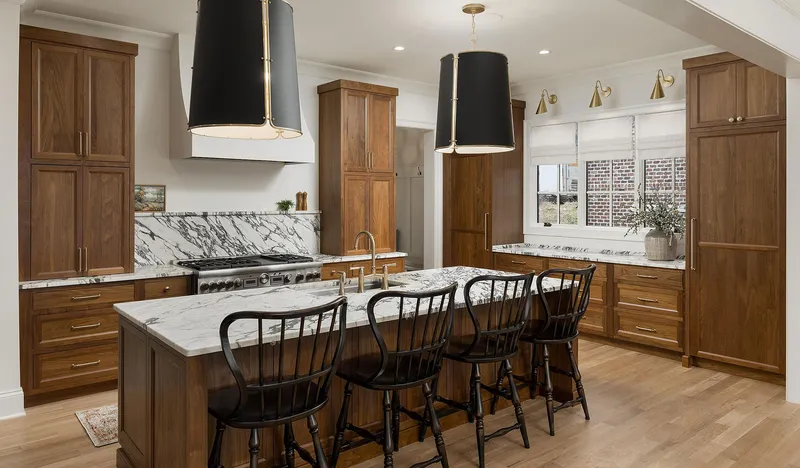
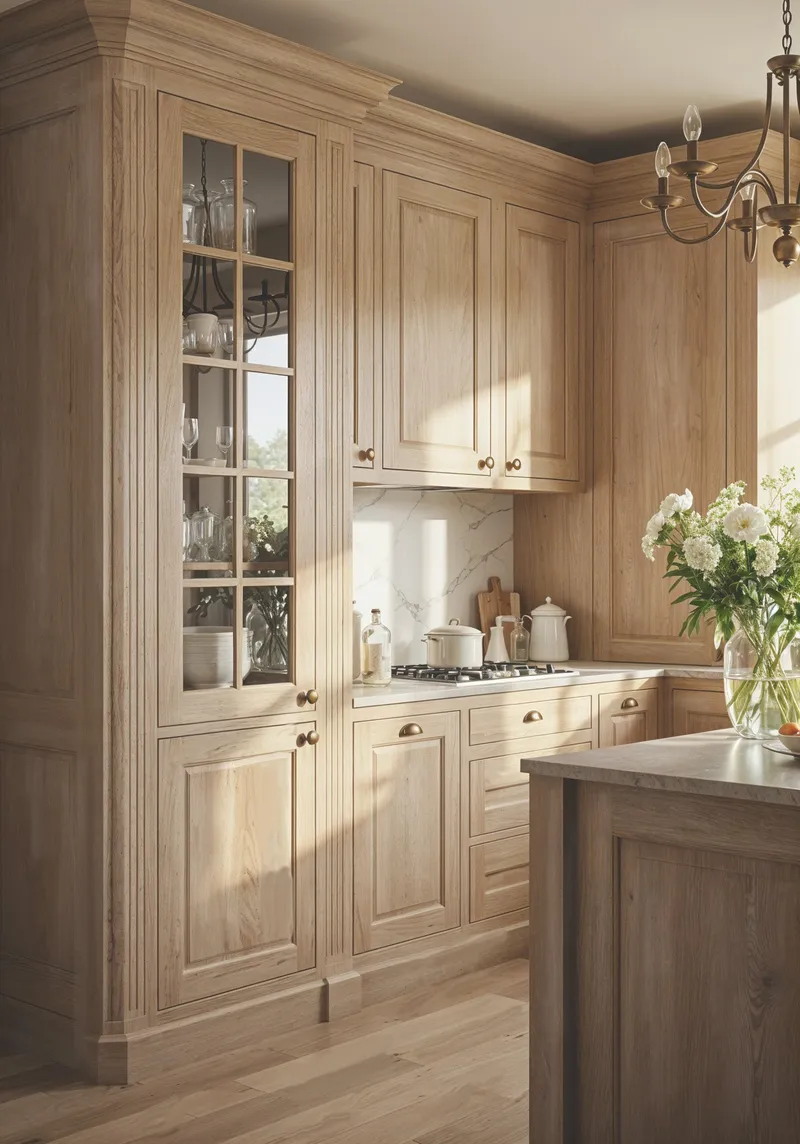
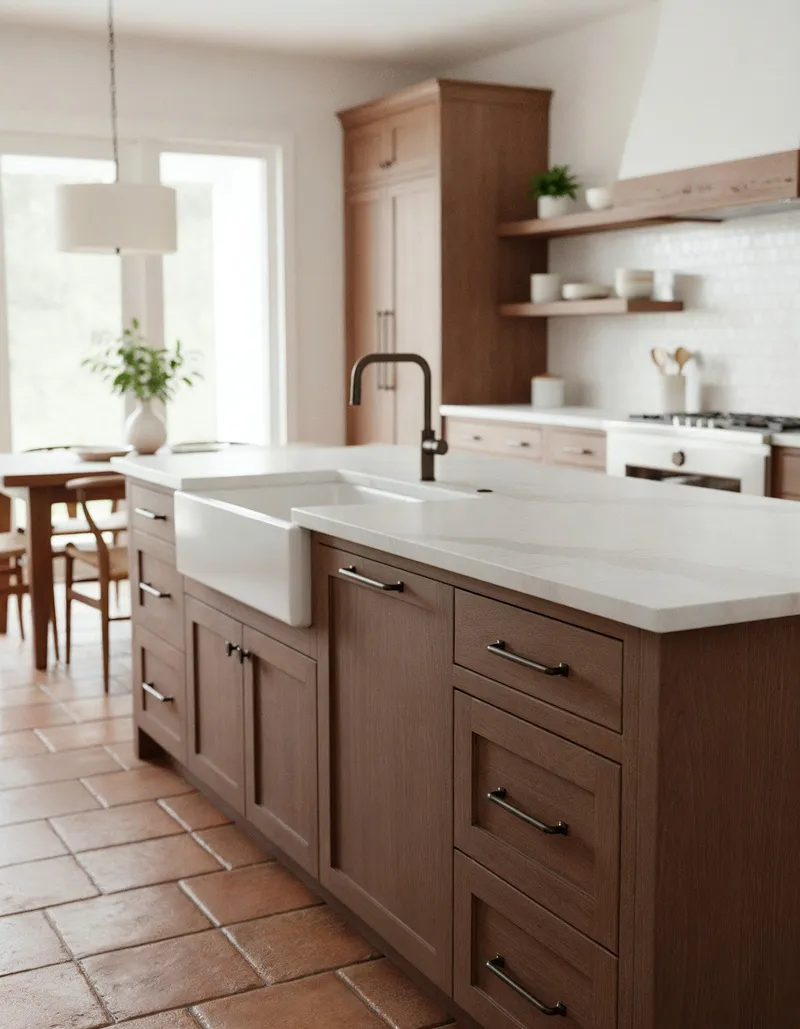
If you want honestly warm modern, this is it: flat or simple doors in real timber, stained and top‑coated so you see the grain, not a wall of beige cosplay. The modern look comes from restraint—slab or flat‑panel fronts, tight reveals, low‑sheen finish, and a stain in the light‑to‑mid range rather than “espresso drama.” Many budget‑friendly projects now lean on color‑stained wood instead of paint to keep things feeling warm and natural.
Under the hood, a good factory finish on stained solid hardwood is more engineered than romantic. KCMA/ANSI A161.1 testing runs doors and drawers through 25,000 operation cycles, then bathes finished surfaces in household liquids for 24 hours to check they don’t fail [1]. That’s the industry’s “this should survive a real kitchen” baseline.
Moisture-wise, KCMA‑certified finishes have to sit in a 120°F (49°C) hotbox at 70% relative humidity for 24 hours without blistering or discoloration [3][4]. So: they can handle a busy, steamy kitchen. What they can’t handle is abuse disguised as “normal use”: draping a wet tea towel over a door, for instance. Manufacturers are very clear that damp cloths or dishtowels hanging on doors can cause permanent peeling and discoloration of the finish [7][8]. That’s not patina; that’s damage.
The other big failure mode is neglect. Prolonged exposure to spills, water, oil, or grease splatters can permanently discolor or damage the finish if you don’t clean them off promptly [9][10][11]. Around sinks and dishwashers, the bottom edges are the danger zone: leave standing water there and you’re asking for swollen fibres and edge breakdown. The manufacturer guidance is blunt—spills and splatters should be cleaned immediately [10][12].
Heat is another edge case. Normal cooking is fine. The self‑clean cycle on your oven is not. The heat from a self‑clean can be intense enough that, if it escapes, it can damage adjacent cabinets; one manufacturer even recommends removing doors and drawers nearest the oven before using self‑clean to avoid finish damage [13][14]. If you love your stained fronts, you treat that cycle with respect.
Sunlight is sneakier. Many cabinet lines now add UV inhibitors to their stained finishes, but the manufacturers still warn that colour can change under UV, depending on wood species, finish, and exposure [15]. Direct sun tends to darken natural wood and can also fade painted, laminated, and Thermofoil surfaces [16]. That’s why blinds or draperies are recommended to shield cabinets from strong direct sunlight [17]. If you have a big south‑facing window, expect doors in the beam to age differently unless you control the light.
Day to day, living with stained hardwood is pleasantly low drama if you follow simple care. For regular dusting, manufacturers recommend a clean, soft, lint‑free cotton cloth [18]. For actual cleaning, a soft cotton cloth dampened with warm water usually does it; you can step up to a fresh solution of dishwashing liquid in warm water or a mild all‑purpose cleaner that doesn’t contain ammonia or silicone [19]. Then you wipe with a clean damp cloth and dry immediately with another soft cloth [20]. That’s it. No magic oils, no greasy polishes.
In practice, the surface “fails” cosmetically before it fails structurally: sheen shifts around handles, darker halos where fingers are greasy, slightly duller patches where people wipe aggressively around the bin drawer. The grain and stain generally swallow light wear, which is why I’ll take a stained slab in a family kitchen over a painted Shaker door any day. A painted chip shows stark substrate; a small knock in stained wood often just looks like part of the story.
On the other hand, stain is unforgiving of shortcuts. You see every sanding swirl, every blotchy patch where the wood absorbed unevenly, every cheap board with wild grain. That’s why flat‑panel stained doors are my favourite and my harshest test: they show exactly how serious your manufacturer and installer are about quality. If your kitchen company treats grain matching and door alignment as optional, you’ll see it every single day.
One safety note: emission and certification standards change by region. In North America, cabinet systems and finishes are tested and certified under specific standards like ANSI/KCMA A161.1 [1][2]. Always confirm with your supplier which standard your product meets and how they expect you to install and clean it in your climate.
Veneered stained wood fronts on MDF or plywood
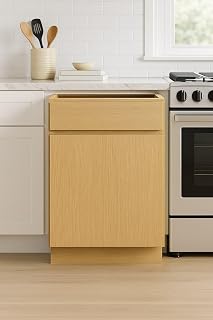
Most “modern stained wood kitchen cabinets” you see in catalogues aren’t solid hardwood slabs; they’re wood veneer on MDF or plywood, stained and top‑coated. Done well, that’s not a downgrade. It can actually give you cleaner grain, better stability, and a more contemporary feel.
Structurally and finish‑wise, KCMA‑certified veneered fronts are put through the same “lifetime of use” regime under ANSI/KCMA A161.1 as solid fronts [2]. Doors and drawers still have to survive the 25,000 operation cycles and finish tests that simulate long‑term kitchen use [1][2]. The finish still has to tolerate the 120°F hotbox at 70% humidity for 24 hours without blistering or discoloration [3][4].
The extra layer here is the substrate’s emissions profile. In the US, hardwood plywood, particleboard, MDF, and thin MDF used in cabinet fronts have to comply with CARB Phase 2 formaldehyde limits—0.05 ppm for hardwood plywood, 0.09 ppm for particleboard, 0.11 ppm for MDF, and 0.13 ppm for thin MDF [5]. Those same composite substrates are also covered by TSCA Title VI in the US [6]. If you care about indoor air quality, you want clear documentation that your cabinets meet these requirements and aren’t some back‑door import dodging the rules.
European or Chinese E1 classification is a separate emission standard, tested by a different method [6]. It’s not interchangeable with TSCA Title VI; you match the certification to your jurisdiction. When health is in the mix, always verify local compliance, don’t just trust a brochure badge.
In use, veneered stained fronts behave much like solid timber in all the important ways: vulnerable to prolonged exposure to spills, liquids, and grease splatters, which can permanently discolor or damage the finish if not cleaned promptly [10][11]. Vulnerable to moisture trapped by draped damp cloths or dishtowels, which can cause permanent damage such as peeling and discoloration [7][8]. Sensitive to the intense heat from an oven’s self‑clean cycle, which can damage cabinets if the heat escapes [13][14]. And responsive to sunlight, which can darken natural wood products and affect surface finishes [16][15][17].
The care routine is identical: regular dusting with a clean, soft, lint‑free cotton cloth [18], cleaning with a soft cotton cloth dampened with warm water and, if needed, dishwashing liquid in warm water or a mild all‑purpose cleaner without ammonia or silicone [19], then a clean damp wipe and immediate drying [20]. Spills and splatters should always be cleaned immediately [12]. Ignore that, and you’ll earn yourself swollen bottom edges and ghost stains around the cooker, just like with solid fronts.
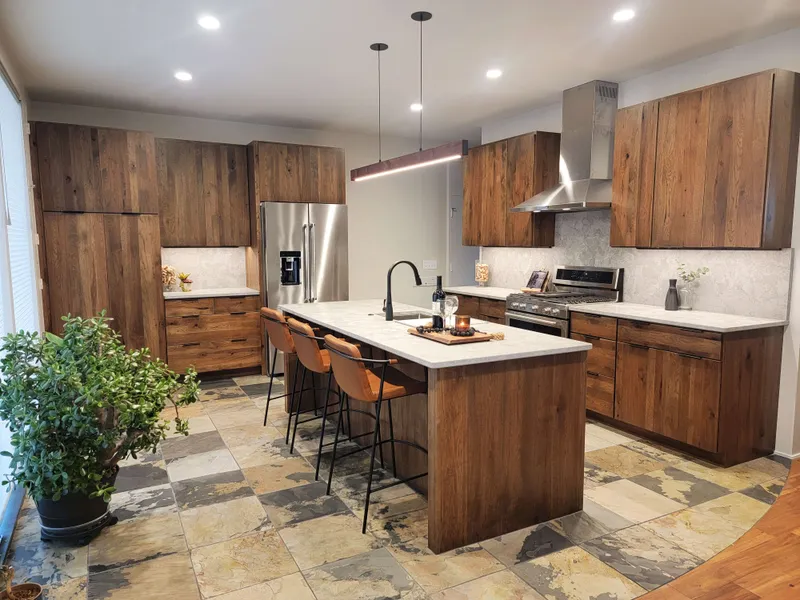
Design‑wise, veneer is your friend when you want extremely consistent grain or a bold directional effect—say, all the base cabinets in one long horizontal oak grain. It is also less forgiving of edge damage, because once you chew through the veneer, there’s no sanding your way back. That’s another reason I tell people to avoid super‑dark stains: on a deep brown veneered door, every fingerprint, dust layer, and tiny chip reads like a smudge on a mirror.

Which one should you choose?
You’re not choosing between “good” and “bad” here; you’re choosing between two flavours of real wood and how honest you want your kitchen to be about wear.
For a warm modern family kitchen
Pick stained wood fronts—solid or high‑quality veneer—with a light‑to‑mid stain. The KCMA/ANSI finish regime with 25,000 cycles and 24‑hour liquid exposure testing is made for exactly this level of abuse [1][2]. Grain camouflages the everyday dings your kids will add; painted doors just record them in high contrast.
For a very tight budget
Go for veneered stained fronts on compliant MDF or plywood. You still get KCMA “lifetime of use” finish performance where certified [2], and you get the modern grain look without paying for solid timber. Just make sure the substrates meet CARB Phase 2 and TSCA Title VI formaldehyde limits, especially MDF and particleboard [5][6].
For a rental or hard‑use investment property
I’d still choose stained over painted. Tenants are not going to baby the kitchen, and cabinet finishes are at real risk from prolonged spills, grease, and wet cloths left hanging on doors [9][7][10][11][8]. A stained grainy surface hides more of the minor scars between turnovers; repainting a whole painted kitchen every few years is a known cost trap.
For a heavily glazed, sun‑drenched kitchen
Stained wood is fine, but you must respect the sun. Finishes may include UV inhibitors, yet manufacturers still warn that sunlight can change colour depending on finish, wood species, and amount of exposure [15]. Direct sunlight tends to darken natural wood and can fade other surfaces, so budget for blinds or draperies to shield the hottest zones [16][17]. If you want zero colour shift over time, you’re chasing something wood isn’t going to give you.
For clients who hate patina and variation
These are not stained‑wood people. Stain keeps the wood honest: natural variation, grain, and gradual change. The finish is tough—KCMA hotbox and liquid tests prove that [3][21][4]—but it will still age. If the expectation is “no change, ever,” send them to a painted system and let someone else manage the future touch‑ups.

Key facts
Show all 9 rows ▾Hide table ▴
| What it covers | Value | Source |
|---|---|---|
| Operation‑cycle durability for kitchen cabinet doors and drawers | 25,000 operation cycles under ANSI/KCMA A161.1 [1] | KCMA (ANSI/KCMA A161.1) [1] |
| Household liquid resistance for cabinet finishes | Exposure to vinegar, citrus juices, grape juice, ketchup, coffee, olive oil, and 100‑proof alcohol for 24 hours, and mustard for 1 hour [21] | KCMA finish testing [21] |
| Heat and humidity resistance for cabinet finishes | 120°F (49°C) at 70% relative humidity for 24 hours in hotbox without blistering or discoloration [3][4] | KCMA performance standard [3][4] |
| Formaldehyde limits for composite cabinet substrates | 0.05 ppm hardwood plywood; 0.09 ppm particleboard; 0.11 ppm MDF; 0.13 ppm thin MDF under CARB Phase 2 [5] | CARB Phase 2 limits as reported for cabinet substrates [5] |
| US indoor air quality compliance for cabinet panels | Hardwood plywood, particleboard, and MDF must comply with TSCA Title VI; E1 is a separate European/Chinese classification [6] | TSCA Title VI / E1 distinction [6] |
| Effect of prolonged spills and moisture on cabinet finishes | Prolonged exposure to food, water, liquids, oil, or grease can cause permanent discoloration or damage [9][10][11] | Manufacturer guidance [9][10][11] |
| Effect of draped damp cloths on cabinet doors | Damp cloths or dishtowels draped over doors can cause permanent finish damage such as peeling and discoloration [7][8] | Manufacturer guidance [7][8] |
| Recommended everyday cleaning method | Clean with soft cotton cloth dampened with warm water, mild dishwashing solution, or mild all‑purpose cleaner without ammonia or silicone; then wipe with clean damp cloth and dry immediately [19][20] | Manufacturer cleaning recommendations [19][20] |
| UV resistance and sunlight effect on cabinet finishes | Finishes may include UV inhibitors, but sunlight exposure can change colour; direct sunlight tends to darken natural wood and can fade other surfaces; shielding with draperies or blinds is recommended [15][17][16] | Manufacturer UV guidance [15][17][16] |
Quick answers
Are stained wood kitchen cabinet fronts durable enough for a busy family kitchen?
Yes—when they use a KCMA/ANSI A161.1 factory finish, cabinet doors and drawers are tested to 25,000 operation cycles and 24‑hour exposure to common household liquids to simulate a lifetime of use [1][2][21]. The finish still needs basic care, but it is engineered for real‑world traffic, not just showrooms.
How water‑resistant are stained wood kitchen cabinets?
KCMA‑certified finishes on stained wood cabinets must withstand a 120°F (49°C) hotbox at 70% relative humidity for 24 hours without blistering or discoloration, making them suitable for high‑humidity kitchen environments [3][4]. Prolonged exposure to standing water or damp cloths, however, can still cause permanent finish damage and discoloration [9][7][10][8].
Do stained wood cabinet finishes change color in sunlight?
Yes, exposure to direct sunlight tends to darken natural wood products and can also fade other finished surfaces, even when the finish includes UV inhibitors [16][15]. Manufacturers recommend using draperies or blinds to shield cabinets from strong direct sunlight to reduce color change over time [17].
What cleaning products are safe for stained wood kitchen cabinets?
The recommended approach is a soft cotton cloth dampened with warm water, or a fresh solution of dishwashing liquid in warm water, or a mild all‑purpose cleaner that does not contain ammonia or silicone [19]. After cleaning, wipe all surfaces with a clean damp cloth and dry immediately with another soft, clean cloth [20].
Can leaving spills or grease on stained cabinets cause permanent damage?
Yes—manufacturers warn that prolonged exposure to spills, food, water, other liquids, and oil or grease splatters can cause permanent discoloration or damage to cabinet finishes [9][10][11]. The guidance is to clean spills and splatters immediately rather than letting them sit [12].
Are veneered stained wood fronts safe from a VOC and formaldehyde perspective?
In the US, hardwood plywood, particleboard, MDF, and thin MDF substrates used in cabinet fronts must meet CARB Phase 2 formaldehyde limits—0.05 ppm for hardwood plywood, 0.09 ppm for particleboard, 0.11 ppm for MDF, and 0.13 ppm for thin MDF—and comply with TSCA Title VI [5][6]. You should always confirm with your supplier that their products meet these limits and any additional local indoor air quality requirements.
Sources
Facts last verified 2026-09-30.
- ANSI/KCMA A161.1 tests cabinet doors and drawers through 25,000 operation cycles and subjects finished surfaces to household liquids for 24 hours. — KCMA, retrieved 2026-09-30.
To earn the ANSI/KCMA A161.1 Quality Certification Seal, kitchen cabinets must endure a battery of 14 tests that simulate a lifetime of use (and abuse). These tests include structural, door operation,…
- ANSI/KCMA A161.1 certification tests kitchen-cabinet structure, drawers, doors, and finish to simulate a lifetime of use. — KCMA, retrieved 2026-09-30.
Before a kitchen cabinet design can receive the KCMA A161.1 Quality Certification Seal, its structure, drawers, doors and finish are tested to simulate a lifetime of use.
- KCMA-certified cabinet finishes are suitable for high-humidity kitchen environments because the finished surfaces must survive a 120°F hotbox at 70 percent relative humidity for 24 hours without blistering or discoloration. — KCMA, retrieved 2026-09-30.
A cabinet door is placed in a hotbox at 120F and 70 percent relative humidity for 24 hours.
- KCMA heat-and-humidity testing places a cabinet door in a 120°F hotbox at 70% relative humidity for 24 hours. — KCMA, retrieved 2026-09-30.
A cabinet door is placed in a hotbox at 120F and 70 percent relative humidity for 24 hours.
- CARB Phase 2 formaldehyde emission limits are 0.05 ppm for hardwood plywood, 0.09 ppm for particleboard, 0.11 ppm for MDF, and 0.13 ppm for thin MDF. — Captivating Cabinets, retrieved 2026-09-30.
CARB 2 compliant cabinets are built from plywood, particleboard and MDF made to California’s Phase 2 formaldehyde emission limits (0.05 ppm for hardwood plywood, 0.09 for particleboard, 0.11 for MDF a…
- Hardwood plywood, particleboard, and MDF used in cabinets are subject to TSCA Title VI formaldehyde compliance requirements in the United States, while E1 is a separate European and Chinese classification tested by a different method. — Captivating Cabinets, retrieved 2026-09-30.
No. E1 is a European and Chinese classification tested by a different method. A cabinet sold in the U.S. still needs to comply with TSCA Title VI, and the importer must certify that.
- Draping damp cloths or dishtowels over cabinet doors can cause permanent damage, such as peeling and discoloration, to the cabinet’s finish. — Abodian, retrieved 2026-09-30.
Avoid draping damp cloths or dishtowels over cabinet doors. The moisture can cause permanent damage, such as peeling and discoloration, to the cabinet’s finish.
- Moisture from damp cloths or dishtowels draped over cabinet doors can cause permanent damage, such as peeling and discoloration, to the cabinet’s finish. — Abodian, retrieved 2026-09-30.
The moisture can cause permanent damage, such as peeling and discoloration, to the cabinet’s finish.
- Stained wood kitchen cabinet fronts should be protected from prolonged exposure to food, water, or other liquids because it can cause permanent discoloration or damage. — NextDAY Cabinets, retrieved 2026-09-30.
Wipe and clean up spills, drips and grease immediately. Prolonged exposure to food, water or other liquids can cause permanent discoloration or damage.
- Prolonged exposure to spills, including food, water or other liquids, or to oil and grease splatters, can cause permanent discoloration or damage to cabinet finishes, requiring immediate cleaning. — Abodian, retrieved 2026-09-30.
Clean spills and splatters immediately. Prolonged exposure to spills, including food, water or other liquids, or to oil and grease splatters, can cause permanent discoloration or damage to your cabine…
- Permanent discoloration or damage to a cabinet’s finish can be caused by prolonged exposure to spills, including food, water or other liquids, or to oil and grease splatters. — Abodian, retrieved 2026-09-30.
Prolonged exposure to spills, including food, water or other liquids, or to oil and grease splatters, can cause permanent discoloration or damage to your cabinet’s finish.
- It is recommended to clean spills and splatters on cabinets immediately. — Abodian, retrieved 2026-09-30.
Clean spills and splatters immediately.
- Exposure to heat generated during an oven’s self-cleaning feature can damage cabinets if the heat escapes from the oven, which can be minimized by removing cabinet doors and drawers nearest the oven. — Abodian, retrieved 2026-09-30.
The heat generated when using an oven’s self-cleaning feature is much greater than during normal cooking. If this heat escapes from the oven, it can damage your cabinets. While this is a rare circumst…
- The heat generated when using an oven’s self-cleaning feature, if it escapes, can damage cabinets, although this is a rare circumstance. — Abodian, retrieved 2026-09-30.
The heat generated when using an oven’s self-cleaning feature is much greater than during normal cooking. If this heat escapes from the oven, it can damage your cabinets. While this is a rare circumst…
- NextDAY Cabinets states that its cabinet finishes include UV inhibitors, but sunlight exposure can still change the color depending on the finish, wood species, and amount of exposure. — NextDAY Cabinets, retrieved 2026-09-30.
NextDAY Cabinets applies UV inhibitors as part of the finishing process to protect the integrity of the finish but under exposure to UV the color may change depending on the finish, wood species a…
- Exposure to direct sunlight tends to darken the color of natural wood products and can also fade painted wood surfaces, laminated surfaces, and Thermofoil. — Abodian, retrieved 2026-09-30.
Exposure to direct sunlight tends to darken the color of natural wood products. Sunlight can also fade painted wood surfaces, laminated surfaces and Thermofoil.
- Exposure to direct sunlight tends to darken the color of natural wood products and can also fade painted wood surfaces, laminated surfaces, and Thermofoil, so draperies or blinds are recommended to shield cabinets from direct sunlight. — Abodian, retrieved 2026-09-30.
Exposure to direct sunlight tends to darken the color of natural wood products. Sunlight can also fade painted wood surfaces, laminated surfaces and Thermofoil. You should consider draperies or blinds…
- For regular dusting of cabinets, use a clean, soft, lint-free cotton cloth. — Abodian, retrieved 2026-09-30.
Use a clean, soft, lint-free cotton cloth for regular dusting.
- For cleaning cabinets, a soft cotton cloth dampened with warm water is usually sufficient, or a fresh solution of dishwashing liquid mixed with warm water, or a mild all-purpose cleaner that does not contain ammonia or silicone. — Abodian, retrieved 2026-09-30.
A soft cotton cloth dampened with warm water is usually sufficient to clean your cabinets. If more thorough cleaning is required, use one of the following cleaning solutions: A fresh solution of dis…
- After cleaning cabinets, wipe all surfaces with a clean, damp cloth and dry immediately using another soft, clean cloth. — Abodian, retrieved 2026-09-30.
After cleaning, wipe all surfaces with a clean, damp cloth. Dry immediately, using another soft, clean cloth.
- KCMA finish testing exposes cabinet surfaces to vinegar, lemon, orange and grape juices, tomato ketchup, coffee, olive oil, and 100-proof alcohol for 24 hours, and mustard for one hour. — KCMA, retrieved 2026-09-30.
The exterior exposed surfaces of the doors, front frames, drawer fronts, and end panels are subjected to vinegar, lemon, orange, and grape juices, tomato ketchup, coffee, olive oil, and 100-proof alco…