


You’re standing in the slab yard, staring at a calm, pale quartz and a dramatic granite with wild veining. The quote in your hand says they’re roughly the same installed price, your contractor shrugs, and your realtor keeps repeating “buyers love stone.” The real “quartz vs granite countertop” decision is not about which one is harder on a lab scale. It’s about how you actually live: whether anyone in your house is realistically going to reseal stone, use trivets, or baby a fancy surface.

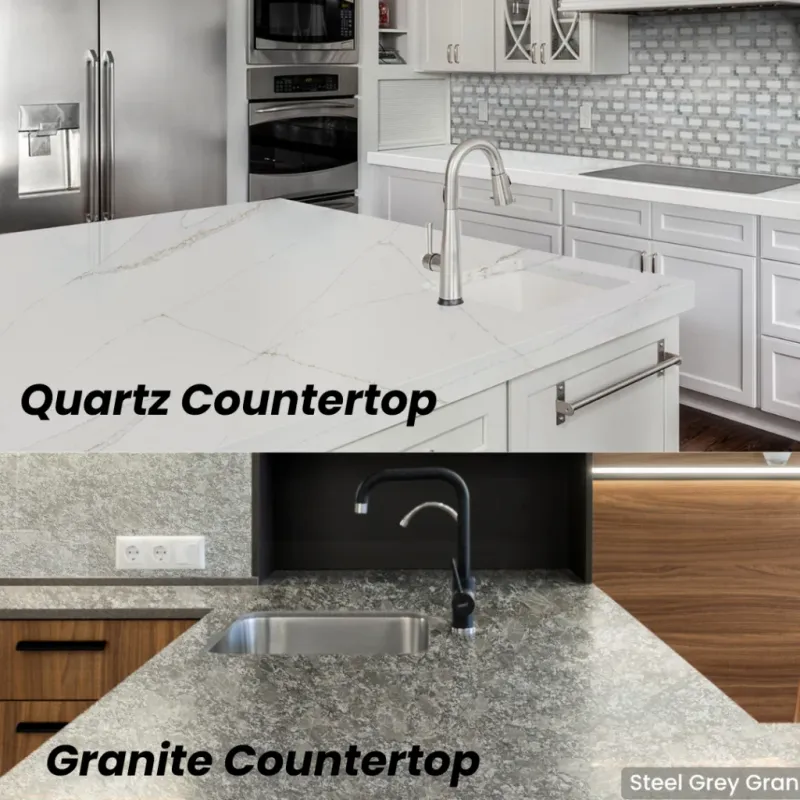
Here’s the blunt verdict: for most busy households who hate maintenance, quartz wins on day-to-day care and predictability. If you’re a serious cook who drops hot pans everywhere and loves natural variation more than easy cleaning, granite is the better fit. And no, neither one will single‑handedly guarantee a resale premium over the other. [1]
| Metric | Quartz countertop | Granite countertop |
|---|---|---|
| Durability | Mohs hardness 6.0–7.0 (Vicostone engineered quartz, EN 101) [2] | Mohs hardness 6–7 (polished granite slabs) [3]; natural stone countertops expected to last a lifetime [4] |
| Moisture / water resistance | Water absorption ≤0.05% by weight, ASTM C97/C97M; non‑porous surface with excellent resistance to common household substances [5][6] | Water absorption 0.2–0.6% by weight for Black Absolute polished granite, ASTM C97 / EN 13755 [7] |
| VOC emission level (g/L) | Not established (check for products with UL GREENGUARD Gold certification for lower VOC emissions) [8][9] | Not established (check for products with UL GREENGUARD Gold certification for lower VOC emissions) [8][9] |
| R‑value / thermal resistance | Not established | R‑value equivalent 0.038–0.083 hr·ft²·°F/Btu for 1" granite; Barre granite 0.052 hr·ft²·°F/Btu [10][11][12] |
| Maintenance interval (years) | No routine sealing required under normal use (Ideal Quartz) [13] | Seal on installation; reseal every 1–3 years depending on porosity and use [14]; a quality sealer may last 10–15 years [15] |
| Cost per unit — material only | $40–$100+ per sq ft (2024, US) [16] ≈ $430.56–$1,076.39+ per m² [16] | $5–$150+ per sq ft (2024, US) [17] ≈ $53.82–$1,614.60+ per m² [17] |
| Cost per unit — installed | $80–$120 per sq ft installed in 2024 (US) [18]; $50–$120 per sq ft installed in 2025 [19] ≈ $861.12–$1,292.00 per m² (2024 range) [18] | $40–$200 per sq ft installed in 2024 (US), most kitchens $60–$120 per sq ft [20] ≈ $430.56–$2,152.80 per m² [20] |
Quartz countertop — the “real life” winner for most busy kitchens
If your reality is kids, red wine, takeout containers, and no one in the house is going to track sealer dates, quartz is made for you. This is engineered stone: crushed mineral plus resin, calibrated in a factory so the surface is non‑porous and very low in water absorption — ≤0.05% by weight in one major product, tested under ASTM C97/C97M. [5] That controlled, non‑porous surface is what gives quartz its excellent resistance to many everyday kitchen substances. [6]

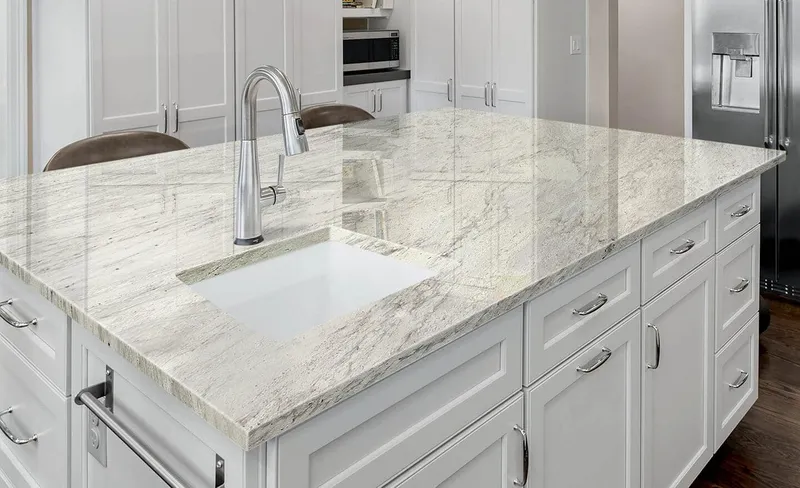
Day to day, that means you wipe things up and move on. There’s no “did we seal last year or the year before?” anxiety, because at least one engineered quartz brand explicitly states that routine sealing is not required under normal kitchen use. [13] This is why I steer almost every overwhelmed family toward quartz: it matches how people actually live, not how they imagine they’ll lovingly baby their counters forever.
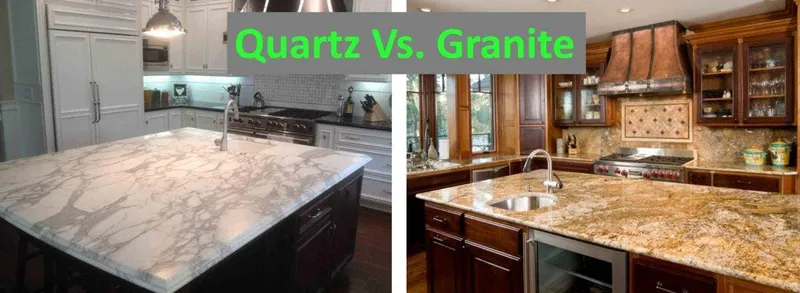
On paper, quartz and granite are equally hard — 6.0–7.0 on the Mohs scale for a common quartz line [2] versus 6–7 for polished granite. [3] In real kitchens, you’re not wearing either of them out by making sandwiches. Where quartz earns its keep is stain resistance and predictability. You get a low‑porosity, engineered surface specifically designed to shrug off most food and drink if you behave like a normal human and wipe it up within a reasonable time. [5][6]
The catch — and there is one — is heat. Those resin binders do not like extremely hot cookware. At least one engineered quartz manufacturer is very clear: their product is not intended as a direct resting surface for extremely hot pots and pans, and they recommend trivets, hot pads, or other barriers. [21] I’ve seen the “mystery ring” around a cooktop too many times to pretend this is hypothetical. If you’re the person who parks a 260 °C (500 °F) sheet pan wherever it lands, quartz is a liability.
Edges and cut‑outs are another weak point. The same maker notes that localized impacts can damage edges, corners, or unsupported areas. [22] That’s not a defect in quartz; it’s how brittle, hard surfaces behave. Dragging a cast‑iron skillet across a sharp dishwasher corner can chip either quartz or granite. Poor cabinet support or over‑ambitious overhangs will crack both.
Installation‑wise, quartz is not DIY. Fabricators template your cabinets, cut sink and hob openings in the shop, then bring the finished pieces to site. Some brands have strict rules: for example, Cambria quartz over appliance openings like dishwashers must have vertical support on three sides [23], and overhangs longer than 12 in (for 2 cm) or 15 in (for 3 cm) need corbels or similar support. [24] Thin (1 cm) quartz used horizontally needs a full 3/4 in wood substrate [25] and added steel support if overhangs exceed 3 in with cross‑members every 15 in. [26] When you see someone’s quartz island snap at the dishwasher, this is usually why — not because “quartz is weak,” but because support rules were ignored.

Chemically, quartz is low‑maintenance but not bulletproof. The same Ideal Quartz guidelines warn that prolonged exposure to aggressive chemicals, industrial solvents, or highly corrosive substances should be avoided. [27] Translation: standard kitchen cleaners are fine; drain cleaner, paint stripper, or undiluted acids are not a good idea on any countertop you care about.
On cost, quartz is firmly in “serious kitchen” territory. In 2024, US material‑only pricing runs around $40–$100+ per square foot [16] (about $430.56–$1,076.39+ per m²). [16] Installed, you’re in the $80–$120 per square foot range according to one 2024 source [18] (about $861.12–$1,292.00 per m² [18]), with another 2025 range showing $50–$120 per square foot installed. [19] People obsess over shaving $5 per square foot off that, but in my experience the real wallet‑drain is paying to fix heat damage or a bad install, not the initial quote.
Where quartz stumbles is outdoors and in high‑UV conditions. One major quartz line clearly states their products are intended primarily for interior applications unless specifically rated for outside use. [28] So if you’re planning an outdoor kitchen, quartz is usually off the table unless the manufacturer prints “exterior‑approved” in black and white.
If you want low‑VOC materials (nursery nearby, asthma in the family), look for quartz products that carry UL GREENGUARD Gold Certification, which is designed to provide greater protection for sensitive groups with lower VOC emissions and compliance with California’s Section 01350 testing method. [8][9] The exact g/L number isn’t disclosed here, but the label is meaningful.
Granite countertop — natural stone character and better heat forgiveness
Granite is the classic: natural igneous stone, real mineral movement, each slab a little different. In the hand, it feels “serious,” and in a kitchen, a good granite can last as long as the room itself — natural stone countertops are commonly described as having a lifetime life expectancy. [4] If you want that sense of permanence and you’re comfortable with basic maintenance, granite makes sense.

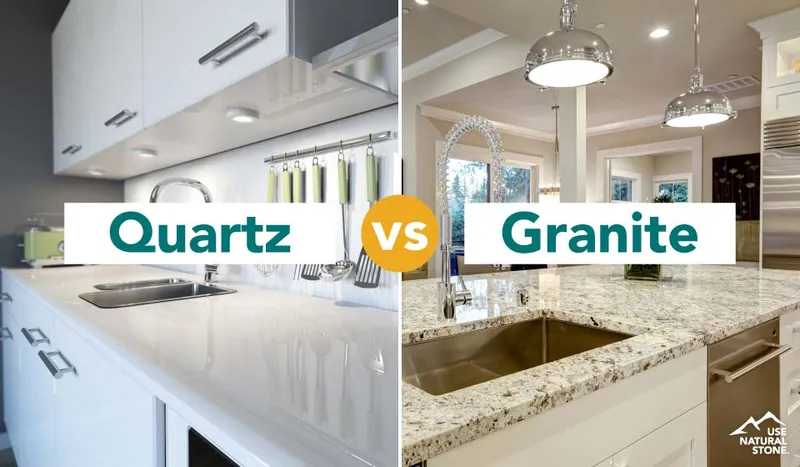
On raw hardness, granite is right there with engineered quartz: 6–7 Mohs for polished granite slabs. [3] It’s not going to wear out from sliding plates or chopping with a board. Where granite earns its keep for serious cooks is heat. While no one in the industry is saying “go ahead and thermal‑shock your counters,” there’s a reason I trust granite more than quartz around hot pans. The big caution from the Natural Stone Institute is about direct, localized heat creating strong thermal gradients that can crack the stone. [29][30] That’s them saying “don’t drop a screaming‑hot pot on one delicate spot” — but compared with resin‑bound quartz, granite is the less fussy partner for everyday warm cookware.
The trade‑off is porosity and staining. Black Absolute granite, for instance, has a water absorption of 0.2–0.6% by weight under ASTM C97/EN 13755. [7] That looks low on paper, but compared with quartz at ≤0.05% [5] and a non‑porous surface [6], it’s a real difference in how casually you can treat oil, wine, and coffee. Granite needs sealing as part of responsible ownership: one guidance says most granite should be sealed at installation and resealed every 1–3 years depending on porosity and use. [14] Another industry source says a quality sealer may last 10–15 years. [15] Those numbers look generous on a chart; in real life, people forget and then wonder why there’s a dark ring around the olive‑oil bottle.
Done right, sealing helps granite resist everyday dirt and spills. [15] Done badly—or skipped—it leaves you with real stains. And harsh cleaners matter here too. The Natural Stone Institute specifically warns that acidic cleaners can etch granite and tells you to talk to your stone supplier before using vinegar on a granite countertop. [31] If your current cleaning routine is “spray everything with whatever’s under the sink,” granite will push back more than quartz.
Thermally, granite is a decent heat conductor and feels cold underhand. Its R‑value equivalent over 1 in thickness ranges from 0.038 to 0.083 hr·ft²·°F/Btu, with Barre granite around 0.052. [10][11][12] That’s technical language for: it will happily suck the warmth out of your forearms, and it won’t do much insulating for radiant‑heat applications.
Installation is similar to quartz: heavy slabs, precise templating, sink and hob cut‑outs that must be supported properly. Edges and narrow strips around a cooktop or sink are vulnerable; a hard stone is still brittle in the wrong place. The same thermal warning from the Natural Stone Institute applies: don’t apply direct localized heat, because strong thermal gradients can cause cracking. [29][30] I’ve seen that failure right at the front rail of a cooktop, where a hot pan meets a thin strip of stone.
On cost, granite is a wider universe. Material‑only, 2024 US prices run from $5 to $150+ per square foot depending on grade. [17] That’s everywhere from “cheaper than laminate” to “exotic showpiece,” about $53.82–$1,614.60+ per m². [17] Installed, you’re at $40–$200 per square foot, with most kitchens landing between $60 and $120 per square foot. [20] In practice that means granite can be notably cheaper than quartz for entry‑level slabs, roughly comparable in the mid‑range, and more expensive at the exotic end.
For VOC‑sensitive projects, the same advice applies as with quartz: look for countertops that carry UL GREENGUARD Gold Certification, which demands compliance with California’s Section 01350 method and limits emissions of more than 360 VOCs. [8][9] The stone itself may be inert, but resins, adhesives, and sealers all live in the VOC conversation.
The upside of granite is simple: if you respect its need for sealing and avoid thermal abuse, a good slab will last the life of the kitchen and then some. [4][14][15] The downside is that it asks more of you than quartz does. If your personality is “I still haven’t changed the HVAC filter this year,” believe your own track record.
Which one should you choose?
Skip the abstract quartz vs granite countertop debate and start with how you actually use your kitchen.
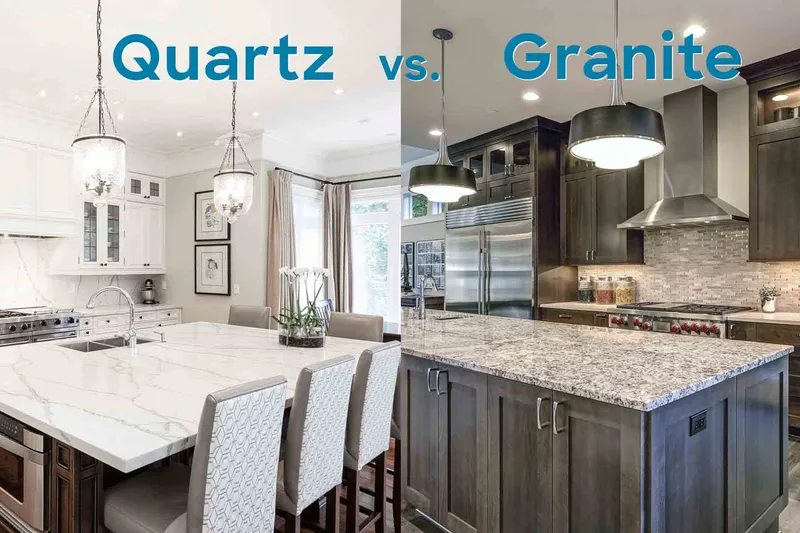
Busy family, low tolerance for maintenance
Pick quartz. You get a non‑porous, extremely low‑absorption surface (≤0.05% by weight [5]) with excellent resistance to common spills [6] and no routine sealing requirement under normal use. [13] Pair it with trivets [21] and call it done. Granite’s resealing interval of 1–3 years [14] is exactly the kind of thing busy households forget, and neglected stone is expensive to fix.
Serious cook who moves hot pots constantly
Lean toward granite. Both materials can crack from intense localized heat [29][30], but quartz manufacturers openly tell you not to put extremely hot cookware directly on the surface and to use trivets. [21] If you know you’ll never change your “hot pan anywhere” habit, granite’s lack of resin makes it the less risky choice, as long as you still avoid extreme point‑heat.
Budget renovation, hunting for value
For pure upfront cost, granite can go lower: material from $5 per sq ft [17] and installed from $40 per sq ft [20], versus quartz material starting around $40 per sq ft [16] and installed from $80 per sq ft in one 2024 range. [18] If you’re shopping the very bottom of the market, entry‑level granite wins. In the typical mid‑range, decisions come down to colour and maintenance tolerance more than a clean price gap.
Outdoor kitchen or high‑sun room
Default to granite. One quartz line is explicit that its products are intended primarily for interior applications unless specifically rated for exterior use. [28] Unless a quartz manufacturer clearly says “outdoor‑approved,” choose granite and still protect it from direct localized heat to avoid thermal cracking. [29][30]
Resale‑focused remodel
Data doesn’t show a proven resale price premium for quartz over granite or vice versa; countertops aren’t a separate line item in the main Cost vs. Value reports. [1] What sells is a well‑installed, current‑looking surface in good condition. If your buyers skew maintenance‑averse, quartz plus a clear low‑maintenance story usually feels more “today” than heavily speckled granite that reads as early‑2000s.
In all of this, one thing matters more than brand wars: a competent fabricator following support and cut‑out rules. Quartz and granite are both hard; it’s the edges, seams, and support that usually fail first. For anything involving structure, safety, or local code (supports over appliances, outdoor use, VOC limits), verify details with your fabricator and local building officials — they live with your region’s quirks every day.
Key facts
Show all 14 rows ▾Hide table ▴
| What it covers | Value | Source |
|---|---|---|
| Quartz hardness | Mohs 6.0–7.0 for engineered quartz slabs (EN 101) [2] | Vicostone [2] |
| Granite hardness | Mohs 6–7 for polished granite slabs [3] | Sabta Granite & Marbles Trading [3] |
| Quartz water absorption | ≤0.05% by weight (ASTM C97/C97M) [5] | Vicostone [5] |
| Granite water absorption | 0.2–0.6% by weight for Black Absolute granite (ASTM C97/EN 13755) [7] | Sabta Granite & Marbles Trading [7] |
| Quartz resealing requirement | No routine sealing required under normal use [13] | Ideal Quartz / Tropical Stone, LLC [13] |
| Granite resealing interval | Seal on install; reseal every 1–3 years depending on porosity and use [14] | SlabWise [14] |
| Granite sealer life expectancy | Quality sealer may last 10–15 years [15] | Natural Stone Institute [15] |
| Quartz installed cost (2024, US) | $80–$120 per sq ft installed [18] | Cabinets City [18] |
| Granite installed cost (2024, US) | $40–$200 per sq ft installed; most kitchens $60–$120 per sq ft [20] | SlabWise [20] |
| Outdoor use guidance for quartz | Intended primarily for interior applications unless specifically designated for exterior use [28] | Ideal Quartz / Tropical Stone, LLC [28] |
| Heat exposure limits — quartz | Not intended as a direct resting surface for extremely hot cookware; trivets/hot pads recommended [21] | Ideal Quartz / Tropical Stone, LLC [21] |
| Heat exposure limits — granite | Direct localized heat can create thermal gradients that crack granite; discouraged by Natural Stone Institute [29][30] | Natural Stone Institute [29][30] |
| Resale value comparison | No proven resale premium of quartz over granite or vice versa in major Cost vs. Value data [1] | SlabWise [1] |
| Low‑VOC countertop guidance | UL GREENGUARD Gold sets lower VOC emission limits and requires compliance with CDPH Section 01350; suitable for sensitive groups [8][9] | UL Solutions [8][9] |
Quick answers
Is quartz more durable than granite for kitchen countertops?
Engineered quartz and granite are similarly hard, with quartz at Mohs 6.0–7.0 [2] and polished granite at Mohs 6–7 [3], and natural stone countertops often described as lasting a lifetime under typical home use. [4] In practice, durability failures usually come from heat, impacts, and poor support rather than the basic hardness of either material. [21][22][29]
Which resists stains and moisture better, quartz or granite?
Quartz has the clear edge on moisture and stain resistance, with engineered slabs showing water absorption ≤0.05% by weight and a non‑porous surface with excellent resistance to many everyday substances. [5][6] A common polished granite like Black Absolute absorbs more water at 0.2–0.6% by weight and relies on sealing to improve resistance to dirt and spills. [7][15]
How often do I need to reseal quartz vs granite countertops?
At least one engineered quartz line states that routine sealing is not required under normal use. [13] Granite, by contrast, should be sealed at installation and then typically resealed every 1–3 years depending on porosity and use, although a high‑quality sealer may last 10–15 years in some cases. [14][15]
What’s the cost difference between quartz and granite countertops installed?
In 2024 US data, quartz countertops are typically $80–$120 per sq ft installed [18], while granite runs from $40 to $200 per sq ft installed with most kitchens between $60 and $120 per sq ft. [20] That means entry‑level granite can be cheaper than quartz, but both overlap in the mid‑range where design and maintenance preferences matter more than a strict price gap.
Can I put hot pans directly on quartz or granite?
Manufacturers of engineered quartz explicitly say their countertops are not intended as a direct resting surface for extremely hot cookware and recommend using trivets or hot pads. [21] Granite is more forgiving but still should not receive direct localized heat, as strong thermal gradients can crack the stone according to the Natural Stone Institute. [29][30]
Does quartz or granite add more resale value to my home?
Current data shows no definitive resale premium for quartz over granite or vice versa, since countertops are not broken out as a dedicated line in the National Association of Realtors Cost vs. Value report. [1] A well‑installed, current‑looking countertop in good condition—whether quartz or granite—does more for resale than the material label alone.
Sources
Facts last verified 2026-10-25.
- Neither granite nor quartz has a definitively proven resale premium over the other in current data, as countertops do not appear as a standalone line item in the National Association of Realtors Cost vs. Value report. — SlabWise, retrieved 2026-10-25.
Neither material has a definitively proven resale premium over the other in current data. The National Association of Realtors produces a Cost vs. Value report annually (via Remodeling Magazine’s join…
- Vicostone engineered quartz countertop slabs have a Mohs hardness of 6.0 to 7.0, measured under EN 101. — Vicostone, retrieved 2026-10-25.
Mohs Scale of Hardness, EN 101: 6.0 to 7.0.
- Polished granite slabs have a Mohs hardness of 6 to 7 according to a published granite product specification. — Sabta Granite & Marbles Trading, retrieved 2026-10-25.
Hardness (Mohs Scale) 6 – 7
- Natural stone countertops are expected to last a lifetime. — National Association of Home Builders, retrieved 2026-10-25.
Natural stone countertops, which are less expensive than a few years ago, are gaining in popularity and are expected to last a lifetime.
- Vicostone engineered quartz countertop slabs have water absorption of 0.05 percent or less by weight, tested under ASTM C 97/C 97M. — Vicostone, retrieved 2026-10-25.
Water Absorption: a. ASTM C 97/C 97M: Less than or equal to 0.05 percent by weight.
- Ideal Quartz engineered quartz countertops have a non-porous surface and controlled manufacturing which contributes to excellent resistance against many substances commonly encountered during everyday use. — Tropical Stone, LLC, retrieved 2026-10-25.
The combination of a non-porous surface and controlled manufacturing contributes to excellent resistance against many substances commonly encountered during everyday use.
- Black Absolute polished granite has water absorption of 0.2 to 0.6 percent, tested under ASTM C97/EN 13755. — Sabta Granite & Marbles Trading, retrieved 2026-10-25.
Water Absorption (ASTM C97 / EN 13755) 0.2 – 0.6%
- The UL GREENGUARD Gold Certification Standard provides greater protection for sensitive groups and sets lower VOC emission limits, making it optimal for products in nurseries, schools, healthcare facilities, and homes where children’s safety is paramount. — UL Solutions, retrieved 2026-10-25.
The UL GREENGUARD Gold Certification Standard is an elevated certification, providing greater protection for sensitive groups. This certification highlights its role in contributing to healthier envir…
- To achieve UL GREENGUARD Gold Certification, products must comply with the requirements of the California Department of Public Health (CDPH) Standard Method for the Testing and Evaluation of Volatile Organic Chemical Emissions from Indoor Sources Using Environmental Chambers, also known as California Section 01350, in addition to limiting emissions of more than 360 VOCs and total chemical emissions. — UL Solutions, retrieved 2026-10-25.
In addition to limiting emissions of more than 360 VOCs and total chemical emissions, UL GREENGUARD Gold Certified products must also comply with the requirements of the California Department of Publi…
- Granite has an R-value equivalent of 0.083 Hr • ft 2 • °F / Btu for a 1" thick dimension stone sample, based on the high value observed. — Natural Stone Institute, retrieved 2026-10-25.
Granite (High Value) 1 | 1.73 | 0.083 |
- Granite has an R-value equivalent of 0.038 Hr • ft 2 • °F / Btu for a 1" thick dimension stone sample, based on the low value observed. — Natural Stone Institute, retrieved 2026-10-25.
Granite (Low Value) 1 | 3.98 | 0.038 |
- Barre Granite has an R-value equivalent of 0.052 Hr • ft 2 • °F / Btu for a 1" thick dimension stone sample. — Natural Stone Institute, retrieved 2026-10-25.
Granite (Barre) 2 | 2.79 | 0.052 |
- Ideal Quartz engineered quartz countertops do not require routine sealing under normal use. — Tropical Stone, LLC, retrieved 2026-10-25.
Unlike many natural materials, it does not require routine sealing and can typically be maintained using ordinary cleaning practices.
- Most granite should be sealed on installation and resealed every 1 to 3 years depending on porosity and use. — SlabWise, retrieved 2026-10-25.
Most granite should be sealed on installation and resealed every 1 to 3 years depending on porosity and use.
- Granite countertops are more resistant to everyday dirt and spills after proper sealing, and a quality sealer may have a life expectancy of ten to fifteen years. — Natural Stone Institute, retrieved 2026-10-25.
In many cases it makes sense to seal marble and granite countertops with a quality sealer. The product should have a life expectancy of ten to fifteen years and be of an oliophobic (resistant to water…
- Engineered quartz countertop material costs $40 to $100 or more per square foot in 2024, excluding fabrication and installation. — Cabinets City, retrieved 2026-10-25.
Material prices start around $40 per square foot on the low end for basic whites, up to $100+ for premium designer grades in bolder colors or designs.
- Granite countertop material costs $5 to $150 or more per square foot before fabrication and installation, depending on grade. — SlabWise, retrieved 2026-10-25.
Raw slab-only pricing runs roughly $5 to $15 per square foot for entry-level granite, $15 to $35 for mid-range, and $35 to $150 or more for premium and exotic colors.
- Engineered quartz countertops cost $80 to $120 per square foot installed in 2024. — Cabinets City, retrieved 2026-10-25.
Quartz countertops generally span $80 to $120 per square foot installed.
- Quartz countertops in 2025 run $50 to $120 per square foot installed. — SlabWise, retrieved 2026-10-25.
Quartz countertops in 2025 run $50 to $120 per square foot installed, with most homeowners landing between $60 and $90 for a mid-range product from a known brand.
- Granite countertops cost $40 to $200 per square foot installed, with most kitchens costing $60 to $120 per square foot. — SlabWise, retrieved 2026-10-25.
Installed granite countertops run $40 to $200 per square foot, and most kitchens land between $60 and $120.
- Ideal Quartz engineered quartz countertops are not intended to serve as a direct resting surface for extremely hot cookware; the use of trivets, hot pads, or other protective barriers is recommended. — Tropical Stone, LLC, retrieved 2026-10-25.
However, engineered quartz is not intended to serve as a direct resting surface for extremely hot cookware. The use of trivets, hot pads, or other protective barriers is recommended whenever placing h…
- Localized impacts from heavy objects may damage edges, corners, or unsupported areas of Ideal Quartz engineered quartz countertops. — Tropical Stone, LLC, retrieved 2026-10-25.
As with all architectural surfaces, localized impacts from heavy objects may damage edges, corners, or unsupported areas.
- Cambria quartz countertops installed over appliance openings such as dishwashers require vertical support on three sides. — Cambria, retrieved 2026-10-25.
For Cambria countertops installed over openings for appliances (such as a dishwasher), vertical support is required on three sides.
- For Cambria quartz countertops, overhangs exceeding 12 inches for 2-cm material or 15 inches for 3-cm material require corbels. — Cambria, retrieved 2026-10-25.
c. Any overhang that exceeds 12″ for 2cm and 15″ for 3cm requires use of corbels.
- Cambria quartz countertops used in a horizontal 1-cm application require a full three-quarter-inch wood substrate for support. — Cambria, retrieved 2026-10-25.
If 1cm product is used in a horizontal application, a full ¾″ wood substrate is required to properly support the material.
- For Cambria quartz countertops, 1-cm horizontal applications with overhangs greater than 3 inches require structural steel with cross-member support every 15 inches on center. — Cambria, retrieved 2026-10-25.
All 1cm horizontal applications with overhangs greater than 3″ require structural steel with cross member support every 15″ on center.
- Prolonged exposure to aggressive chemicals, industrial solvents, or highly corrosive substances should be avoided with Ideal Quartz engineered quartz countertops. — Tropical Stone, LLC, retrieved 2026-10-25.
Prolonged exposure to aggressive chemicals, industrial solvents, or highly corrosive substances should be avoided.
- Ideal Quartz products are intended primarily for interior applications. — Tropical Stone, LLC, retrieved 2026-10-25.
Ideal Quartz™ products are intended primarily for interior applications unless specific products are identified by Ideal Quartz™ as suitable for exterior use.
- Granite countertops can crack when localized direct heat creates strong thermal gradients, and the Natural Stone Institute discourages direct application of localized heat. — Natural Stone Institute, retrieved 2026-10-25.
Granite is typically heat resistant up to temperatures of ±250°C (±480°F), although direct application of localized heat sources is discouraged, since strong thermal gradients within the stone can ini…
- Granite countertops should not receive direct localized heat because the resulting thermal gradients can initiate cracking. — Natural Stone Institute, retrieved 2026-10-25.
Granite is typically heat resistant up to temperatures of ±250°C (±480°F), although direct application of localized heat sources is discouraged, since strong thermal gradients within the stone can ini…
- Acidic cleaners can etch granite, so the Natural Stone Institute advises consulting the stone supplier before using vinegar on a granite countertop. — Natural Stone Institute, retrieved 2026-10-25.
Do not use vinegar as a cleaning agent without consulting your stone supplier as to the mineralogy of your particular granite as well as the compatibility of any sealer or impregnator that may have be…