


You’re standing in an empty shell of a restaurant, or a stripped-back modern kitchen, staring at a dead-looking slab and a quote for “microcement finish” that somehow undercuts new polished concrete. The Pinterest images all look the same: flat grey, no joints, no drama. But microcement vs polished concrete flooring is not a cosmetic tweak – it’s a decision about what you want to live with for the next decade under chairs, drops, grease, grit and delivery trolleys.
Here’s the blunt version: if you have or can pour a decent slab and you’re planning for real commercial traffic, polished concrete wins. Properly treated polished concrete floors can last the life of the building[1] and easily go 20+ years in service[2]. Microcement is a decorative skim with good abrasion data – Class AR 0.5 with max wear depth 50 µm in one tested system[3] – but it sits on top of whatever sins lie beneath and depends on a sealer you must actively look after. Choose microcement when you need that highly controlled, continuous look over awkward substrates; choose polished concrete when you actually want a workhorse.
| Metric | Microcement flooring | Polished concrete flooring |
|---|---|---|
| Durability | Abrasion resistance Class AR 0.5, max wear depth 50 µm (UNI EN 13892‑4:2003)[3] | 50 mg abrasion loss and 81.5% increase in abrasion resistance vs untreated concrete (Taber Abraser, Sikafloor CureHard‑24)[4]; service life 20+ years[2] up to life of the building with the right maintenance[1] |
| Moisture / water resistance | Low water‑absorption coefficient W3 for a shower floor system (UNI EN 1062‑3:2012)[5] | Water absorption 0.03 kg/m²·h⁰·⁵ for densified concrete (EN 1062‑3)[6] |
| VOC emission level (g/L) | Indoor‑air emissions rating A+ (UNI EN ISO 16000‑6:2019 / UNE EN 16516:2018)[7] (no g/L value published) | Not established |
| R‑value / thermal resistance | Not established | Not established |
| Maintenance interval (years) | Not established | Daily dust‑mopping or sweeping recommended[8]; revitalizing treatment twice a year[9] (no year-based interval published) |
| Cost per unit (m²) | Not established | $32.29–$161.46 per m² installed, based on $3–$15 per sq ft in Southern California[10] |
| Cost per unit (sq ft) | Not established | $3–$15 per sq ft installed in Southern California[10] |
Microcement flooring – thin, controlled, and high‑maintenance in commercial use
Microcement is what you reach for when ripping out the floor is politically or structurally impossible, but you still want that smooth “concrete” look. It can go over existing ceramic or porcelain tiles that are in good condition on an even surface[11], and must not go over tiles that are damaged or imperfect – those have to be removed and a solid, flat substrate recreated first[12]. That’s the first reality check on “we’ll just skim over what’s there.”
Manufacturers are very clear about what the substrate has to look like before you even open a bucket. One system demands a solid, load‑bearing, level, fully cured, stain‑free background with minimum tensile strength 1.5 N/mm² and maximum humidity 4%[13]. Another requires concrete at least class C20/25, pull‑off strength ≥1 N/mm², and humidity no higher than 4%[14]. Those aren’t nice‑to‑haves. They’re the line between a floor that survives a restaurant refit and one that starts cracking on tile joints at the first busy weekend.

On paper, microcement handles wear reasonably well. A Conmarble microcement flooring system hits abrasion resistance Class AR 0.5 with max wear depth 50 µm under UNI EN 13892‑4:2003[3], and also carries an A+ indoor‑air emissions rating under UNI EN ISO 16000‑6:2019 and UNE EN 16516:2018[7]. For wet rooms, a Creativo microcement shower floor build‑up achieves low water‑absorption coefficient W3 in EN 1062‑3:2012[5] and anti‑slip ratings like R9 in DIN 51130 for shower use[15]. So the chemistry is not the weak link.
What lets these floors down is movement and detailing. Creativo explicitly warns that an incorrectly sealed drain can let water infiltrate, leading to stains, blisters and system failure because the different materials around the drain move differently and create micro‑cracks[16]. I’ve seen the same pattern around gullies, thresholds and patched substrates: the microcement itself is fine, but the jointing and sealing don’t keep up with commercial abuse.
Slip‑resistance is another nuance. One reinforced microcement system reaches R10 at a 16.8° slip angle under DIN 51130[17], and another logs USRV 41, Class 2 under UNE EN 12633:2003[18]. Those are respectable values for smooth decorative finishes. They do not turn a sloped, greasy kitchen into a non‑issue; they just tell you the surface, as tested, has grip when clean and properly sealed.
Maintenance is where owners get a shock. Microcement seems “low VOC, low joints, low fuss” on the spec sheet, but the published data is mostly about emissions and slip[7][17][18][15], not about how often you’ll be re‑sealing. In practice, the sealer is sacrificial. In restaurants and bars I’ve worked on, the visible microcement layer often outlives the topcoat, which goes dull and patchy in paths and service zones long before the decorative coat is technically worn out.

Add in the failure modes: water ingress around drains[16], substrate‑driven cracking triggered by ignoring those tensile strength and humidity limits[13][14], and the reality that damaged tiles under a “quick skim” were never acceptable[12]. For a residential kitchen with sensible cleaners, microcement can be a joy. For a high‑turnover casual dining chain that treats every surface like vinyl, it’s a mismatch.
My view: microcement is the right tool when you need controlled colour, minimal build‑up, and continuity over floors, walls and joinery – especially in upper‑floor units and modern kitchens. It is not the material you choose because you think you’ve hacked the budget. Prep it properly and seal it properly for a restaurant and the cost gap to polished concrete gets thin, while durability still tilts against it over the long run.
Polished concrete flooring – the slab as finished floor
Polished concrete is not a coating; it is your concrete slab ground and refined. The durability story is very different. With a densifier like Sikafloor CureHard‑24, abrasion loss can be as low as 50 mg in a Taber Abraser test, with an 81.5% increase in abrasion resistance over untreated concrete[4]. Manufacturers openly talk about polished concrete floors lasting the life of the building with the right maintenance[1], and “professionally polished” surfaces lasting 20+ years[2]. In heavy commercial use, that matters more than anything.
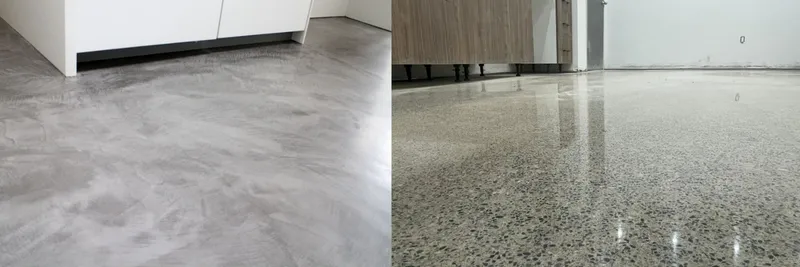
Water performance is solid when the system is specified properly. Sikafloor CureHard‑24‑treated concrete records water absorption of 0.03 kg/m²·h⁰·⁵ under EN 1062‑3[6], which is a very low uptake for a mineral floor. That doesn’t make a restaurant immune to spilled wine or fryer oil – acids from food like cola, milk, pickles or mustard will still etch concrete if not removed quickly[19] – but it does mean routine wet cleaning and occasional standing water aren’t the existential threat they are to a thin coating on a moving substrate.
The substrate requirements here are baked into the structure rather than the topping. Guidance for concrete destined to be polished calls for a mix design strength of 3500 psi or higher[20], a floor flatness FF level of 50 or above to make the polishing process work efficiently[21], and a full 28‑day cure before polishing starts[22]. If you’re working with a poor existing slab, one published route is to add a topping layer at least 50 mm (2 in) thick and then polish that[23]. This is the “do it once” approach: design or repair the slab as the real floor.

Maintenance data is refreshingly honest. One leading system recommends daily dust‑mopping or sweeping, or as needed[8] – basically, don’t let grit sit there and act like sandpaper. They also suggest refreshing the gloss with a dry, high‑speed burnisher on floors protected with their guard products[24], and they frame “revitalizing” as a twice‑a‑year task[9]. Protective treatments can be re‑applied without stripping off the old coat[25], which keeps the maintenance cycle relatively light for big commercial areas.
Cost is where polished concrete often looks scary up front and cheap over 10–20 years. In Southern California, installed pricing for polished concrete flooring runs from $3 to $15 per sq ft[10], which is about $32.29–$161.46 per m²[10]. Real‑world examples: a 2,000 sq ft retail showroom comes in at $10,000–$24,000 installed[26], while a 10,000 sq ft warehouse runs $30,000–$60,000[27]. Bigger jobs benefit from economies of scale[28], and there’s a clear premium on tiny projects under 400 sq ft[29].
Compare that to the grind‑and‑seal variant, which typically costs $2–$5 per sq ft[30]. That’s a different finish – more about a film‑forming sealer than true high‑end polishing – but for some restaurants and retail refits it’s a pragmatic middle ground when the slab isn’t worth a full mechanical polish.

In daily life, polished concrete is boring in the best way. You still need decent entrance matting, staff trained not to let acids sit on the surface[19], and cleaners matched to the protective treatment[8][24][9]. But when someone drags a chair wrong or drops a box, you’re usually looking at patina, not failure. That’s exactly why, for heavy commercial traffic, I put polished concrete ahead of microcement every time.
Which one should you choose?
This is where the “it depends” trap lives, so let’s not go there. Here’s how microcement vs polished concrete flooring actually shakes out in real projects.
Ground‑floor retail or restaurant with a decent slab
You are a polished concrete client. You already own the substrate polished concrete needs: a slab that can be brought up to scratch with grinding and densifying. You’ll pay somewhere in the $3–$15 per sq ft installed range[10], less per unit on larger floor areas[28]. In exchange, you get a floor whose service life is measured in decades[2] or the life of the building[1], not in sealer cycles. Don’t burn budget hunting “the best microcement suppliers” for a job that simply wants the best polishing contractor.
Upper‑floor retail, hospitality, or apartments over mixed substrates
If you’re dealing with tile over a suspended slab, microcement becomes the realistic option – but only if the tiles are sound and even[11] and the substrate meets strength and humidity limits like ≥1–1.5 N/mm² pull‑off and ≤4% moisture[13][14]. If the background is a patchwork mess or movement‑prone, you either rebuild the substrate properly or accept a different finish. Polished concrete is off the table unless you introduce a new topping slab at least 50 mm (2 in) thick[23].
Modern residential kitchen or small boutique
Microcement is the honest answer if you want a very controlled, uniform grey wrapped over floors, plinths and maybe walls. Polished concrete will show aggregate, repairs and pour lines, no matter what; if you’re already nervous about “imperfections,” believe that instinct. Stick with a tested system that offers decent abrasion class[3], low water absorption for wet zones[5], and verified slip ratings[17][18][15], and budget time and money to keep the sealer healthy.
Hard‑working restaurant kitchens, bars and food courts
Choose polished concrete if the slab is there or can be added. You get densified concrete with low water absorption[6], long life[1][2], and straightforward maintenance routines – daily sweeping[8], periodic burnishing[24], and twice‑yearly revitalizing[9]. Microcement can technically be built for wet areas[5][15], but the failure modes around drains[16] and the abuse from harsh degreasers and standing grease make it a relationship, not a one‑off install. If you know your staff will abuse the floor, don’t pretend otherwise.
Budget‑sensitive commercial refit over bad tile
Neither option is magically cheap. Microcement done to spec means removing damaged tiles[12], checking strength/humidity[13][14], then layering a multi‑coat system and commercial‑grade sealer. Polished concrete may need a new 50 mm topping slab[23] before you even start grinding. If the choice is painful either way, a grind‑and‑seal system at $2–$5 per sq ft[30] on a repaired slab can be the pragmatic compromise – less glamorous than high‑end polish, but often more durable than a microcement that’s been “value‑engineered” into failure.
For any of these paths, local codes, slip requirements and fire and VOC documentation still apply. Always verify strength, moisture and finish specs with a local engineer, manufacturer or installer before you commit a whole job to one system.
Key facts
Show all 29 rows ▾Hide table ▴
| What it covers | Value | Source |
|---|---|---|
| Microcement abrasion resistance | Class AR 0.5, max wear depth 50 µm (UNI EN 13892‑4:2003) | Conmarble microcement flooring[3] |
| Microcement indoor‑air emissions | A+ rating (UNI EN ISO 16000‑6:2019 / UNE EN 16516:2018) | Conmarble microcement flooring[7] |
| Microcement water absorption (wet‑area system) | Low water‑absorption coefficient W3 (UNI EN 1062‑3:2012) | Creativo Microcement shower floor system[5] |
| Microcement slip resistance (smooth finish) | R10, slip angle 16.8° (DIN 51130) | Stucco Italiano reinforced microcement[17] |
| Microcement slip resistance (Class 2) | USRV 41, Class 2 (UNE EN 12633:2003) | ConMarble microcement system[18] |
| Microcement slip resistance (shower) | R9 (DIN 51130) | Creativo Microcement shower application[15] |
| Microcement substrate strength and humidity – example 1 | Minimum tensile strength 1.5 N/mm²; max humidity 4% | ClaudiCemento microcement flooring[13] |
| Microcement substrate strength and humidity – example 2 | Concrete strength class ≥C20/25; pull‑off strength ≥1 N/mm²; humidity ≤4% | Festfloor Go microcement[14] |
| Microcement over tile – allowed condition | Existing ceramic/porcelain tiles in good condition with even surface | CREATIVO® microcement[11] |
| Microcement over tile – prohibited condition | Tiles with imperfections or damage must be removed | CREATIVO® microcement[12] |
| Microcement failure at drains | Incorrectly sealed drains can cause stains, blisters and system failure via micro‑cracks | CREATIVO® system[16] |
| Polished concrete abrasion performance | 50 mg abrasion loss; 81.5% increase in abrasion resistance vs untreated concrete (Taber Abraser) | Sikafloor CureHard‑24‑treated concrete[4] |
| Polished concrete water absorption | 0.03 kg/m²·h⁰·⁵ (EN 1062‑3) | Sikafloor CureHard‑24‑treated concrete[6] |
| Polished concrete service life – building scale | Can last the life of the building with the right maintenance plan | PROSOCO[1] |
| Polished concrete service life – minimum expectation | Easily 20+ years | Stelr[2] |
| Polished concrete daily maintenance | Dust‑mopping or sweeping daily or as needed | PROSOCO[8] |
| Polished concrete periodic maintenance | Revitalizing twice a year; burnishing over LSGuard/PolishGuard to refresh gloss | PROSOCO[24][9] |
| Re‑applying concrete protective treatments | Can be re‑applied without stripping the old coat | PROSOCO Consolideck[25] |
| Acid damage to concrete | Acids from foods like cola, milk, pickles and mustard will etch concrete if not removed quickly | PROSOCO[19] |
| Concrete mix strength for polishing | ≥3500 psi | Concrete intended for polishing[20] |
| Floor flatness target for polishing | FF 50 or greater | Concrete floor flatness guidance[21] |
| Cure time before polishing | Polishing should not begin until 28 days after pour | Concrete polishing guidance[22] |
| Minimum topping thickness for retrofit polishing | 50 mm (2 in) minimum topping slab | Retrofit polished concrete guidance[23] |
| Polished concrete cost range | $3–$15 per sq ft; $32.29–$161.46 per m² installed | Southern California pricing[10] |
| Polished concrete showroom example | 2,000 sq ft retail showroom costs $10,000–$24,000 installed | Stelr example[26] |
| Polished concrete warehouse example | 10,000 sq ft warehouse costs $30,000–$60,000 installed | Stelr example[27] |
| Grind‑and‑seal cost | $2–$5 per sq ft installed | Stelr[30] |
| Economies of scale in polished concrete pricing | Large commercial facilities see significantly reduced installed price per sq ft | Stelr[28] |
| Small job pricing premium | Jobs under 400 sq ft carry higher price per sq ft due to setup/crew minimums | Stelr[29] |
Quick answers
Is polished concrete more durable than microcement in restaurants and retail?
Yes – polished concrete has documented service lives of 20+ years[2] and can last the life of the building with proper maintenance[1], while a densified surface shows 81.5% higher abrasion resistance and just 50 mg abrasion loss vs untreated concrete in testing[4]. Microcement systems can reach abrasion class AR 0.5 with max wear depth 50 µm[3], but they remain thin decorative layers dependent on substrate stability and sealer care, so they are more vulnerable in heavy commercial traffic.
Is microcement waterproof for showers and wet restaurant zones?
No single layer is “waterproof” on its own, but a microcement shower floor build‑up can achieve a low water‑absorption coefficient W3 under UNI EN 1062‑3:2012[5] and anti‑slip ratings such as R9 in DIN 51130[15]. However, failures from water infiltration still occur around badly detailed drains where movement creates micro‑cracks and allows water to penetrate[16], so correct waterproofing and detailing are critical.
What does microcement vs polished concrete flooring cost for commercial projects?
Verified cost data exists for polished concrete: in Southern California, installed polished concrete flooring runs $3–$15 per sq ft[10], with examples like $10,000–$24,000 for a 2,000 sq ft retail showroom[26] and $30,000–$60,000 for a 10,000 sq ft warehouse[27]. A grind‑and‑seal finish comes in lower at $2–$5 per sq ft[30]. There is no published per‑square‑foot cost in the data set for microcement, so you should obtain current local quotes and compare them directly to these polished concrete ranges.
How often does polished concrete need maintenance?
Polished concrete needs daily dust‑mopping or sweeping, or as needed, to control grit[8], plus periodic gloss refreshing with a high‑speed burnisher over the protective guard where used[24]. One manufacturer frames deeper “revitalizing” work as a twice‑a‑year task[9], and protective treatments can be re‑applied without stripping the old coat[25].
Can any existing tile or slab be covered with microcement?
No – microcement manufacturers require specific substrate strength and moisture conditions, such as minimum tensile strength 1.5 N/mm² and humidity ≤4%[13] or pull‑off strength ≥1 N/mm² with humidity ≤4%[14]. Existing ceramic or porcelain tiles can only be overlaid when they are in good condition on an even surface[11]; damaged or imperfect tiles must be removed and a new solid, flat base created[12].
Is polished concrete cheaper on large commercial floors?
Yes – large commercial facilities benefit from economies of scale that significantly reduce the installed price per square foot for polished concrete[28], while small jobs under 400 sq ft attract higher per‑square‑foot rates due to setup and crew minimums[29]. Within that, the verified overall range is $3–$15 per sq ft installed in Southern California[10].
Sources
Facts last verified 2026-10-25.
- Polished concrete floors, with the right maintenance plan and products, can last the life of the building. — PROSOCO, retrieved 2026-10-25.
Concrete floors, with the right maintenance plan and the right products, can last the life of the building.
- Professionally polished concrete floors easily last 20+ years. — Stelr, retrieved 2026-10-25.
Professionally polished concrete floors easily last 20+ years.
- Conmarble microcement flooring has abrasion resistance Class AR 0.5, with a maximum wear depth of 50 µm, under UNI EN 13892-4:2003. — ConMarble, retrieved 2026-10-25.
Abrasion resistance (BCA)|Class AR 0.5, max 50 µm|UNI EN 13892-4:2003
- Sikafloor CureHard-24 used in polished concrete production achieved 50 mg abrasion loss and an 81.5% increase in abrasion resistance compared with an untreated sample, using a Taber Abraser test. — Sika, retrieved 2026-10-25.
Abrasion resistance 50 mg or 81.5 % increase in abrasion resistance compared to un- treated sample (C(0,70) concrete according to EN 1766) (Taber Abraser, H-22 Wheel, 1000 g / 1000 cycles)
- Creativo Microcement shower floor system has a low water-absorption coefficient W3, according to UNI EN 1062-3:2012. — COLORIFICIO MP s.r.l., retrieved 2026-10-25.
For application in the shower the system has a low water-absorption coefficient W3 (UNI EN 1062-3:2012) and medium vapour-permeability V2 (UNI EN ISO 7783:2012).
- Sikafloor CureHard-24-treated concrete had a water absorption value of 0.03 kg/m²·h⁰·⁵ under EN 1062-3. — Sika, retrieved 2026-10-25.
Water absorption w = 0.03 kg/m2×h0.5 (EN 1062-3) (on a substrate w > 1 kg/m2 h0.5)
- Conmarble microcement flooring has an indoor-air emissions rating of A+ under UNI EN ISO 16000-6:2019 and UNE EN 16516:2018. — ConMarble, retrieved 2026-10-25.
Emissions into indoor air|A+|UNI EN ISO 16000-6:2019 / UNE EN 16516:2018
- PROSOCO recommends a daily interval for dust-mopping or sweeping polished concrete floors, or as needed. — PROSOCO, retrieved 2026-10-25.
Dust-mop or sweep floors once a day or as needed.
- PROSOCO recommends a twice-a-year interval for revitalizing polished concrete floors. — PROSOCO, retrieved 2026-10-25.
Revitalize
- The installed cost for polished concrete flooring in Southern California ranges from $3 to $15 per square foot. — Stelr, retrieved 2026-10-25.
Polished concrete cost runs $3 to $15 per square foot installed, and most Southern California projects land between $6 and $10.
- CREATIVO® microcement can be applied over existing ceramic or porcelain tiles if the tiles are in good condition and the surface is even. — Creativo Microcemento, retrieved 2026-10-25.
If the tiles are in good condition and the surface is even, it is possible to proceed.
- CREATIVO® microcement cannot be applied over existing ceramic or porcelain tiles if the tiles have any imperfections or have been damaged; they must be removed, and a solid, flat surface must be recreated first. — Creativo Microcemento, retrieved 2026-10-25.
First check the condition of the tiles. If the tiles have any imperfection or have been damaged, it will not be possible to apply microcement on top. It will be necessary to remove them and recreate a…
- ClaudiCemento requires a solid, load-bearing, level, fully cured, stain-free substrate with a minimum tensile strength of 1.5 N/mm² and maximum humidity of 4% before microcement flooring installation. — ClaudiCemento, retrieved 2026-10-25.
For the microcement flooring the substrate to be solid, load bearing, level, fully cured, stain free with a minimum tensile strength of 1.5 N/mm2 and dry maximum humidity allowed 4%.
- Festfloor Go requires a firm, moisture-free concrete substrate with concrete strength class at least C20/25, minimum pull-off strength of 1 N/mm², and humidity no higher than 4%. — Festfloor, retrieved 2026-10-25.
The substrate should be firm and free of moisture. The substrate concrete strength class should be at least C20/25 (B25). The concrete substrate must be sound and of sufficient compressive strength wi…
- Creativo Microcement for application in the shower and on shower floors has R9 for anti-slip properties per DIN 51130. — COLORIFICIO MP s.r.l., retrieved 2026-10-25.
Microcement and resin system with a maximum thickness of 2-3 mm, with CE-marking as per UNI EN 13813 standard, HACCP certified for use in food environments, R9 for anti-slip properties (DIN 51130).
- Water infiltration through an incorrectly sealed drain can lead to stains, blisters, and failure of the CREATIVO® system, as the surface of the drain is composed of different materials with different elastic moduli and can be subject to different movements, potentially creating micro-cracks that allow water to penetrate. — Creativo Microcemento, retrieved 2026-10-25.
The surface of the drain is composed by different materials, with different elastic modulus and can consequently be subject to different movements. This movements may eventually lead to the creation o…
- Stucco Italiano’s reinforced microcement system has a DIN 51130 ramp-test rating of R10 at a 16.8° slip angle in its smooth finish. — Stucco Italiano, retrieved 2026-10-25.
Anti-slip property DIN51130 method ramp test, surface "Smooth"= angle 16.8 – R 10
- ConMarble’s microcement system has a slip-resistance result of USRV 41, classified as Class 2 under UNE EN 12633:2003. — ConMarble, retrieved 2026-10-25.
|Slip resistance|USRV 41, Class 2|UNE EN 12633:2003|
- Acids, such as those from acidic food like cola, milk, pickles, or mustard, will etch concrete if not removed quickly. — PROSOCO, retrieved 2026-10-25.
ACIDIC FOOD (COLA, MILK, PICKLES, MUSTARD, ETC.) Immediately clean with fresh water or DailyKlean*. Acids will etch concrete if not removed quickly.
- New concrete floors intended for polishing should have a mix design of 3500 psi or higher. — Wikipedia, retrieved 2026-10-25.
The mix design of the concrete should be 3500 psi or higher.
- A FF (floor flatness) level of 50 or greater is desired for concrete floors to facilitate the polishing process. — Wikipedia, retrieved 2026-10-25.
According to the Global Concrete Polishing Institute, a FF (floor flatness) level of 50 or greater is desired to facilitate the polishing process.
- Polishing should not begin until new concrete is fully cured, which is generally 28 days. — Wikipedia, retrieved 2026-10-25.
Polishing should not begin until the concrete is fully cured (generally 28 days).
- For retrofit floors in poor condition, a topping slab with a minimum thickness of 50 mm (2 inches) can be added on top of the existing slab before polishing. — Wikipedia, retrieved 2026-10-25.
If the existing surface is in very poor condition a topping slab with a minimum thickness of 50 mm (2 inches) can be added on top of the existing slab.
- PROSOCO recommends refreshing the gloss of polished concrete floors by running a dry, high-speed burnisher over a floor protected with LSGuard or PolishGuard. — PROSOCO, retrieved 2026-10-25.
Simply run a dry, high-speed burnisher over a floor protected with LSGuard or PolishGuard.
- PROSOCO states that protective treatments for Consolideck concrete floors can be re-applied without stripping away the old coat. — PROSOCO, retrieved 2026-10-25.
Another bonus: Consolideck protective treatments can be re-applied without having to strip away the old coat.
- For a retail showroom of 2,000 sq ft in Southern California, the installed cost for polished concrete flooring is typically between $10,000 and $24,000. — Stelr, retrieved 2026-10-25.
Retail showroom (2,000 sq ft) : $10,000–$24,000
- For a commercial warehouse of 10,000 sq ft in Southern California, the installed cost for polished concrete flooring is typically between $30,000 and $60,000. — Stelr, retrieved 2026-10-25.
Commercial warehouse (10,000 sq ft) : $30,000–$60,000
- For large commercial facilities, economies of scale can significantly reduce the installed price per square foot for polished concrete flooring compared to smaller projects. — Stelr, retrieved 2026-10-25.
While smaller projects have a higher cost per square foot due to setup time, large commercial spaces benefit from economies of scale.
- For polished concrete projects, the installed price per square foot is higher for smaller jobs under 400 sq ft due to a premium for setup and crew minimums. — Stelr, retrieved 2026-10-25.
Large projects trend toward the low end of each range; small jobs under 400 sq ft carry a per-foot premium for setup and crew minimums.
- The installed cost for a grind and seal concrete floor is $2–$5 per square foot. — Stelr, retrieved 2026-10-25.
Grind and seal | $2–$5 | Budget projects, utility spaces, garages