


A hand blown glass chandelier can make a room look finished, expensive, and intentional. Or it can look like themed restaurant lighting and fight with everything else you own.
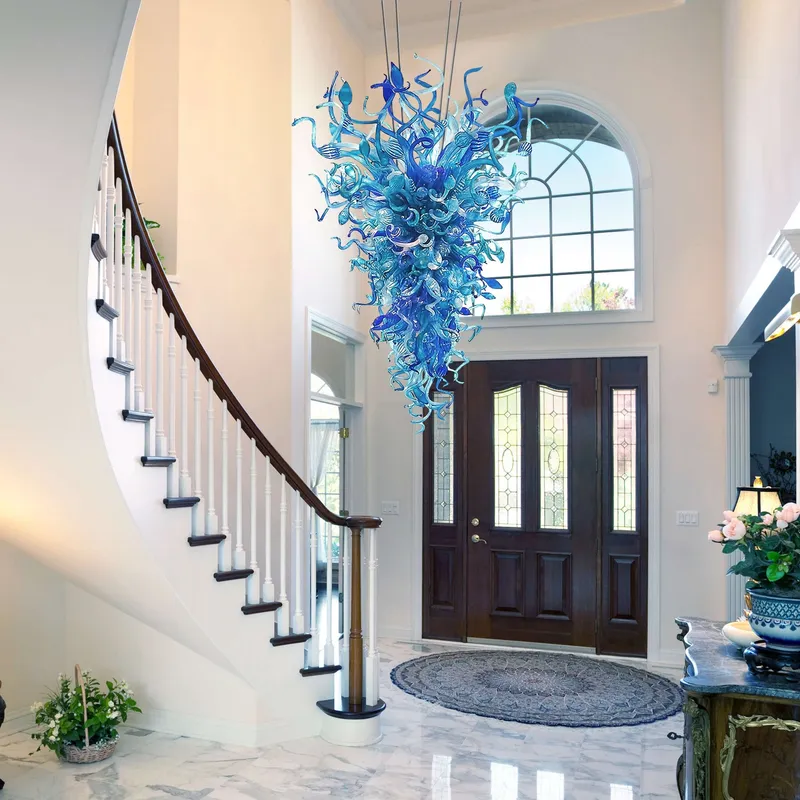
The difference isn’t just the glass. It’s authenticity, scale, weight, wiring, and how ruthless you are about treating the chandelier as the main event instead of an accessory.
Here’s how to choose a hand blown glass chandelier that actually works in your home—whether you’re eyeing a Murano glass chandelier for modern interiors, a Chihuly style blown glass chandelier, or a custom blown glass chandelier for your dining room.
1. Decide what you’re really buying: art or décor
Start here, because it affects everything else: are you buying functional art, or are you buying a decorative light?

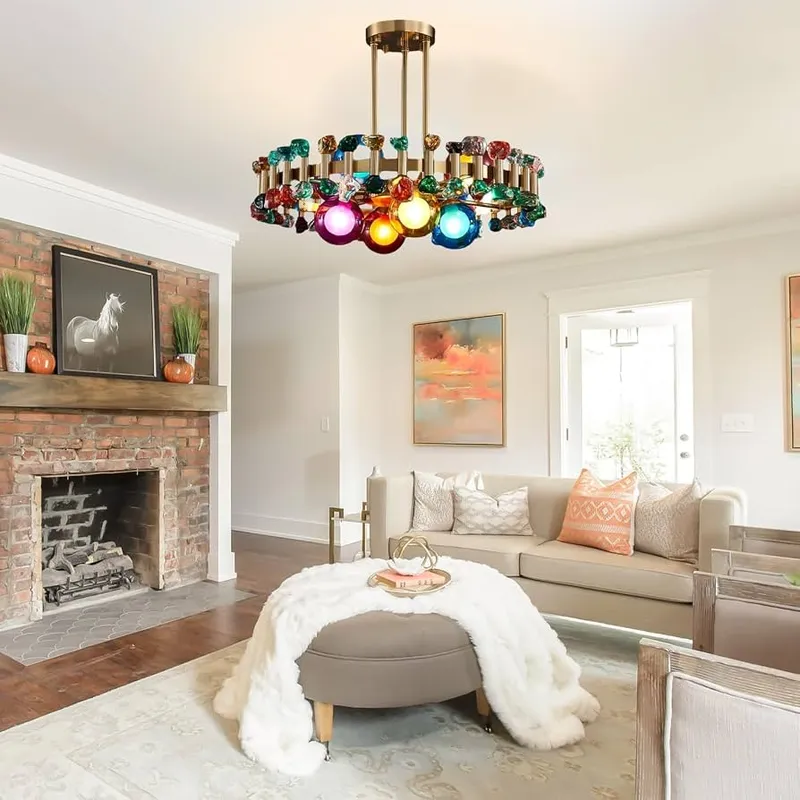
If the listing says “Murano-style” and the price is under $500, you’re not buying a serious hand blown glass chandelier. You’re buying décor. The glass will look flatter, the metal will be lighter and cheaper, and in person it will feel more like costume jewelry than glass sculpture.
That’s fine if you just want a colorful focal point in a casual room and you’re honest about it. But if you care about impact and long-term satisfaction, you’re better off buying fewer things and saving for one authentic Murano piece or a genuinely well-made artisan fixture.
At the higher end, you’re paying for real Venetian or Italian production, dense glass, better hardware, and the option to customize size, drop, and wiring. That’s when the chandelier stops reading as “decorative light” and starts functioning as art.
2. Learn the language: Murano, Murano-style, and Chihuly style
The lighting market plays fast and loose with labels. You can’t trust the adjectives.

Authentic Murano glass
If you want a real Murano glass chandelier for modern interiors, you need proof. Not just pretty photos.
Ask for:
- Maker’s name and workshop location (Murano or Venice)
- Certificate of authenticity and documentation of origin
- Detailed close-up photos of glass, canopy, wiring, and hardware
- Where the electrical work is done and how it’s wired (US/EU/UK, etc.)
- Whether replacement glass pieces are available later
If the seller can’t answer those clearly, you’re not looking at true Murano—just Murano-inspired glass.
Murano-style and Murano-esque
These words cover everything from decent Italian-inspired glass to factory-made knockoffs on big marketplaces.
Under roughly $500, assume it’s decorative: thin glass, light frames, generic metal finishes. Some of those are fun in kids’ rooms or rentals, but they will never give you the depth, heft, or glow of real Venetian glass.
Chihuly style chandeliers
This is the most abused category. A lot of “Chihuly style blown glass chandeliers” online look like Vegas buffet centerpieces: random curls, clashing colors, zero control.
Unless you know the glassmaker and can see a tight, intentional color palette, skip it. True Chihuly-inspired work has discipline: edited colors, controlled movement, and glass that catches light instead of just screaming for attention. The cheap versions instantly date a room and scream theme restaurant.
3. Get the size right: design to the table, not the ceiling
The biggest waste of money is a gorgeous custom blown glass chandelier for a dining room that doesn’t fit the table. Catalog photos and showroom ceilings lie; your table doesn’t.

Dining room sizing rules that actually work
For rectangular tables, a strong guideline: the chandelier should be about two-thirds the table width, not the room width. If your table is 100 cm wide, aim for a chandelier around 65–75 cm wide. For long tables, use an elongated form or multiple elements instead of a single tiny center blob.
Height matters just as much. Over a dining table, most chandeliers should hang so the lowest glass sits about 75–90 cm above the tabletop (roughly 30–36 inches). Too high and it floats awkwardly. Too low and you’ll clip it with tall vases and standup toasts.
Entryway and foyer scale
A statement glass chandelier for an entryway needs breathing room and clearance. In a single-height entry (around 2.4–2.7 m ceilings), you usually need at least 210–215 cm from floor to lowest glass to avoid head bumps. In double-height foyers, the chandelier should sit where you can see the silhouette clearly from both the door and the upper landing, without hanging into the door swing or stair path.
Clustered pieces always feel larger than their measured diameter because the elements bloom out irregularly. If a listing says 75 cm wide but the glass curls stick out beyond the frame, treat it more like 85–90 cm visually.
4. Respect the weight or pay for it later
This is where people get burned: they fall in love with the photo and ignore the weight line in the specs.
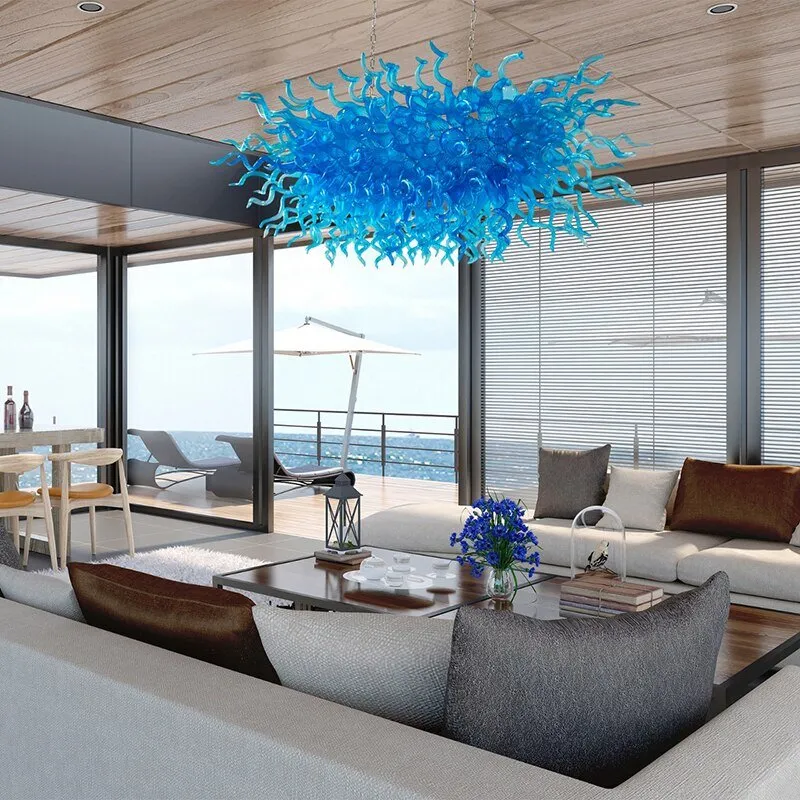
Many serious hand blown glass chandeliers are heavy. A good-size Murano piece can hit 30–40 kg. Larger gallery-level pieces go beyond 40 kg, especially those with 18+ arms or dense clusters.
That is not something you hang off a random junction box. A 40 kg chandelier on a flimsy ceiling fitting is a disaster I’ve seen more than once. Best case, you crack plaster and deform metal. Worst case, it comes down.
For any chandelier over about 15–20 kg, you want:
A reinforced mounting point tied into joists or blocking, a rated bracket or independent ceiling support, and an electrician who flinches—in a good way—when you say “this fixture is 40+ kg.” If they’re casual about it, find another electrician. You may also need a carpenter to add blocking from above before the electrician connects wiring.
Always check both shipping weight and installed weight. Crates can be 70–100 kg; you’ll need a plan just to get the box indoors and up stairs.
5. Get the light right: sockets, bulbs, and wiring
Beautiful glass with bad light is pointless. Before you buy, nail the technical basics:
Most Italian and Murano makers configure for common standards: E12 bulbs for US, E14 for much of Europe, and 110 V versus 220–240 V wiring options. They typically cap incandescent bulbs around 40W per socket, but almost all decent fixtures today are LED-compatible.
For a dining room, you want a balance: enough lumens to light faces and food, and dimming for mood. LED bulbs are your friend here—cooler running, lower energy use, and gentler on the glass over time. Just match bulbs to the dimmer type the electrician installs, or you’ll get flicker and dead spots.
Checklist before you pay anyone: socket type, voltage, maximum wattage per bulb, total recommended wattage, dimmer compatibility, whether bulbs are included, canopy size (so you know if it covers your ceiling box), and maximum/minimum hanging drop. For some imported or marketplace pieces, wiring may need to be redone locally to meet code; always confirm with a licensed electrician in your country.
6. Match style to room, not trend
Hand blown glass is everywhere in 2026, especially vintage Murano lighting. But not every trending piece belongs in your house.

Modern dining rooms
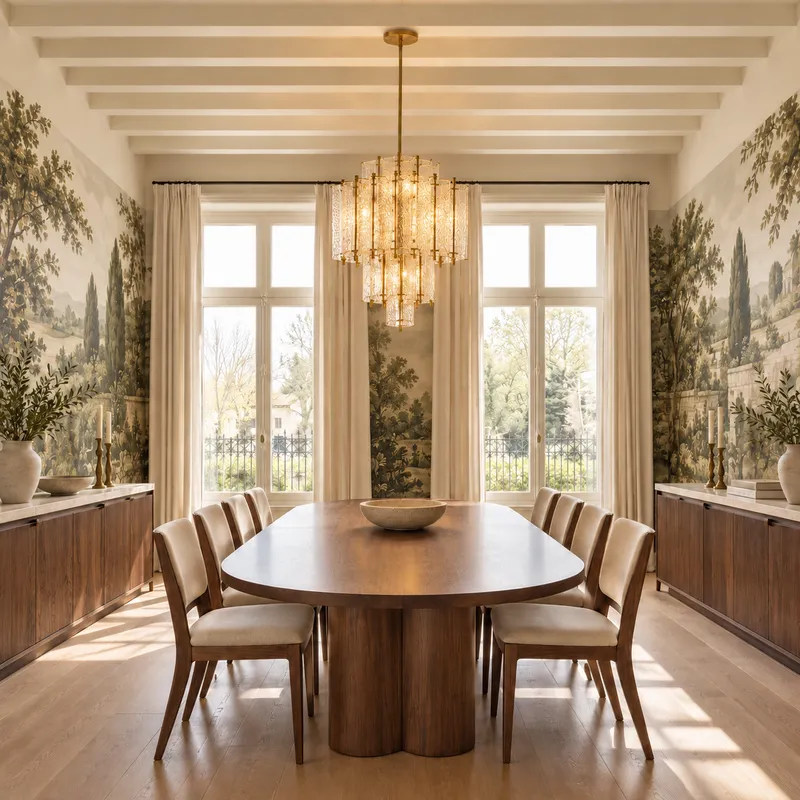
Here’s where these fixtures earn their keep. A sculptural, hand blown glass chandelier above a table is the textbook “functional art” move. The table anchors it, the glass softens the room, and the whole composition can carry a minimalist interior.
What works now: clean silhouettes with organic glass pieces; clear, smoke, amber, or single-color glass in restrained rooms; or a saturated multicolor Murano glass chandelier when you’re willing to design the entire dining room around that one object. If you aren’t prepared to let the chandelier lead, don’t go loud—choose a simpler tonal piece instead.
Entryways and stair halls
A statement glass chandelier for an entryway sets the tone for the whole house. In double-height areas, large clusters and sculptural forms are strong. But they need distance; if your foyer is shallow, dense curls or spikes will feel aggressive and impossible to clean.
Look at the approach paths: from the front door, from the living room, from the stair. The silhouette should make sense from all those angles, not just from directly underneath.
Minimal and contemporary interiors
This is where vintage Murano is especially powerful in 2026—if you let it be itself. Lean into the irregularities, soft diffusion, and slightly offbeat shapes. That tension against clean architecture makes the room look intentional and expensive.
What kills it: polishing everything to death, pairing ornate vintage glass with cold grey vinyl, recessed cans everywhere, and a dozen other “statement” pieces. Then your five-figure chandelier just looks like a confused attic find.
7. Custom vs ready-made: when it’s worth going bespoke
Custom is not a flex if the basics are wrong. It’s just a more expensive mistake.
Go custom when you need to solve a real problem: an unusually long dining table, a low but wide ceiling, a tall stair void, or a precise color composition. Good studios will let you tailor number of lights, diameter, height, glass colors, arrangement, canopy finish, cord or rod length, and country-specific wiring.
But customization comes with trade-offs: longer lead times (20–30+ days is common before shipping), stricter cancellation terms, complex assembly, and harder returns. You also need to lock down the design relative to your furniture plan—especially that dining table—before placing the order. “We’ll find a table later” is how clients end up with a gorgeous, wrong-size chandelier no one wants to admit doesn’t work.
8. Installation, assembly, and living with it
A lot of hand blown glass chandeliers do not arrive ready to hang. They arrive as a kit: metal frame, glass arms or tubes, decorative leaves, canopy, wiring. Assembly is fussy and slow, and you are doing it in mid-air on a ladder or scaffold.

For serious fixtures, assume professional installation: an electrician plus at least one extra pair of hands, sometimes a carpenter and even a small lift in tall foyers. Ask up front whether the glass parts are labeled, whether you get a template or diagram, and if the maker offers phone or video support during install.
Cleaning is another long-term reality. Dense clusters and multilevel tiers collect dust. Plan for a soft microfiber cloth, gentle techniques, and some kind of safe access (extension poles or temporary scaffolding) at least once or twice a year. Avoid aggressive solvents and any twisting of arms or decorative elements; you’re not cleaning a steel fixture.
And before you place the order, ask a blunt question: if one glass leaf or tube breaks in two years, can the maker replace it, and at what cost? A chandelier that can’t be repaired is far riskier than one with a parts program in place.
9. Quick decision guide: what to prioritize
Use this as your short list when comparing options for a hand blown glass chandelier:
| Decision area | Non‑negotiable for a good result |
|---|---|
| Authenticity | Certificate, maker info, origin, clear photos of glass and hardware |
| Scale | Diameter ~⅔ table width; proper hanging height; clearances in entryway |
| Weight/structure | Exact weight, reinforced support, installer who understands heavy fixtures |
| Light quality | Correct sockets/voltage, LED-compatible, dimmable, enough output for the room |
| Room design | Chandelier chosen first, with the rest of the room intentionally quieter |
| Customization | Only when needed for table size, ceiling height, or wiring—never just for novelty |
| Maintenance | Plan for assembly, cleaning access, and replacement parts availability |
Mini FAQ
Is a vintage Murano chandelier a good idea for a modern interior in 2026?
Yes—if you respect what it is. Use the vintage Murano chandelier as the anchor and keep floors, walls, and furniture disciplined and calm. When you let the irregular glass and soft diffusion do the work, the room feels deliberate and high-end instead of nostalgic.
Can I use a Chihuly style blown glass chandelier in a small dining room?
Only if the palette is tight and the size is correct. In small rooms, chaotic shapes and loud colors quickly overwhelm. If you want that sculptural energy, commission or buy from a known glassmaker with strong editing, and size it carefully to your table. Otherwise, go for a simpler blown-glass form.
Is a hand blown glass chandelier worth the cost compared to a standard fixture?
If you treat it as the main event of the room, yes. A strong hand blown glass chandelier can carry an entire dining room or entryway, which means you can spend less on a lot of other decorative items. If you’re going to bury it under competing art, patterns, and “statement” pieces, then no—buy a clean metal fixture and put your budget somewhere else.