


You’re standing in front of two bids: one for fiber cement, one for vinyl, both promising “low maintenance” and “decades of durability.” The fiber cement number is higher, your contractor shrugs and says, “Vinyl’s fine, everyone uses it,” and now you’re deep in the weeds of fiber cement vs vinyl siding with no clear winner.
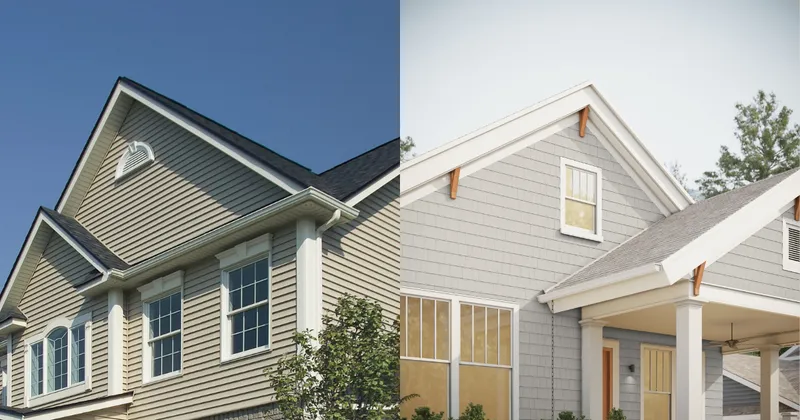
Here’s what the decision really comes down to: how long you’ll own the building, how picky you are about appearance, and how harsh your climate is. Fiber cement siding can realistically be a 100‑year cladding under the right conditions [1], while vinyl typically tops out around 50–60 years of useful life [2][3]. And in my experience, vinyl often gets torn off and landfilled long before that because it looks tired or brittle, while fiber cement usually just needs paint and caulk.
If you care about long‑term value, a serious look at fiber cement vs vinyl siding points to a clear verdict: fiber cement wins for any building you expect to own past the first siding cycle; vinyl is the short‑to‑medium term, low‑touch option when upfront cost and easy installation trump everything else.
| Metric | Fiber cement siding | Vinyl siding |
|---|---|---|
| Durability | Estimated service life 100+ years in typical conditions [1] | Estimated service life 60 years; useful life 50+ years [2][3] |
| Moisture / water resistance | Not established | Not established |
| VOC emission level (g/L) | Not established | Not established |
| R-value / thermal resistance | R‑0.13 per 1/4 in (6.35 mm) of fiber‑cement product [4] | Not established |
| Maintenance interval (years) | Not established | No routine maintenance required to prolong lifetime; cleaning as needed for appearance [5] |
| Cost per unit (both m² and sq ft) | Not established | Hollow vinyl: $2–$5 per sq ft (≈$21.53–$53.82 per m²); insulated vinyl: $8–$10 per sq ft (≈$86.11–$107.64 per m²) [6] |
Fiber cement siding: what it’s really like to own
Fiber cement is the grown‑up in this comparison. Under typical conditions, it carries an estimated service life of 100+ years [1], which is another way of saying the siding will usually outlast your patience with the paint colour. On modern homes and commercial buildings, this matters: repainting is nuisance work; full re‑clads are budget killers.
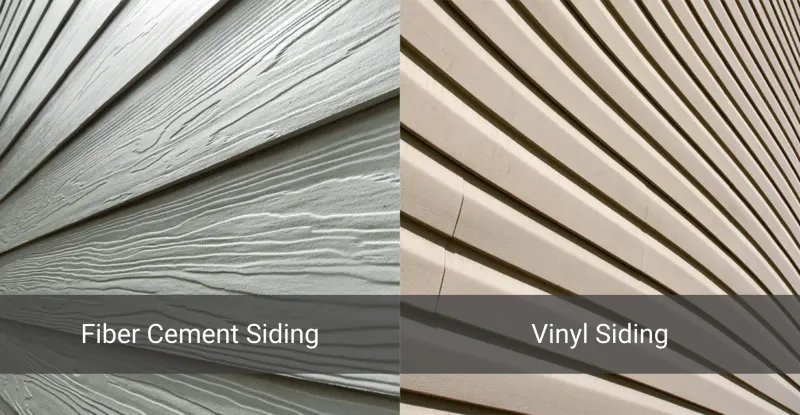
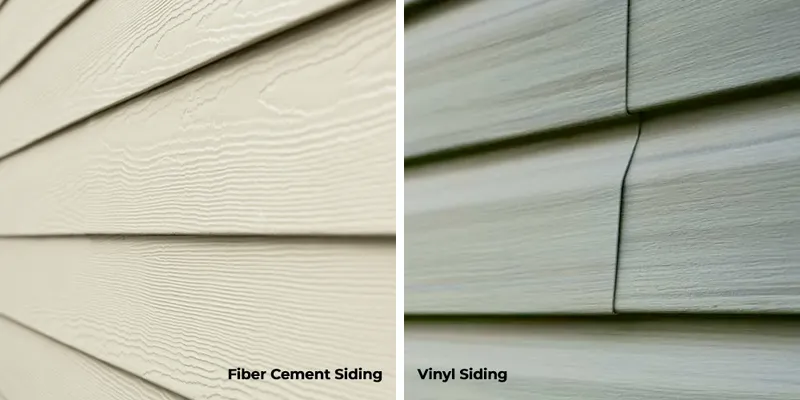
On the wall, fiber cement looks solid. The boards are heavy and rigid, so you get flatter planes and crisper shadow lines than you’ll ever get from vinyl. That’s why architects keep reaching for it on modern elevations and coastal houses: it reads like a real building, not a plastic shell. When I’m working on anything with clean lines—deep overhangs, sharp corners, minimal trim—vinyl simply doesn’t make the cut visually.
Technically, the material is conservative but competent. The actual thermal resistance is low—R‑0.13 per 1/4 in (6.35 mm) [4]—so you’re not choosing fiber cement for its insulation. The thermal work has to happen in your wall assembly, not in the siding. Where fiber cement does shine is fire and code credentials: ICC‑ES documentation shows products complying with ASTM C1186 as Grade II, Type A and achieving a Class A rating under ASTM E84 with a flame‑spread index of 0 and smoke‑developed index below 5 [7]. That’s exactly the kind of thing commercial reviewers and insurers like seeing in the spec book.
Here’s the catch: fiber cement is unforgiving of sloppy work. I’ve seen beautiful projects undermined by cracked boards at nailed edges, swollen unsealed cuts, and ugly, failing caulk joints. The failure isn’t usually the board itself; it’s everything around it—flashing, joints, trims, clearances. Get those wrong, especially in a coastal climate, and you’ll be staring at peeling paint and suspicious staining within a few seasons.
Installed correctly, though, fiber cement is brutally durable in harsh exposure. I’ve watched coastal storms beat up vinyl elevations while adjacent fiber cement walls took the same wind and water and essentially shrugged. The few times fiber cement has disappointed on coastal jobs, it came down to unsealed field cuts and garbage flashing, not the core material.
Living with fiber cement is about accepting repaint cycles as a feature, not a bug. The board can easily last decades; the coating will not. When the finish chalks or fades, you repaint instead of re‑siding. That’s a big reason the 100+ year service life number [1] actually matters: you’re spreading your upfront siding investment over multiple paint jobs instead of multiple trips to the landfill.
From a long‑term financial point of view, this is why I don’t treat fiber cement as a “luxury splurge.” Once you factor in that vinyl can be hitting the dumpster in year 15–20 on hard‑lived buildings while the fiber cement equivalent just needs paint and caulk, the “cheap vs premium” story falls apart. If you intend to own the house or commercial building longer than a car lease cycle, fiber cement is the smarter money play.
Vinyl siding: when the easy option makes sense
Vinyl siding exists for a reason: it’s light, quick to hang, and familiar to almost every siding crew in the country. That makes it attractive on tight schedules and tight budgets.
On paper, it isn’t fragile. InterNACHI pegs vinyl siding at around 60 years of estimated service life [2], and the Vinyl Siding Institute describes a useful life of 50 years or more [3][8]. Manufacturers back that up with long warranties. So no, vinyl isn’t “throwaway” by design.
Where vinyl really sells itself is routine care. The Vinyl Siding Institute is blunt: no routine maintenance is required to prolong its lifetime, only cleaning with water and household cleaners to keep it looking decent [5]. If your priority is avoiding ladders and paint altogether, that’s compelling. For rental houses and low‑touch portfolios, this “hose it down when it looks dirty” reality is why vinyl keeps winning bids.
Upfront cost is also hard to ignore. Typical hollow vinyl siding without insulation runs about $2–$5 per sq ft (roughly $21.53–$53.82 per m²) [6]. Insulated vinyl jumps to about $8–$10 per sq ft (roughly $86.11–$107.64 per m²) [6]. Fiber cement pricing isn’t in the fact set, but even without it, you can see the spread inside the vinyl family alone: the moment you move toward “premium” insulated profiles, you’re not in bargain territory anymore.
Technically, vinyl has a solid standards backbone. ASTM D3679 sets requirements for rigid PVC siding: windload resistance, dimensions, impact strength, weathering, and thermal‑expansion nail‑slot allowance [9][10]. VSI member companies produce vinyl siding to that standard [11] and also test for colour and appearance retention under ASTM D7856 [12]. For commercial or multifamily work, these references matter when you’re trying to convince a skeptical plan reviewer that your cladding won’t fly off at the first storm.
But the technical story hides vinyl’s daily reality: it moves. Expansion and contraction are built into the whole system, which is why installers are trained under ASTM‑based practices to allow for natural expansion and contraction while keeping panels straight and secure [13] and to detail around windows and doors to prevent water infiltration [13]. Drive the nails tight, pin the siding at the ends, or mis‑detail the trim, and you’ll get buckle, wave, or panels that peel back in the wind.
Coastal and high‑wind sites are a good example of vinyl’s conditional nature. Research notes that vinyl can be used in high‑wind and coastal areas only when it is rated for the applicable wind zone and installed with manufacturer‑specified fasteners [14]. That’s the polite way of saying: pick the right product, install it correctly, or expect trouble. In the field, I’ve seen winter‑brittle panels crack from a single ladder hit, and storm winds unzip whole elevations that were nailed “like wood” instead of per standard.
For modern homes, vinyl is where I draw the line. The laps, J‑channels, panel sheen, and inevitable bit of waviness don’t just “read differently”; they fight the architecture. On a traditional gable‑front with plenty of trim, it hides; on a minimalist cube, it screams.
On commercial exteriors, the issue is appearance over time more than compliance. Vinyl can absolutely meet performance standards [9][10][11][12], but after a decade of tenants, UV, and panel replacements, it tends to look patchy and tired. Panels fade at different rates, profiles get discontinued, and every repair adds a bit more visual noise. That’s why I rarely recommend it for street‑facing multifamily or retail work if the budget can possibly stretch to a repaintable system.
Which one should you choose?
Different projects, different winners. Here’s where fiber cement vs vinyl siding breaks cleanly.

Budget renovation, tight schedule
If you’re flipping, stabilising a rental, or just trying to stop water getting in this year on a limited budget, vinyl wins. The lower material cost—$2–$5 per sq ft for standard hollow profiles [6]—plus faster, lighter installation will usually beat fiber cement on immediate outlay. For low‑commitment ownership, the long runway of 50+ years useful life [3] is more than enough.
Long‑term home you plan to keep
If you see yourself in the house for 15–30+ years, treat siding like a long‑term asset. Fiber cement’s estimated 100+ year service life [1] means your future costs concentrate in repainting, not re‑siding. Vinyl’s 50–60‑year expectation [2][3] sounds similar until you factor in visual aging, brittleness, and colour mismatch on partial repairs. Over long ownership, fiber cement is the better value play and the one that keeps the house looking intentional rather than pieced together.
Modern or architect‑driven design
For a modern façade—big flat elevations, dark colours, minimal trim—fiber cement is the only serious option between the two. Its rigidity gives you flat walls and sharp lines, it can be repainted to refresh the design, and it carries Class A fire performance under ASTM E84 with a flame‑spread index of 0 [7]. Vinyl’s laps, J‑channels, and movement make modern detailing look compromised.
Coastal and high‑exposure climates
In coastal wind and salt, both materials need proper detailing, but fiber cement is the one I trust when the installer knows what they’re doing. Vinyl can be used in high‑wind and coastal areas only if you pick a product rated for the wind zone and use manufacturer‑specified fasteners [14]; even then, you’re betting on plastic to survive decades of UV, cold‑weather impacts, and storms. Fiber cement, tested to serious wind standards such as ASTM E330 and TAS 202/203 [15], will usually keep doing its job as long as the cuts are sealed and the flashing is competent.
Commercial and multifamily exteriors
If the building has to still look respectable after ten years of tenants and deferred maintenance, fiber cement is the clear winner. ICC‑ES listings showing ASTM C1186 compliance and Class A fire performance [7] help with code and insurance, and repaintability lets you refresh or rebrand without tearing off cladding. Vinyl can meet ASTM D3679 requirements [9][10] and benefits from VSI‑backed manufacturing standards [11][12], but in the field it tends to look mismatched and tired after a few patch cycles. For street‑facing walls on commercial or multifamily buildings, I treat vinyl as a last resort.
“Never want to paint” owners
If climbing a ladder with a paintbrush is an absolute non‑starter, vinyl aligns best with that vow. Its maintenance story is simple: no routine maintenance needed to extend life; just wash for appearance [5]. Fiber cement will require repainting over time; if you know you’ll never budget or schedule that work, better to pick the honest plastic and accept the aesthetic compromise than to install fiber cement and neglect it.
For any of these scenarios, always confirm local code, fire, and wind requirements, and check actual installed quotes. Labour, access, and detailing can move the real‑world price more than the material list alone.
Key facts
Show all 12 rows ▾Hide table ▴
| What it covers | Value | Source |
|---|---|---|
| Fiber cement estimated service life | 100+ years in typical conditions [1] | InterNACHI [1] |
| Vinyl siding estimated / useful life | Estimated 60 years; useful life 50+ years [2][3][8] | InterNACHI; Vinyl Siding Institute [2][3][8] |
| Fiber cement thermal resistance | R‑0.13 per 1/4 in (6.35 mm) thickness [4] | ICC‑ES evaluation data [4] |
| Vinyl siding maintenance requirement | No routine maintenance required for lifetime extension; cleaning recommended for appearance [5] | Vinyl Siding Institute [5] |
| Vinyl siding material cost (hollow) | $2–$5 per sq ft (≈$21.53–$53.82 per m²) [6] | Bob Vila [6] |
| Vinyl siding material cost (insulated) | $8–$10 per sq ft (≈$86.11–$107.64 per m²) [6] | Bob Vila [6] |
| Fiber cement fire and material standard | Complies with ASTM C1186 Grade II, Type A; Class A under ASTM E84, flame‑spread index 0, smoke‑developed index <5 [7] | ICC‑ES ESR‑2290 [7] |
| Fiber cement wind / structural testing | Products tested to ASTM E330, TAS 202, TAS 203 [15] | Intertek [15] |
| Vinyl siding core product standard | Rigid PVC siding requirements under ASTM D3679 for windload resistance, impact strength, weathering, and nail‑slot allowance [9][10] | ASTM International [9][10] |
| Vinyl Siding Institute manufacturing standards | VSI members produce siding to ASTM D3679 and colour retention standard ASTM D7856 [11][12] | Vinyl Siding Institute [11][12] |
| Typical vinyl siding thickness | Horizontal vinyl siding: 0.040 in (1.016 mm) thickness (industry‑wide average) [16] | Vinyl Siding Institute [16] |
| High‑wind / coastal suitability for vinyl | Conditionally suitable when rated for the wind zone and installed with manufacturer‑specified fasteners [14] | Pacific Northwest National Laboratory [14] |
Quick answers
Is fiber cement more durable than vinyl siding?
Yes. Fiber cement siding has an estimated service life of 100+ years in typical conditions [1], while vinyl siding is estimated around 60 years with a useful life of 50+ years [2][3]. In practice, that means fiber cement is the better bet for buildings you plan to own for decades.
Is vinyl siding cheaper than fiber cement in 2024?
The only verified cost data here is for vinyl: hollow vinyl siding costs $2–$5 per sq ft (≈$21.53–$53.82 per m²), and insulated vinyl costs $8–$10 per sq ft (≈$86.11–$107.64 per m²) for material [6]. Fiber cement costs aren’t established in the facts, but in most 2024 bids vinyl wins on upfront material price while fiber cement tends to win on long‑term value because it can last 100+ years [1]. Always confirm installed quotes locally, because labour and detailing can outweigh material differences.
Does either fiber cement or vinyl siding add meaningful insulation (R-value)?
Only fiber cement has an established R‑value here, and it’s modest: R‑0.13 per 1/4 in (6.35 mm) of product [4]. No R‑value is established for vinyl siding in these facts, so you should plan on getting almost all of your thermal performance from the wall assembly, not from the siding.
How much maintenance does vinyl siding really need?
Vinyl siding does not require routine maintenance to prolong its lifetime, but cleaning with water and household cleaners is recommended to maintain its appearance [5]. You’ll still need to wash it periodically and address any cracked or loose panels even if you never plan to paint.
Is vinyl siding suitable for high-wind or coastal areas?
Vinyl siding is only conditionally suitable for high‑wind and coastal areas: it must be specifically rated for the applicable wind zone and installed with manufacturer‑specified fasteners [14]. If you skip either requirement, you’re outside the tested performance envelope and much more likely to see blow‑offs or damage.
What key fire and code standards does fiber cement meet?
Fiber cement products covered in ICC‑ES ESR‑2290 comply with ASTM C1186 as Grade II, Type A and have a Class A rating under ASTM E84, with a flame‑spread index of 0 and smoke‑developed index below 5 [7]. For many residential, multifamily, and commercial projects in the U.S., those ratings make it easier to satisfy fire and exterior wall requirements—always verify with your local building department.
Sources
Facts last verified 2026-11-05.
- InterNACHI estimates the service life of fiber cement siding at 100+ years under its chart’s stated assumptions. — InterNACHI, retrieved 2026-11-05.
Fiber Cement 100+
- InterNACHI estimates the service life of vinyl siding at 60 years under its chart’s stated assumptions. — InterNACHI, retrieved 2026-11-05.
Vinyl Siding 60
- Vinyl siding has a useful life of 50 years or more, and many manufacturers provide warranties of 50 years or longer. — Vinyl Siding Institute, retrieved 2026-11-05.
Vinyl siding has a useful life of 50 years or more, as many manufacturers provide warranties of 50 years or longer.
- Fiber-cement products have an actual thermal resistance of R-0.13 per 1/4 inch thickness under the cited evaluation data. — ICC-ES, retrieved 2026-11-05.
1/4 1.95 0.51 7.80 0.13
- No routine maintenance is required to prolong the lifetime of vinyl siding, though cleaning is recommended to maintain appearance using water and household cleaners. — Vinyl Siding Institute, retrieved 2026-11-05.
No routine maintenance is required to prolong the lifetime of vinyl siding, although cleaning is recommended to maintain appearance. Cleaning would normally be done with water and household cleaners.
- Hollow vinyl siding without insulation costs $2 to $5 per square foot, while insulated vinyl siding costs $8 to $10 per square foot. — Bob Vila, retrieved 2026-11-05.
The price for hollow siding with no insulation ranges from $2 to $5 per square foot, while insulated vinyl costs between $8 and $10 per square foot.
- ICC-ES ESR-2290 states that the covered fiber-cement products comply with ASTM C1186 as Grade II, Type A and are Class A under ASTM E84, with a flame-spread index of 0 and smoke-developed index below 5. — ICC-ES, retrieved 2026-11-05.
The products comply with ASTM C1186, as Grade II, Type A; are Class A rated with a flame-spread index of 0 and a smoke-developed index of less than 5 when tested in accordance with ASTM E84;
- Vinyl siding has a useful life of 50 years or more. — Vinyl Siding Institute, retrieved 2026-11-05.
Vinyl siding has a useful life of 50 years or more, as many manufacturers provide warranties of 50 years or longer.
- ASTM D3679 establishes requirements for rigid PVC siding that include windload resistance, dimensions, impact strength, weathering, and thermal-expansion nail-slot allowance. — ASTM International, retrieved 2026-11-05.
This specification establishes requirements and test methods for the materials, dimensions, warp, shrinkage, impact strength, expansion, appearance, and windload resistance of extruded single-wall sid…
- ASTM D3679 covers rigid PVC siding requirements including dimensions, impact resistance, weathering, windload resistance, and thermal-expansion nail-slot allowance. — ASTM International, retrieved 2026-11-05.
Materials shall be tested and the individual grades shall conform to specified values of length and width, thickness, camber, heat shrinkage, impact resistance, coefficient of linear expansion, gloss,…
- VSI member companies produce vinyl siding according to the standard ASTM D3679, Standard Specification for Rigid Poly (Vinyl Chloride) (PVC) Siding. — Vinyl Siding Institute, retrieved 2026-11-05.
Vinyl siding produced by VSI member companies are produced according to the standard ASTM D3679, Standard Specificiation for Rigid Poly(Vinyl Chloride) (PVC) Siding.
- VSI member companies produce vinyl siding according to the standard ASTM D7856, Standard Specification for Color and Appearance Retention of Solid and Variegated Color Plastic Siding Products using CIELab Color Space. — Vinyl Siding Institute, retrieved 2026-11-05.
• ASTM D7856 Standard Specification for Color and Appearance Retention of Solid and Variegated Color Plastic Siding Products using CIELab Color Space
- Proper vinyl siding installation techniques, which are tested and verified for optimal results during VSI certification, include allowing for natural expansion and contraction while the siding remains straight and secure, and placing siding around doors and windows to prevent water infiltration. — Belk Builders, retrieved 2026-11-05.
This includes allowing for natural expansion and contraction while the siding remains straight and secure. Further, installers must place siding around doors and windows to prevent water infiltration.
- Vinyl siding is conditionally suitable for high-wind and coastal areas when the siding is rated for the applicable wind zone and installed with manufacturer-specified fasteners. — Pacific Northwest National Laboratory, retrieved 2026-11-05.
If installing vinyl siding in high-wind areas, use siding rated for high wind zones and install with fasteners per the manufacturer’s instructions.
- Nichiha AWP and lap fiber-cement siding products were tested to ASTM E330 and additional high-wind standards TAS 202 and TAS 203. — Intertek, retrieved 2026-11-05.
7.1 Reports of tests demonstrating compliance with ASTM C1186, ASTM E84, ASTM E330, ASTM E2768, NFPA 268, NFPA 285, NFPA 286, TAS 202, and TAS 203.
- Industry-wide averaged horizontal vinyl siding has a thickness of 0.040 inches (1.016 mm). — Vinyl Siding Institute, retrieved 2026-11-05.
In this declaration, an industry-wide average of horizontal vinyl siding with a 0.040” thickness with a 50/50 ratio with poly(vinyl) chloride (PVC) and acrylonitrile-styrene-acrylate (ASA) capstock is…