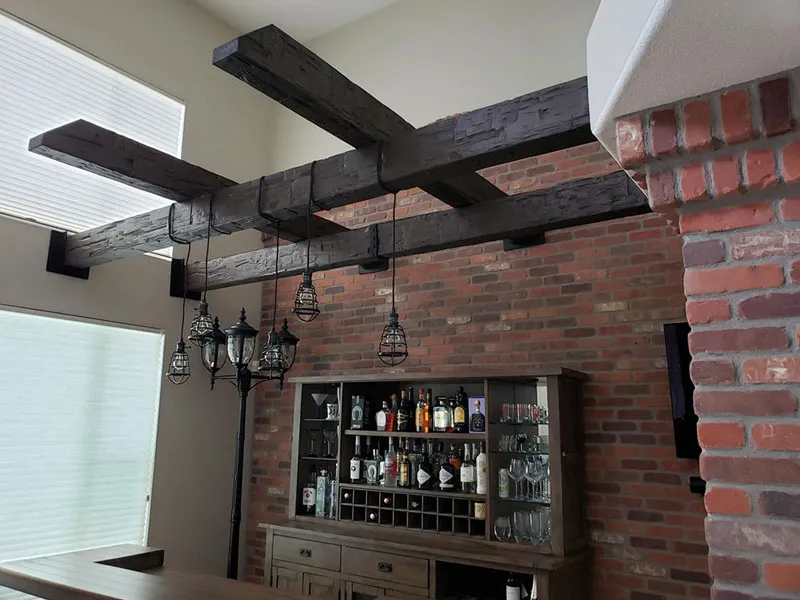
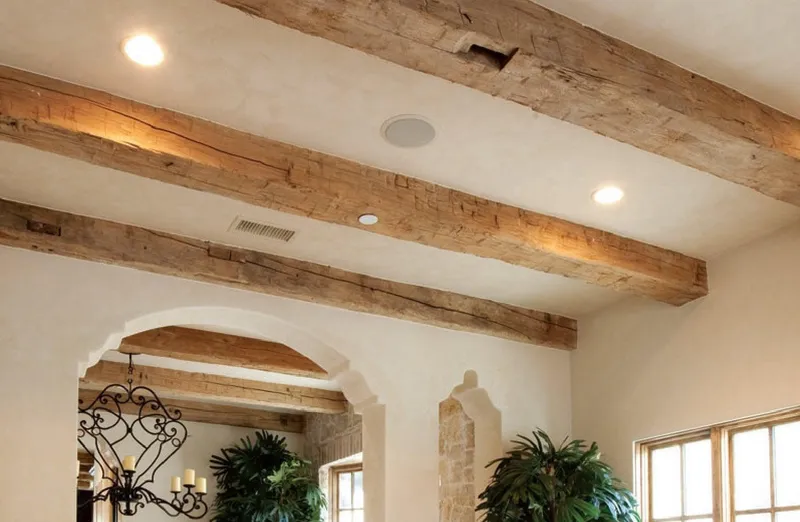
You’re standing in the living room, paint chips in one hand and a quote for “faux reclaimed wood ceiling beams” in the other, wondering if this is going to look like a magazine shoot or a theme restaurant. Your contractor says the polyurethane beams are “easy” and “maintenance‑free,” the reclaimed yard is trying to sell you a pile of heroic old timbers, and your architect is quietly suggesting a simple box beam instead. The choice isn’t about style boards; it’s about weight, maintenance, installation headaches, and how close anyone will ever get to those beams.
Here’s the blunt verdict: for most modern homes, especially vaulted ceilings and renovations, high‑density polyurethane faux reclaimed wood ceiling beams are the smartest default for non‑touchable, high ceilings; real‑wood box beams win when the beams are near eye level and need to pass the “up close” test; solid reclaimed beams are a niche, heavy, high‑maintenance passion project best reserved for clients who genuinely care more about authenticity than convenience.
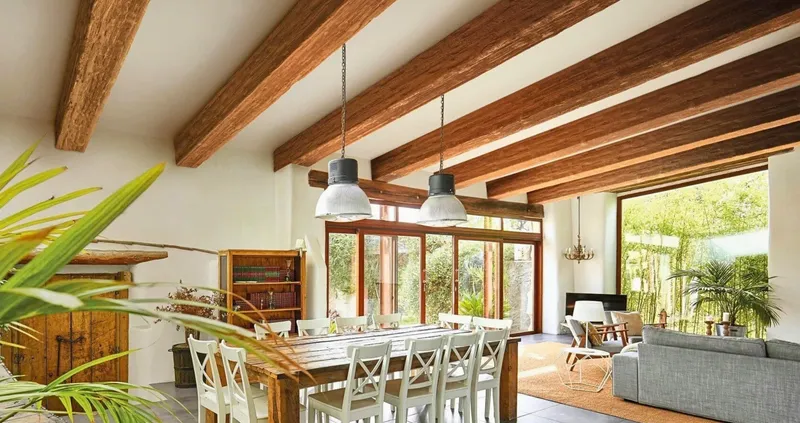
| Metric | Polyurethane faux reclaimed wood beams | Real-wood box beams (kiln-dried, faux reclaimed finish) | Solid reclaimed wood beams |
|---|---|---|---|
| Durability (published measure) | Not established | Not established | Douglas fir reclaimed beam may deliver ~100 years of additional service in a new structure[1] |
| Moisture / water resistance | Water absorption below 1%[2] | Kiln-dried lumber for interior beams should be at 6–8% moisture content for stability indoors[3][4] | Reclaimed timber has already reached equilibrium with outdoor conditions and adjusts only marginally indoors; movement that a new beam would have has largely already occurred[5][6] |
| VOC emission level (g/L) | Not established | Not established | Potential lead-based paint and chemical preservatives (CCA, pesticides) on older reclaimed wood; emissions level not quantified[7][8][9][10] |
| R-value / thermal resistance | Polyurethane rigid panels: 6.8–7.5 per inch when new, 5.5–6.25 per inch after 5–10 years[11][12][13][14] | Softwood reference: 1.41 per inch[15][16][17][18] | Softwood reference: 1.41 per inch[15][16][17][18] |
| Maintenance interval (years) | No periodic varnishing or impregnation renewal required for maintenance[19] | Not established | Reseal or re‑oil every 2–3 years indoors[20] |
| Cost per unit (m² and sq ft) | Not established | Not established | Material: $12–$40 per linear foot[21] (area-equivalent cost not established) |
Polyurethane faux reclaimed wood ceiling beams
Use these when you want drama overhead without turning your ceiling into an engineering problem. Polyurethane faux beams are hollow, non‑structural shells[22] with water absorption below 1%[2], which makes them ideal for lightweight ceiling beams on vaulted ceilings and retrofits where the existing structure won’t happily take a couple hundred pounds of timber.
From a living-with-it perspective, this is the least demanding option. The manufacturer explicitly says they require no periodic varnishing or impregnation renewal[19], so you’re not up on a ladder every few years nursing clear coat. Day to day you’re just dusting and occasionally wiping marks—your real “maintenance cost” is access, not product care.
Thermally, polyurethane is actually a small layer of insulation: newly manufactured rigid polyurethane panels are around R‑6.8 to R‑7.5 per inch[11][13], dropping to roughly R‑5.5 to R‑6.25 per inch after 5–10 years[12][14]. You’re not installing beams as an energy upgrade, but they’re certainly not making things worse.
The catch is installation quality. Beam mounting blocks or cleats should be installed every 3–4 ft (0.9–1.2 m) along the run[23], and these beams are explicitly non‑structural[22]. That means your crew must actually find joists, anchor properly, and respect that these are shells, not load‑bearing members. If they just glue them to drywall, you’ll see movement, gaps, or sagging, and the illusion dies fast.
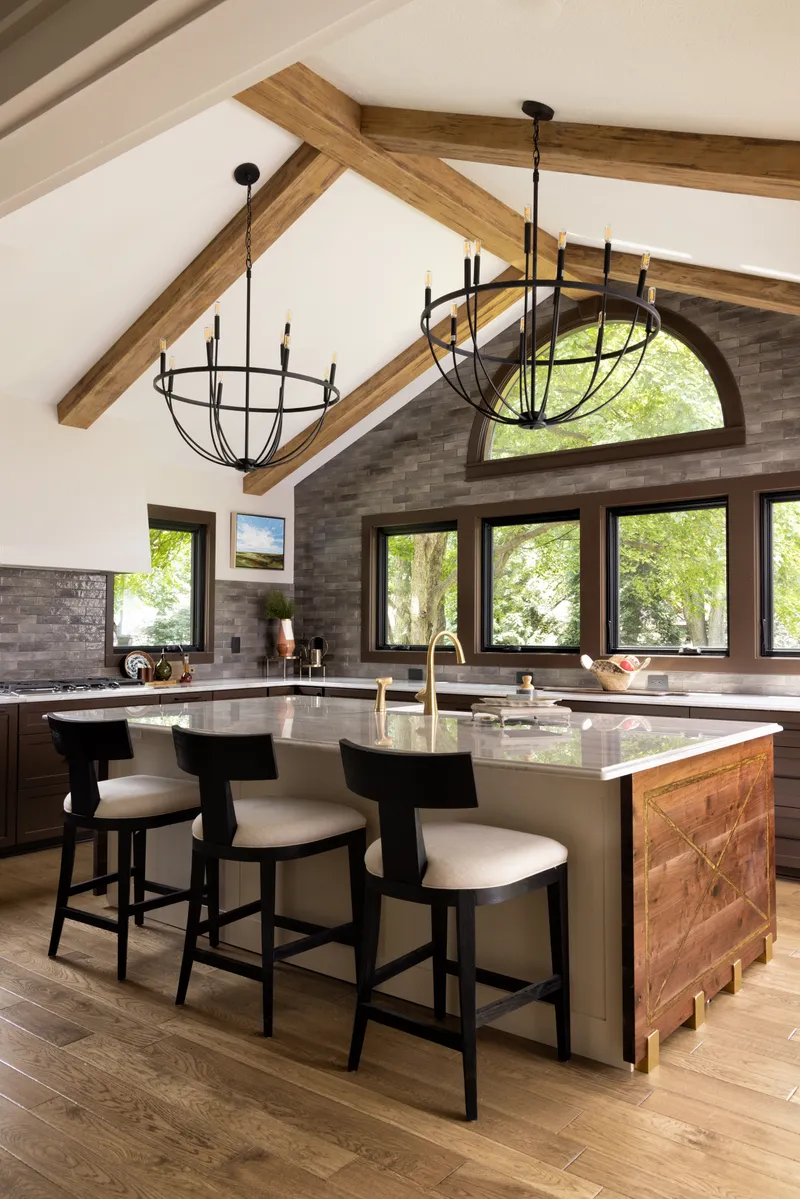
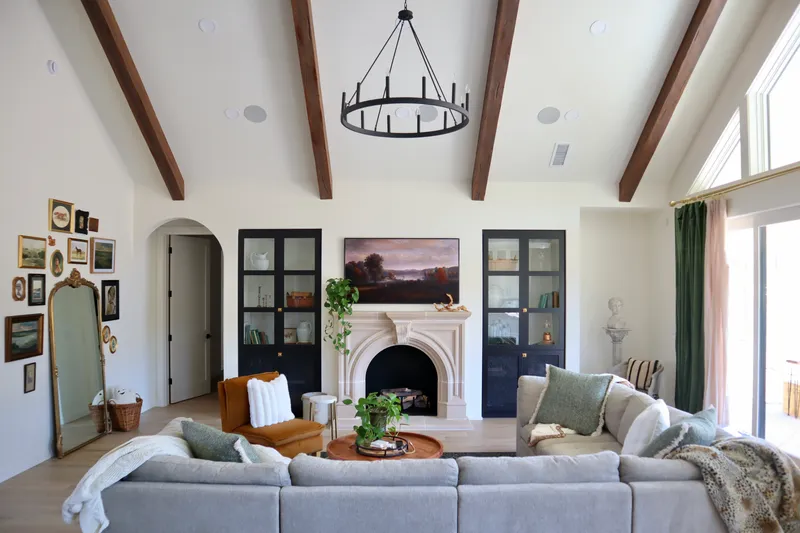
Design-wise, these only look good when they’re treated like real architecture, not craft‑store trim. Proportion, layout, and end details are everything. I’ve watched a well‑installed faux beam on a 16‑ft vaulted ceiling completely fool architects standing on the floor. I’ve also seen a cheap checkerboard of skinny faux beams turn a brand‑new living room into “theme bar in the suburbs.” The worst mistake with reclaimed wood look ceiling ideas is repetition: identical knots and distress marks across every beam make the ceiling read like a stamped laminate floor overhead.
My hard rule: I don’t use foam beams where people can touch them. Up close, seams, end cuts, and the surface texture betray the game; you end up with an expensive prop. Keep them high, treat the layout like you’re actually exposing structure, and obsess over the terminations into walls and ridge lines. If you aren’t willing to be that fussy, leave the ceiling plain and put the budget somewhere else.
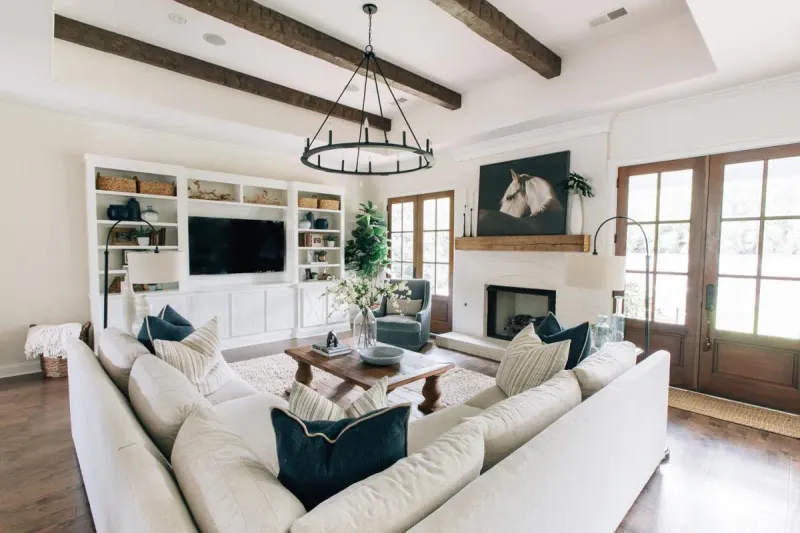

Real-wood box beams with a faux reclaimed finish
Box beams are the middle path: lighter and easier than massive reclaimed timbers, but far more convincing than foam when people are right underneath them. They’re typically built from kiln‑dried lumber, and for interior use that lumber should be down around 6–8% moisture content[3][4]. That moisture level is what keeps new cracks and splits under control indoors[3][4].
That stability is critical because box beams live or die at the seams. Wide boards that weren’t dried properly will cup, twist, or open up along mitres. With correctly dried stock, you’re starting from a much better place: less post‑installation movement, fewer surprise gaps.
Thermal performance here is typical softwood: about R‑1.41 per inch[15][16][17][18]. Again, not a reason to choose them, but it tells you they’re not a thermal bridge disaster either.
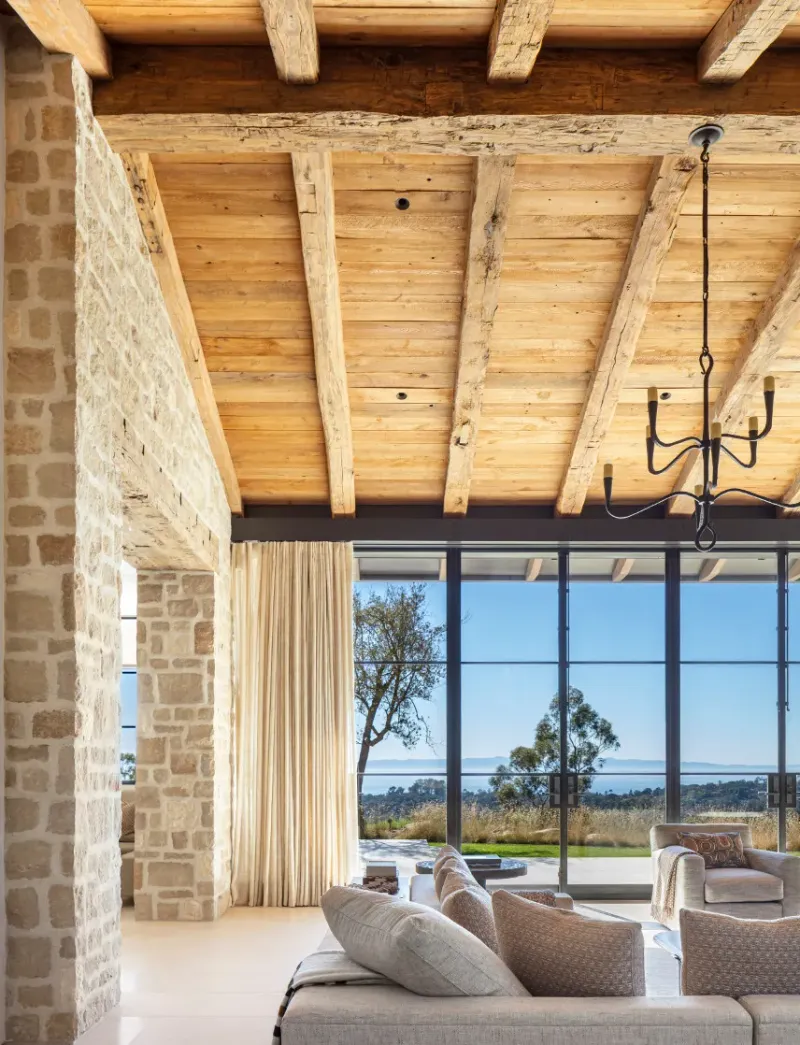
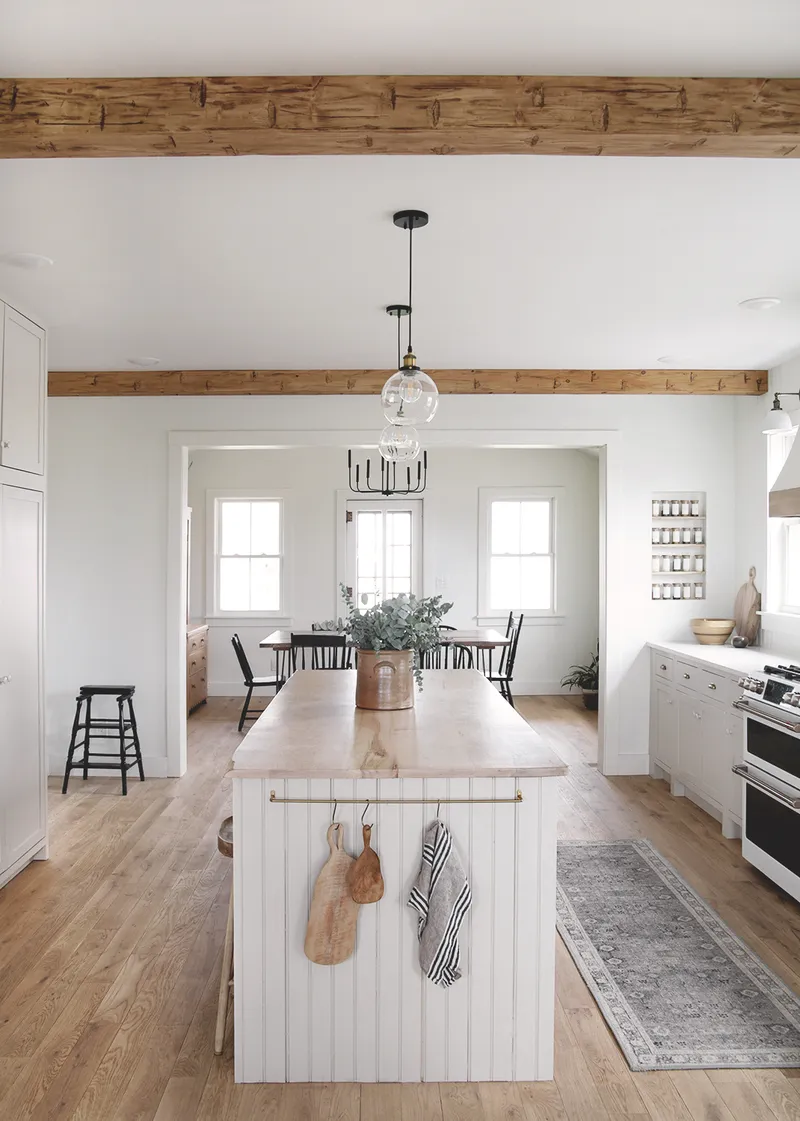
These are what I reach for when the beams are low, part of a rustic farmhouse ceiling design with beams over a kitchen island or in a family room, and people will see grain and joints at close range. Because they’re real wood, touch‑ups and future repairs are believable: you can sand, stain, distress a bit more, and it just looks like wood behaving like wood.
The trade-off is labour. Box beams are carpentry, not product. Boards need acclimating, joints need planning, and every intersection and end condition should be drawn once and then tested in real timber. When that’s done well, you get beams that feel like part of the house rather than a “decor package.” When it’s rushed, you see hairline seams, mismatched stain, and mitres that open after the first winter.
If your contractor shrugs off layout with “we’ll just grid them every three feet,” push back. A perfect grid of beams in a farmhouse living room screams “developer special.” I’d rather see three well‑scaled, properly aligned box beams that connect to the architecture—tying into a fireplace wall, framing a dining area—than a cheap checkerboard of fake rustic.
Key warning: there’s no published VOC or emission figure here, because the lumber is new and the finish depends on whatever your finisher chooses. If indoor air quality is a concern, you need to specify low‑VOC stains and topcoats and verify them locally; don’t assume “wood” is automatically clean.
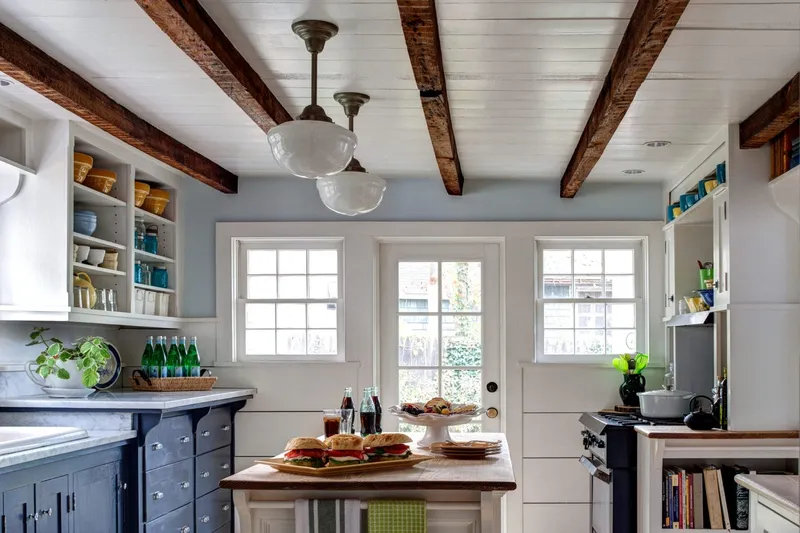

Solid reclaimed wood ceiling beams
Solid reclaimed beams are the full‑fat version: heavy, authentic, and fussy. When you get them right, you get a piece of history overhead. There’s published guidance that a Douglas fir beam harvested in the late nineteenth century, used for a hundred years, and then reclaimed and recut may still have another century of service ahead[1]. That’s serious durability.
These beams are also relatively stable in moisture terms because the big movements have already happened. Reclaimed timber has reached equilibrium with outdoor conditions over decades and will adjust only marginally when brought inside[5], and the shrinkage or twist you’d expect in a new beam has largely finished[6]. So you’re less likely to see dramatic new checks open after installation; the cracks you see are generally the cracks you get.
Thermally, they behave like other softwoods: about R‑1.41 per inch[15][16][17][18]. No surprises there. The real issues are cost, contaminants, and maintenance.
Cost-wise, reclaimed beams are not a budget move. Material alone is about $12–$40 per linear foot[21], with larger and heavier timbers at the top of that range[21]. Installed cost will be higher, but there’s no reliable per‑square‑foot figure to quote; local labour and rigging drive it. Always confirm current pricing with your supplier or contractor before locking this into a design.
Chemically, reclaimed wood can be a minefield. Wood from pre‑1978 structures may carry lead‑based paint or legacy toxic finishes[7][8][9], and beams from agricultural or industrial buildings can contain preservatives such as chromated copper arsenate (CCA) and pesticide residues[7][10]. Soft spots that compress under hand pressure, persistent musty odours, or confirmed lead or pesticide contamination are flagged as disqualifying in kitchen use[24], and the same logic applies to any interior room people occupy. Attempting to “seal over” compromised reclaimed wood just creates a false sense of safety while damage continues underneath[25].
On top of that, you have ongoing care: interior reclaimed wood beams should be resealed or re‑oiled every 2–3 years to maintain finish and help prevent drying cracks[20]. That’s ladders, tarps, and disruption baked into your life. If you want low‑maintenance, this is not that.
So when are these worth it? When the project truly needs real heft and history: historic renovations, high‑end rustic homes, statement great rooms where the whole design orbits around those beams. And when you’re ready to pay not just for the wood but for proper inspection (for metal, rot, and contaminants), engineering of supports, and a realistic maintenance plan.
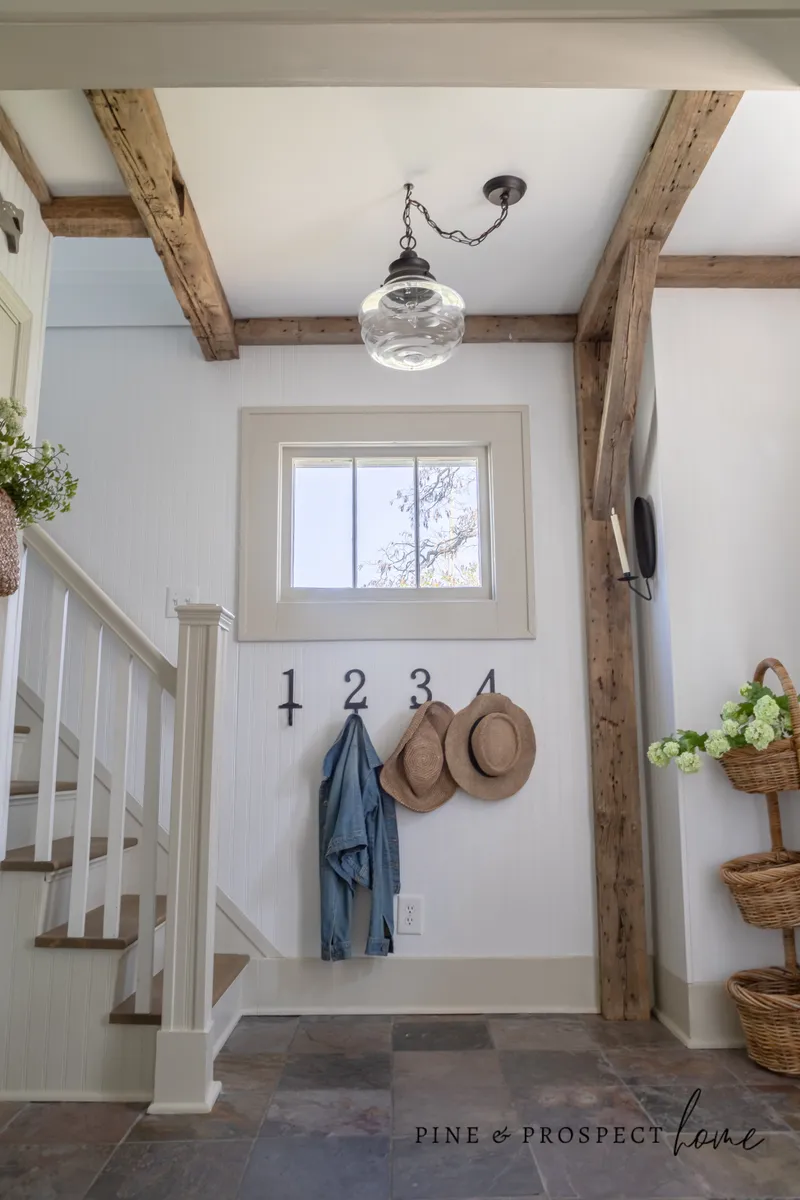

Which one should you choose?
Let’s cut through scenarios.
Vaulted ceilings or retrofits with limited structure
Polyurethane faux reclaimed wood beams win. They’re non‑structural by design[22], extremely light, and mounted on blocks every 3–4 ft[23], which keeps the load small and distributed. I’ve watched crews wrestle 300‑pound “authentic” beams into a vaulted ceiling for a result that looks identical from the floor to a well‑installed foam beam that went up in an afternoon. For tall rooms where no one will touch them, polyurethane is the right tool.
Low ceilings, kitchens, and anywhere people can touch the beams
Box beams in real wood are the honest answer. Up close, foam always gives itself away, especially at seams, edges, and cut ends. You get better tactile quality, easier touch‑ups, and you’re working with kiln‑dried lumber sitting at a controlled 6–8% moisture content[3][4]. Just insist on a thoughtful layout instead of a lazy grid.
High-end rustic great room or historic house where authenticity matters more than hassle
Solid reclaimed beams earn their place here. A Douglas fir reclaimed beam with another potential century of service[1] and decades of movement already out of its system[5][6] brings a kind of presence nothing faux truly matches. But you must budget for $12–$40 per linear foot in material[21], regular resealing every 2–3 years[20], and proper screening for lead and chemical preservatives[7][8][9][10]. If that feels excessive, step back to a box beam.
Clients with chemical-sensitivity or strict indoor air goals
There is no published VOC number for any of these in the facts above. Reclaimed wood, in particular, may carry lead and other toxins from old coatings[7][8][9][10]. If health is a core driver, you should treat every option as a spec exercise: demand finish and coating data from suppliers, consider new kiln‑dried lumber with known low‑VOC finishes, and consult local building and health professionals before committing.
“I want rustic farmhouse beams, but I hate cleaning and maintenance”
Polyurethane wins again. Maintenance-free finish[19] means your only recurring job is dusting, whereas reclaimed beams are on a 2–3‑year reseal cycle[20]. The trick is restraint: one or two substantial faux beams, well‑placed, will look far more expensive than a dark, chunky beam every three feet.
Across all these: if no one on your team is willing to obsess over proportion, layout, and end details, don’t install beams at all. A plain, clean ceiling is less disappointing than an expensive, badly detailed grid of “rustic” stripes.
Key facts
Show all 13 rows ▾Hide table ▴
| What it covers | Value | Source |
|---|---|---|
| Polyurethane faux beam water absorption | Below 1%[2] | Manufacturer water absorption rating[2] |
| Polyurethane faux beam maintenance | No periodic varnishing or impregnation renewal required[19] | Manufacturer maintenance guidance[19] |
| Faux beam mounting block spacing | Every 3–4 ft (0.9–1.2 m)[23] | Manufacturer installation instructions[23] |
| Faux beam structural role | Non‑structural, decorative only[22] | Manufacturer usage limitation[22] |
| Softwood R‑value | 1.41 per inch (approximate)[15][16][17][18] | Thermal performance references[15][16][17][18] |
| Polyurethane R‑value range | 6.8–7.5 per inch new; 5.5–6.25 per inch after 5–10 years[11][12][13][14] | Rigid polyurethane panel data[11][12][13][14] |
| Reclaimed Douglas fir beam service life | Potential additional ~100 years of service[1] | Case study of reclaimed beam reuse[1] |
| Reclaimed timber movement | Adjusts only marginally indoors; shrinkage/twist largely already occurred[5][6] | Guidance on reclaimed timber stability[5][6] |
| Reclaimed beam contaminants | May contain lead paint, toxic finishes, CCA, and pesticide residues[7][8][9][10] | Reclaimed wood safety guidance[7][8][9][10] |
| Reclaimed interior beam maintenance | Reseal or re‑oil every 2–3 years[20] | Interior reclaimed beam care guidance[20] |
| Reclaimed beam material cost | $12–$40 per linear foot[21] | US cost guidance for reclaimed beams[21] |
| Indoor kiln‑dried lumber moisture | 6–8% moisture content recommended[3][4] | Interior lumber drying standard[3][4] |
| Clearance to recessed lights | At least 1/2 in (12.7 mm) from combustible materials for non‑IC fixtures[26] | US DOE Building America guidance[26] |
Quick answers
Are polyurethane faux reclaimed wood ceiling beams really low maintenance?
Yes: manufacturers state that polyurethane faux wood beams require no periodic varnishing or impregnation renewal for maintenance[19]. You still need to dust them, but there’s no built‑in refinishing cycle like with oiled or sealed reclaimed wood beams, which typically need attention every 2–3 years[20]. Always confirm the specific finish requirements for the brand you’re buying.
How much do solid reclaimed wood ceiling beams cost compared with faux beams?
Published material costs for reclaimed wood beams are about $12–$40 per linear foot[21], while no equivalent per‑foot or per‑square‑foot figures are established in the facts for polyurethane faux beams. In practice, reclaimed beams usually end up as the premium option once you add handling, installation, and their 2–3‑year resealing cycle[20][21]. Get local quotes for both before committing, because labour rates and sourcing change quickly.
How long can reclaimed wood beams last indoors?
A Douglas fir beam that already served a hundred years in an industrial building may still have another century of service after being reclaimed and recut for a new structure[1]. That kind of service life assumes the beam is structurally sound, properly supported, and protected from ongoing moisture problems, so have any reclaimed timber evaluated by a qualified professional.
Do reclaimed wood beams move or crack much after installation?
Reclaimed timber has generally reached equilibrium with outdoor conditions and will adjust only marginally when brought into interior conditions[5], and the shrinkage or twist you’d expect in a new beam has largely already occurred[6]. You can still see surface checking and minor movement, but the big dimensional changes have usually happened long before you install it.
What R-value do faux reclaimed polyurethane beams add to a ceiling?
Rigid polyurethane has an R‑value of about 6.8–7.5 per inch when new[11][13], decreasing to roughly 5.5–6.25 per inch after 5–10 years[12][14]. In contrast, softwood used for real wood beams is around R‑1.41 per inch[15][16][17][18]. The beam depth and coverage area are usually small relative to the whole ceiling, so treat this as a minor thermal bonus, not a primary insulation strategy.
Are there safety concerns with reclaimed beams over a kitchen or living room?
Yes: reclaimed wood from pre‑1978 buildings may carry lead‑based paint or other toxic finishes[7][8][9], and pieces from agricultural or industrial structures can contain CCA preservatives and pesticide residues[7][10]. Guidance for kitchen use flags active rot, deep structural cracking, mold penetration, and confirmed lead or pesticide contamination as disqualifying conditions[27][24][25], and the same cautions apply anywhere indoors—have suspect beams tested and assessed before installation.
Sources
Facts last verified 2026-10-25.
- A Douglas fir beam harvested in the late nineteenth century and used for a hundred years in an industrial building, then reclaimed and recut for a new structure, may have another century of service ahead of it. — Site Persists, retrieved 2026-10-25.
A Douglas fir beam harvested from a primary forest in the late nineteenth century, used in an industrial building for a hundred years, reclaimed and recut for a new structure, may have another century…
- Polyurethane faux wood beams have water absorption below 1%. — Polure, retrieved 2026-10-25.
As the material has low water absorption (below 1%), it is safe in kitchens and bathrooms, and with UV-resistant paint it serves soffits and veranda ceilings outdoors.
- Kiln-dried lumber intended for interior use should be dried to a moisture content of 6% to 8%, which helps reduce the risk of new cracks and splits in decorative box beams. — Virginia Tech, retrieved 2026-10-25.
Lumber that is going to be used for interior uses should be dried to a moisture content of 6 percent to 8 percent.
- Kiln-dried lumber suitable for indoor use should have a moisture content of 6% to 8%; drying below 22% reduces the risk of creating new cracks and splits. — Virginia Tech, retrieved 2026-10-25.
Once the lumber dries below 22 percent moisture, the risk of creating new cracks and splits is low. Lumber that is going to be used for interior uses should be dried to a moisture content of 6 percent…
- Reclaimed timber has already reached equilibrium with outdoor conditions over decades and, once brought to interior conditions, will adjust only marginally. — Site Persists, retrieved 2026-10-25.
Reclaimed timber has already completed this process. It has reached equilibrium with outdoor conditions over decades and, once brought to interior conditions, will adjust only marginally.
- The movement (shrinkage or twist) that might be expected in a new beam has already occurred in reclaimed timber, as the wood has finished settling. — Site Persists, retrieved 2026-10-25.
The movement that might be expected in a new beam — a millimeter or two of shrinkage, a slight twist as the grain releases tension — has already occurred. The wood has finished settling. It is, in a m…
- Reclaimed wood sourced from structures built before 1978 may carry lead-based paint or legacy toxic finishes, and wood from agricultural or industrial buildings can contain chemical preservatives such as CCA. — Tar River Timber Works, retrieved 2026-10-25.
Reclaimed wood sourced from structures built before 1978 may carry lead-based paint or legacy toxic finishes, and wood from agricultural or industrial buildings can contain chemical preservatives such…
- Reclaimed wood can contain lead paint or toxic finishes when sourced from older structures. — Tar River Timber Works, retrieved 2026-10-25.
Reclaimed wood can contain lead paint or toxic finishes when sourced from older structures.
- The EPA states that approximately three-quarters of U.S. homes built before 1978 still contain lead-based paint, defined as any coating with at least 1 mg/cm² or 0.5% lead by dry weight, and wood salvaged from these buildings may carry that same coating. — Tar River Timber Works, retrieved 2026-10-25.
According to the EPA , approximately three-quarters of U.S. homes built before 1978 still contain lead-based paint, defined as any coating with at least 1 mg/cm² or 0.5% lead by dry weight . Wood salv…
- Reclaimed wood can contain pesticide or chemical residue, particularly when sourced from agricultural or industrial structures treated with chromated arsenicals (CCA). — Tar River Timber Works, retrieved 2026-10-25.
Reclaimed wood can contain pesticide or chemical residue, particularly when sourced from agricultural or industrial structures treated with chromated arsenicals (CCA).
- Newly manufactured polyurethane rigid panels (CFC/HCFC Expanded) have an R-value of 7.5 per inch. — LearnMetrics, retrieved 2026-10-25.
Polyurethane Rigid Panel (CFC/HCFC Expanded) New R-7.5 Per Inch
- After 5-10 years, polyurethane rigid panels (CFC/HCFC Expanded) have an R-value of 6.25 per inch. — LearnMetrics, retrieved 2026-10-25.
Polyurethane Rigid Panel (CFC/HCFC Expanded) After 5-10 Years R-6.25 Per Inch
- Newly manufactured polyurethane rigid panels (Pentane Expanded) have an R-value of 6.8 per inch. — LearnMetrics, retrieved 2026-10-25.
Polyurethane Rigid Panel (Pentane Expanded) New R-6.8 Per Inch
- After 5-10 years, polyurethane rigid panels (Pentane Expanded) have an R-value of 5.5 per inch. — LearnMetrics, retrieved 2026-10-25.
Polyurethane Rigid Panel (Pentane Expanded) After 5-10 Years R-5.5 Per Inch
- Softwood has an R-value of 1.41 per inch. — LearnMetrics, retrieved 2026-10-25.
Softwood R-1.41 Per Inch
- The R-value of softwood is approximately 1.41 per inch. — Frontier Log Homes, retrieved 2026-10-25.
The R-value of wood is roughly 1.41 per inch for softwoods and about 0.71 per inch for hardwoods, so a 6-inch solid log wall carries a clear-wall R-value of just over R-8.
- The R-value for wood ranges from about 1.41 per inch for most softwoods down to roughly 0.71 per inch for most dense hardwoods. — Frontier Log Homes, retrieved 2026-10-25.
The R-value for wood ranges from about 1.41 per inch (2.54 cm) for most softwoods down to roughly 0.71 per inch for most dense hardwoods.
- Cedar, spruce, pine and fir (softwoods) have an R-value of approximately 1.41 per inch. — Frontier Log Homes, retrieved 2026-10-25.
Cedar, spruce, pine and fir (softwoods): approximately R-1.41 per inch
- Polyurethane faux wood beams require no periodic varnishing or impregnation renewal for maintenance. — Polure, retrieved 2026-10-25.
Polyurethane beam, rafter and log surfaces are maintenance-free; no periodic varnishing or impregnation is needed.
- Interior reclaimed wood beams should be resealed or re-oiled every 2–3 years to maintain their finish and help prevent drying cracks. — Elite Ceiling Designs, retrieved 2026-10-25.
Interior beams should be re-sealed or re-oiled every 2–3 years to maintain their finish and prevent drying cracks.
- Reclaimed wood beams cost approximately $12–$40 per linear foot for material, with larger and heavier timbers costing more. — Design Transition Studio, retrieved 2026-10-25.
Typical ranges: 12-$40 per linear ft, with larger, heavier timbers reaching higher.
- Polyurethane faux wood beams are non-structural and should be used only for decorative purposes. — Heritage + TimberThane, retrieved 2026-10-25.
Beams are non-structural and should be used purely for decorative purposes.
- Faux wood ceiling beam mounting blocks should be installed every 3 to 4 feet along the beam. — Ekena Millwork, retrieved 2026-10-25.
It is recommended to use blocks of wood every 3 to 4 feet.
- Soft spots that compress under hand pressure, a persistent musty odor after drying, or confirmed lead or pesticide contamination are disqualifying conditions for reclaimed wood in kitchen use. — Tar River Timber Works, retrieved 2026-10-25.
However, soft spots that compress under hand pressure, a persistent musty odor after drying, or confirmed lead or pesticide contamination are disqualifying conditions.
- Attempting to seal over compromised reclaimed wood creates a false sense of safety while the underlying damage continues to progress beneath the surface. — Tar River Timber Works, retrieved 2026-10-25.
Attempting to seal over compromised wood creates a false sense of safety while the underlying damage continues to progress beneath the surface.
- A recessed luminaire not identified for insulation contact must be spaced at least 1/2 inch from combustible materials. — U.S. Department of Energy Building America Solution Center, retrieved 2026-10-25.
A recessed luminaire that is not identified for contact with insulation should have all recessed parts spaced at least ½ inch from combustible materials.
- Reclaimed wood is too damaged to salvage for kitchen use when it shows active rot, deep structural cracking, confirmed toxic chemical treatment (such as CCA), or extensive mold penetration beyond the surface layer. — Tar River Timber Works, retrieved 2026-10-25.
Reclaimed wood is too damaged to salvage for kitchen use when it shows active rot, deep structural cracking, confirmed toxic chemical treatment (such as CCA), or extensive mold penetration beyond the …