


You’re standing in a showroom, staring at two boards that look almost identical. One is “engineered,” one is “solid,” and the salesperson just told you, with a straight face, that both are “perfect for anywhere in the home.” You’re trying to decide what you’d put in your own house, not just what photographs well for a listing. That’s the real heart of the engineered vs solid hardwood flooring choice: not which is more “premium,” but which one survives your slab, your climate, your family, and your tolerance for future work.
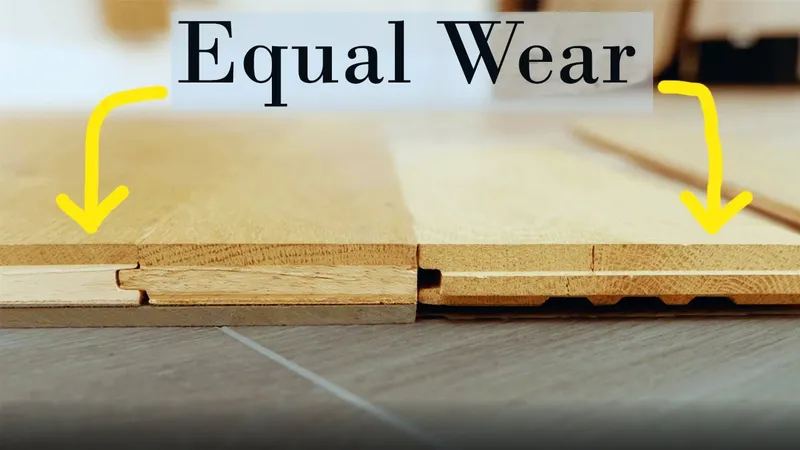
Here’s the blunt version. In dry, stable, above-grade rooms where you care about sanding and refinishing for decades, solid hardwood wins. In basements, on concrete, over radiant heat, or in any house with wobbly humidity, a serious, well-built engineered floor is the grown-up choice—and in my projects that’s usually the default. If it’s on a slab or in a real basement and the client insists on solid, I either talk them out of it or walk away.
| Metric | Engineered hardwood flooring | Solid hardwood flooring |
|---|---|---|
| Durability | 35-year residential finish warranty (Mercier Generations on engineered) [1]; up to 50-year residential finish warranty (Mercier Generations Intact 2500 on engineered) [2] | Predicted 100+ year life expectancy for wood floors [3] |
| Moisture / water resistance | Approved for basements, first floors, and upper floors [4]; can be installed below grade when a moisture barrier such as Selitac Thermally Insulating Underlayment or Silent Step Ultra 3 in 1 is used [5]; product will expand if moisture content rises beyond 9% [6] | Compatible with basements only when dry and weather-tight, basement RH not more than 10 percentage points higher than upper floors, and installed above grade or on grade, not below grade [7]; requires controlled humidity between 50% and 65% and temperature around 20 °C (68 °F) to limit shrinkage and swelling [8]; all wood floors affected by subfloor moisture and RH conditions [9] |
| VOC emission level (g/L) | VOC-free and formaldehyde-free finish according to ASTM D‑5116 [10]; Greenguard Gold indoor air quality certification for all species, widths, and colors [11]; Greenguard Gold criteria cap predicted formaldehyde at 9 μg/m³ (7.3 ppb) [12] and total aldehydes at 0.043 ppm [13] | Not established |
| R-value / thermal resistance | 15 mm (0.59 in) engineered board loses 0.08 K/W·m² according to EN ISO 10456 / EN ISO 12664 [14] | 15 mm Spruce solid wood: thermal resistance 0.12 m²K/W [15]; 19 mm Spruce: 0.15 m²K/W [16]; 25 mm Spruce: 0.19 m²K/W [17]; 19 mm Pine: 0.15 m²K/W [18] |
| Maintenance interval (years) | Not established | Maintenance coat recommended every 3–5 years [19]; sanding and refinishing every few decades [19] |
| Cost per unit (m² and sq ft) | Not established | Not established |
Engineered hardwood flooring
If your project touches a basement, a concrete slab, or a house that goes bone-dry in winter and swampy in summer, this is where I start. Engineered isn’t the “cheap fake” many people imagine; it’s a real-wood wear layer over a layered core designed to move less when humidity swings. That reduced movement is why major manufacturers explicitly approve engineered for basements, first floors, and upper floors [4], and why Shaw will let you go below grade at all—if you use a proper moisture barrier under it [5]. You can see typical construction differences in solid hardwood vs engineered flooring guides from major brands.

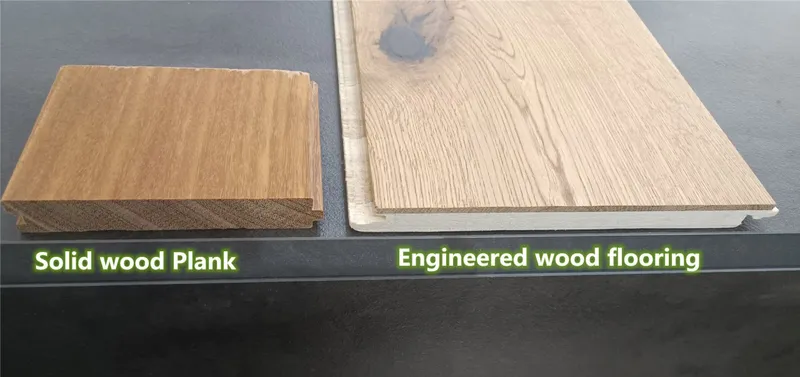
That “if” is doing a lot of work. Engineered wood still expands when its moisture content climbs beyond 9% [6]. The slab, the crawl space, the wet mopping habit, the un-air-conditioned vacation home—they can all push it there. When that happens, you don’t get a neat, tidy failure. You get edges that peak, joints that open, hollow sounds where the glue bond lost its grip, or planks that start to move when you walk across them. In basements, failure starts visually with cupping or crowned seams long before you’re ripping whole areas back up.
On the flip side, run the house too dry for too long and you can see “dry cupping,” where the top layer shrinks and pulls the plank edges upward because relative humidity sits below the manufacturer’s range [20]. This is where the NWFA’s guidance to keep indoor RH between 30% and 50% for wood floors [21] is not a suggestion; it’s a survival rule. I’ve watched beautiful floors in fancy homes crater simply because the HVAC was never set up to control humidity.
Durability-wise, ignore marketing fluff and look at two things: finish system and wear-layer thickness. A product like Mercier’s engineered lines can carry a 35-year residential finish warranty [1], and their higher-spec Generations Intact 2500 finish stretches that to 50 years [2]. That’s not a promise the dog can’t scratch it; it’s an indicator that the finish chemistry and abrasion resistance (tested under standards like Nema LD3’s Taber test [22]) are serious. Pair that with a wear layer thick enough to qualify under the NWFA refinishable program—at least 3.2 mm for unfinished and 2.5 mm for factory-finished [23]—and you’ve got a floor that can be renovated later instead of thrown away at the first sign of real damage.
This is exactly why I care more about construction than logo when clients ask for the “best engineered hardwood flooring brands compared to solid wood.” A boring, reputable producer with a 4 mm wear layer and a solid finish will quietly outlast a “designer” line of paper-thin veneers you can never safely sand. Below that 3/32 in wear layer threshold, NWFA explicitly says: don’t sand it [23].
On indoor air quality, good engineered flooring can actually be the safer bet for sensitive clients. You can buy products with VOC-free, formaldehyde-free factory finishes tested under ASTM D‑5116 [10], and with Greenguard Gold certification across all species and colors [11]. Greenguard Gold criteria are tight: predicted formaldehyde capped at 9 μg/m³ (7.3 ppb) [12] and total aldehydes at 0.043 ppm [13]. That’s not “zero,” but it’s low enough for schools and healthcare projects. Site-applied finishes on solid floors can be just as safe, but only if you pick the right products and manage ventilation properly.
Thermally, a 15 mm engineered board loses 0.08 K/W·m² [14], which in practice plays nicely with radiant systems. That low resistance is exactly why engineered is usually the safer choice over in-floor heat: less movement stress on boards when temperatures cycle.
Where engineered disappoints is when people treat it like indestructible plastic. Drag a sofa across it, let grit pile up at the entry, or run chairs without pads, and you’ll chew up the finish just as fast as on solid. Once deep damage hits the veneer, your repair options narrow fast unless you bought that thicker-wear-layer, refinishable product. And no, a floating install is not a license to ignore a wavy or dusty slab; those shortcuts just move the problem into the future.
Solid hardwood flooring
In a dry, conditioned, above-grade room on a wood subfloor, solid hardwood is still the king. It’s familiar to every installer, forgiving to sand, and brutally simple as a concept: one species, one solid piece. Get the environment right and the life expectancy is measured in generations, not decades—wood floors in general are predicted at 100+ years [3]. That’s the appeal if you’re thinking like a long-term owner rather than a flipper.

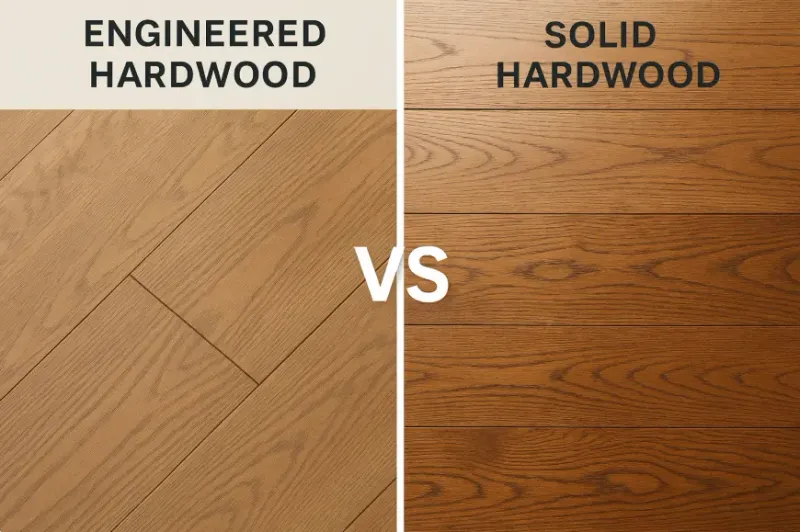
What you buy with solid isn’t magic “extra durability.” It’s repair margin. There’s more wood above the tongue, which means you can sand and refinish hard, change colors, and clean up serious damage multiple times across those decades. NWFA suggests full sanding and refinishing only every few decades, with lighter maintenance coats every 3–5 years [19]. In real life, almost nobody keeps that schedule perfectly, but it’s a realistic frame for how long a properly installed solid floor can look good before major surgery.
Where solid bites back is moisture movement. Oak, for example, averages around 0.26% shrinkage in width [24], and that’s driven by shifts in the wood’s moisture content, which is why FEEL WOOD ships its solid floors at a controlled 9 ± 2% moisture content [25]. Let relative humidity wander outside the recommended 50–65% band at around 20 °C (68 °F) [8] and you start to see what manufacturers list as classic failure modes: gapping, cupping, crowning, buckling, cracking, splitting, checking, and warping [26]. Drop RH below 35% and checking, cracking, splitting, splinters, warping, and bowing become much more likely [27]. I’ve seen beautiful site-finished oak floors go from tight and elegant to gap-riddled and noisy in one bad heating season.
Basements and damp slabs are where solid is most often mis-sold. The nuance: NWFA and manufacturers allow wood flooring in basements and crawl spaces only when those areas are dry and subfloor moisture is within range [9]. Hallmark goes further for solid hardwood: the basement must be dry and weather-tight, its relative humidity no more than 10 percentage points higher than upper floors, and the flooring installed above grade or on grade, not below grade [7]. Those aren’t fussy technicalities. They are the line between “floor that lasts 50 years” and “floor that fails after the first wet spring.” For more on this trade-off, some pros lay out a hardwood vs engineered wood flooring comparison focused on long-term performance.
When solid is used over screeds, the moisture specs are precise. For calcium sulphate screeds, residual moisture must be ≤0.5 CM-% unheated and ≤0.3 CM-% heated [28]. For cement screeds, ≤2.0 CM-% unheated and ≤1.8 CM-% heated [29]. I’ve never met a DIYer who actually measured this, which is one reason I don’t recommend bare concrete plus solid wood as a casual weekend project.
On the standards side, decent solid products are milled under EN 13990 (softwood) or EN 13629 (hardwood) [30], and any serious installer should be working from NWFA guidelines [9]. They define how you acclimate, how you measure, and what’s “within spec” when something goes wrong.
Thermal resistance is a touch higher than engineered: 15 mm Spruce solid flooring sits at 0.12 m²K/W [15], 19 mm at 0.15 m²K/W [16], 25 mm at 0.19 m²K/W [17], and 19 mm Pine also at 0.15 m²K/W [18]. Those numbers matter if you’re stacking materials over radiant—too much resistance and the system underperforms—but they’re right in the range radiant designers expect.
Living with solid hardwood feels more “alive.” It will open hairline gaps in dry seasons and close them in humid ones. The finish will wear in traffic lanes. The floor will develop dents and patina. If you’re the sort of person who sees that as character, you’ll probably love it. If you expect a showroom-flat surface forever, you’ll be calling your installer every winter, furious about gaps that are doing exactly what the material is supposed to do.
Where I unapologetically push solid is when a client has a stable, conditioned, above-grade wood subfloor and a genuine obsession with future refinishing—changing stain colors, fixing deep damage instead of replacing boards, running the same floor for 40 years. In that narrow but important lane, engineered simply can’t match the long-term flexibility of solid, no matter how good the finish warranty is. If you’re still torn, it helps to walk through a detailed solid vs engineered hardwood guide that breaks down use cases room by room.
Which one should you choose?
Let’s skip the vague “it depends” dodge and match engineered vs solid hardwood flooring to real-world scenarios.

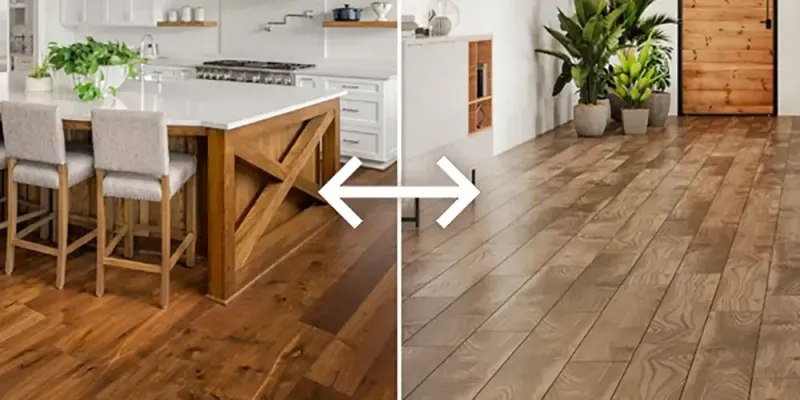
Basements, slabs, and radiant heat
On a slab or in a true basement, I default to engineered or I walk away. Manufacturers explicitly approve engineered for basements and all levels [4], and Shaw allows below-grade installs with a proper moisture barrier under it [5]. Solid hardwood, by contrast, is only considered compatible with basements when they are dry, weather-tight, within tight humidity differences to upper floors, and the flooring is installed above grade or on grade—not below grade [7]. In practice, that “perfect” basement is rare. Winner here: engineered, every time.
Whole-house remodel, mixed substrates
If you’ve got concrete downstairs and wood joists upstairs, the most expensive-looking result is usually one high-quality engineered line run everywhere. You avoid height jumps, transition strips, and the patchwork look of mixing solid upstairs with something cheaper over slab. Thermally, engineered’s 15 mm board with 0.08 K/W·m² loss [14] works fine over radiant and regular heating, and durability can be excellent with 35–50 year finish warranties [1][2]. Winner: engineered, preferably a refinishable line that meets NWFA wear-layer thresholds [23].
Dry, above-grade rooms where you plan to live for decades
Here’s where solid earns its keep. On a stable wood subfloor, in rooms where you can control humidity roughly in the 50–65% range at around 20 °C [8], you get a floor with a predicted life of 100+ years [3] and the ability to sand it hard every few decades [19]. If your priority is long-term refinishability and repair, solid wins—and you should budget for proper maintenance coats every 3–5 years [19].
High-traffic family homes and pets
For hallways, kitchens, kids, and dogs, construction matters less than finish quality. Engineered with a tough, long-warranty factory finish (35–50 years [1][2]) can absolutely hold its own, and sometimes outperform a softer, site-finished solid floor. In these rooms my bias is: pick the product—engineered or solid—with the best-warranted finish system and a realistic plan for maintenance, not the one with the most romantic story.
Moisture-marginal houses (vacation homes, big humidity swings)
In homes that sit closed part of the year, or in climates with wild humidity swings, I lean engineered. It still needs indoor RH in the recommended 30–50% band [21], but its cross-layer build gives you more margin than a solid board that can gap, cup, crown, or warp when humidity drifts out of range [26][27]. Solid is just less forgiving if you’re not around to babysit the thermostat and dehumidifier.
Whatever you choose, treat all the moisture and climate numbers as minimum safety checks, not nice-to-have extras. Before you spend real money, have a qualified local pro test the slab or subfloor, verify humidity, and confirm that your installation plan lines up with NWFA guidance [9][21]. Manufacturer warranties are written around those conditions; ignore them and you’re very much on your own. If you want another angle on the engineered vs solid decision, there’s also a concise solid wood vs engineered wood overview that walks through real-world pros and cons.
Key facts
Show all 12 rows ▾Hide table ▴
| What it covers | Value | Source |
|---|---|---|
| Engineered finish warranty – standard line | 35-year residential finish warranty on Mercier Generations engineered hardwood [1] | Mercier Wood Flooring (manufacturer) [1] |
| Engineered finish warranty – high-performance line | 50-year residential finish warranty on Mercier Generations Intact 2500 engineered hardwood [2] | Mercier Wood Flooring (manufacturer) [2] |
| Predicted life expectancy of wood floors | 100+ years for wood floors in general [3] | Spotlight Home Inspection (blog) [3] |
| Engineered oak wear-layer hardness | White Oak engineered wear layer: 1,360 lbf Janka hardness [31] | Mercier Wood Flooring (manufacturer) [31] |
| Engineered emissions and certification | VOC-free, formaldehyde-free finish (ASTM D‑5116) [10]; Greenguard Gold certified for all SKUs [11] | Mercier Wood Flooring (manufacturer); Gresart (manufacturer) [10][11][12][13] |
| Engineered humidity recommendation | Maintain indoor relative humidity between 30% and 50% for wood floors [21] | National Wood Flooring Association [21] |
| Solid wood shipped moisture content | 9 ± 2% moisture content at delivery for FEEL WOOD solid flooring [25] | FEEL WOOD (manufacturer) [25] |
| Solid wood recommended humidity and temperature | Indoor humidity 50–65% and temperature around 20 °C (68 °F) [8] | FEEL WOOD (manufacturer) [8] |
| Engineered refinishable wear-layer minimum | ≥3.2 mm for unfinished, ≥2.5 mm for factory-finished; below 3/32 in should not be sanded [23] | National Wood Flooring Association [23] |
| Solid floor maintenance intervals | Maintenance coat every 3–5 years; sanding and refinishing every few decades [19] | National Wood Flooring Association [19] |
| Common engineered failure modes | Dry cupping from low RH [20]; delamination as separation at glue line [32] | Hardwood Floors Magazine (trade) [20][32] |
| Common solid failure modes | Gapping, cupping, crowning, buckling, cracking, splitting, checking, warping when RH is uncontrolled or too low [26][27] | Johnson Hardwood (manufacturer) [26][27] |
Quick answers
Is engineered hardwood more durable than solid hardwood?
Engineered flooring can carry finish warranties of 35 years [1] and up to 50 years [2], while solid wood floors have a predicted life expectancy of 100+ years [3]. The practical difference is that engineered’s finish is guaranteed for decades, whereas solid’s big advantage is that it can be sanded and refinished multiple times across that 100+ year span.
Which is better for basements: engineered or solid hardwood?
Engineered is clearly safer for basements: it’s explicitly approved for basement and below-grade use when paired with a proper moisture barrier [5][4]. Solid hardwood is only considered compatible with basements when they are dry, weather-tight, with basement humidity very close to upper floors, and installed above grade or on grade rather than below grade [7], which is a much tighter—and rarely met—set of conditions.
How often do solid hardwood floors need maintenance or refinishing?
Solid hardwood floors should receive a maintenance coat every 3–5 years [19], with full sanding and refinishing only every few decades [19]. Those intervals assume normal residential use and indoor humidity kept within the recommended range [8].
Can engineered hardwood be refinished like solid hardwood?
Engineered hardwood can be sanded and refinished only if its wear layer meets NWFA’s minimum thickness—3.2 mm for unfinished and 2.5 mm for factory-finished products [23]. Floors with wear layers below 3/32 in should not be sanded at all [23], whereas solid hardwood generally has much more material available for repeated refinishing.
Which has better indoor air quality: engineered vs solid hardwood flooring?
High-quality engineered products can offer excellent indoor air performance, with VOC-free and formaldehyde-free finishes tested under ASTM D‑5116 [10] and Greenguard Gold certification limiting predicted formaldehyde to 9 μg/m³ [12] and total aldehydes to 0.043 ppm [13]. Solid hardwood can be just as clean if finished with low-emission products, but specific emission levels depend entirely on the finish system chosen for that floor.
How do engineered and solid hardwood compare for thermal performance over radiant heat?
A 15 mm engineered wood board has a thermal loss of 0.08 K/W·m² [14], while solid Spruce at similar or greater thickness ranges from 0.12 to 0.19 m²K/W in thermal resistance [15][16][17]. That lower resistance makes engineered slightly more responsive and often preferred over radiant heating systems, provided all moisture and humidity requirements are met.
Sources
Facts last verified 2026-11-05.
- Mercier Generations Finish on engineered hardwood flooring has a warranty of 35 years for normal residential use. — Mercier Wood Flooring, retrieved 2026-11-05.
35 years for normal residential use
- Mercier Generations Intact 2500 Finish on engineered hardwood flooring has a warranty of 50 years for normal residential use. — Mercier Wood Flooring, retrieved 2026-11-05.
50 years for normal residential use
- All wood floors have a predicted life expectancy of 100+ years. — Spotlight Home Inspection, retrieved 2026-11-05.
All Wood Floors …………………………………………………………………………………………… 100+
- Engineered hardwood flooring can be installed in basements, first floors, and upper floors. — Mercier Wood Flooring, retrieved 2026-11-05.
Installation sites Basement, first floor and upper floors
- Shaw engineered hardwood flooring can be installed below grade when a moisture barrier is used during installation. — Shaw Floors, retrieved 2026-11-05.
The construction of an engineered hardwood gives it enhanced structural stability that allows it to be installed at any grade level when a moisture barrier such as Selitac Thermally Insulating Underla…
- Engineered wood flooring will expand if it is exposed to conditions that increase its moisture content beyond 9%. — The Solid Wood Flooring Company, retrieved 2026-11-05.
Wood flooring will expand if it is exposed to conditions that increases its moisture content beyond 9%.
- Solid hardwood flooring is compatible with basements only when the basement is dry and weather-tight, its relative humidity is no more than 10 percentage points higher than that of the upper floors, and the flooring is installed above grade or on grade rather than below grade. — Hallmark Floors, retrieved 2026-11-05.
1. Basement should be free of all moisture and be weather tight. 2. Relative humidity of basements should not be more than 10% higher than the upper floors.
- For solid wood flooring, humidity levels should be controlled within the 50% and 65% range and a temperature around 20 °C to prevent excessive shrinkage and swelling. — FEEL WOOD, retrieved 2026-11-05.
Care should be taken to control humidity levels within the 50 and 65 % range and a temperature around 20 °C will prevent excessiv shrinkage and swelling in your hardwood floor.
- NWFA installation guidance requires basements and crawl spaces to be dry before wood flooring installation, with subfloor moisture within the product manufacturer’s specified range. — NWFA, retrieved 2026-11-05.
Basements and crawl spaces must be dry.
- Mercier engineered hardwood flooring finish is VOC-free and formaldehyde-free according to ASTM D-5116. — Mercier Wood Flooring, retrieved 2026-11-05.
VOC-free and formaldehyde-free finish: ASTM D-5116
- Mercier engineered hardwood flooring has Greenguard Gold certification for all species, widths, and colors. — Mercier Wood Flooring, retrieved 2026-11-05.
Greenguard Gold certification: Applies to all species, widths and colors.
- The GREENGUARD Gold Certification Criteria for Building Products and Interior Finishes specify a maximum allowable predicted formaldehyde concentration of 9 μg/m³ (7.3 ppb). — Gresart, retrieved 2026-11-05.
Formaldehyde 50-00-0 9 (7.3 ppb) μg/m³
- The GREENGUARD Gold Certification Criteria for Building Products and Interior Finishes specify a maximum allowable predicted total aldehydes concentration of 0.043 ppm. — Gresart, retrieved 2026-11-05.
Total Aldehydes (B) – 0.043 ppm
- 15mm thick engineered wood flooring boards with a 4mm or 6mm top layer will lose 0.08 K/Wm2. — The Solid Wood Flooring Company, retrieved 2026-11-05.
15mm boards with a 4mm or 6mm top layer will lose 0.08 K/Wm2
- FEEL WOOD 15 mm thick Spruce solid wood flooring has a thermal resistance of 0.12 m²K/W. — FEEL WOOD, retrieved 2026-11-05.
Spruce 0,13 0,12 15 135
- FEEL WOOD 19 mm thick Spruce solid wood flooring has a thermal resistance of 0.15 m²K/W. — FEEL WOOD, retrieved 2026-11-05.
Spruce 0,13 0,15 19 135
- FEEL WOOD 25 mm thick Spruce solid wood flooring has a thermal resistance of 0.19 m²K/W. — FEEL WOOD, retrieved 2026-11-05.
Spruce 0,13 0,19 25 135
- FEEL WOOD 19 mm thick Pine solid wood flooring has a thermal resistance of 0.15 m²K/W. — FEEL WOOD, retrieved 2026-11-05.
Pine 0,13 0,15 19 135
- NWFA recommends sanding and refinishing residential wood floors every few decades, while applying a maintenance coat every 3–5 years. — National Wood Flooring Association, retrieved 2026-11-05.
every 3-5 years Maintenance coat every few decades Sand and refinish
- Engineered hardwood can develop dry cupping when relative humidity remains below the manufacturer’s recommendations because the top wear layer loses moisture and shrinks across its face, pulling the plank edges upward. — Hardwood Floors Magazine, retrieved 2026-11-05.
When relative humidity levels remain below the manufacturer’s recommendations for long enough, engineered planks can begin to dry cup. When this happens, the top lamina/wear layer loses moisture and b…
- NWFA recommends maintaining indoor relative humidity between 30% and 50% for wood flooring in normal household environments. — National Wood Flooring Association, retrieved 2026-11-05.
environment is controlled to stay within a relative humidity range between 30% to 50% and a temperature range between 60-80 degrees Fahrenheit.
- Nema LD3 is a standard used for abrasion resistance testing (Taber test). — Mercier Wood Flooring, retrieved 2026-11-05.
Abrasion resistant finish (Taber test) Mercier Generations finish: Nema LD3: 1 000 cycles Generations Intact 2500 finish: Nema LD3: 2 500 cycles
- NWFA’s engineered-wood refinishable program requires a minimum wear-layer thickness of 3.2 mm for unfinished products and 2.5 mm for factory-finished products, and NWFA states that floors with wear thickness below 3/32 inch should not be sanded. — National Wood Flooring Association, retrieved 2026-11-05.
2. Unfinished Wood Flooring Products, shall have a minimum wear layer thickness of 3.2mm. 3. Factory Finished Wood Flooring Products, shall have a minimum wear layer thickness of 2.5mm.
- The shrinkage in width of oak solid wood flooring, similar to ash, averages around 0.26%. — FEEL WOOD, retrieved 2026-11-05.
The shrinkage in the width of oak (similar to ash) is in average around 0,26 %.
- FEEL WOOD solid wood flooring is delivered with a guaranteed wood moisture content of 9 +/- 2%. — FEEL WOOD, retrieved 2026-11-05.
The FEEL WOOD solid wood flooring will be delivered with a guaranteed wood moisture content of 9 +/- 2 % and installed in a room with relative air humidity of 50 – 65 %.
- Common documented failure modes for solid hardwood flooring include gapping, cupping, crowning, buckling, cracking, splitting, checking, and warping when moisture conditions are uncontrolled or relative humidity falls below the recommended range. — Johnson Hardwood, retrieved 2026-11-05.
The homeowner/end-user **MUST** be made aware of the effect that moisture has on wood flooring e.g., moisture gain can result in wood rot, discoloration, development of mold, finish blisters, finish f…
- Solid hardwood flooring can develop gapping, checking, cracking, splitting, splinters, warping, and bowing when relative humidity falls below 35%. — Johnson Hardwood, retrieved 2026-11-05.
It is critical that the relative humidity does not drop below 35%, otherwise you may experience the following condition(s) with your floor: Gapping due to shrinkage, checking, cracking, splitting, spl…
- Calcium sulphate screed for solid wood flooring installation should have a residual moisture content of ≤0.5 CM-% for unheated screeds and ≤0.3 CM-% for heated screeds. — FEEL WOOD, retrieved 2026-11-05.
Calcium sulphate screed, calcium sulphate floating screed: un- heated: ≤0.5 CM-% and heated screed: ≤0.3 CM-%
- Cement screed for solid wood flooring installation should have a residual moisture content of ≤2.0 CM-% for unheated screeds and ≤1.8 CM-% for heated screeds. — FEEL WOOD, retrieved 2026-11-05.
Cement screed: unheated: ≤2.0 CM-% and heated: ≤1.8 CM-%
- FEEL WOOD solid wood flooring for softwood is produced according to EN 13990 and for hardwood according to EN 13629. — FEEL WOOD, retrieved 2026-11-05.
FEEL WOOD solid wood flooring is produced according to EN 13990 for softwood and EN 13629 for hardwood.
- The Janka hardness for White Oak engineered hardwood flooring wear layer is 1,360 lbf. — Mercier Wood Flooring, retrieved 2026-11-05.
White Oak (1 360), Red Oak (1 290), Hard Maple (1 450)
- Delamination in engineered hardwood is separation of two layers or plies caused by failure of the adhesive bond, typically appearing as a clean separation at the glue line. — Hardwood Floors Magazine, retrieved 2026-11-05.
Delamination/Glue-Line Separation occurs when there is a separation of two layers/plies within a piece of engineered flooring due to the lack of an adhesive bond. This is typically identified as a cle…