


You’re standing in the bathroom, plaster sample in one hand, Pinterest full of “earthy spa” photos in the other, and the contractor is asking a very practical question: “So… is this stuff OK in the shower?” This is where the idea of a clay-based bathroom wall finish kit either makes your project or quietly ruins it.
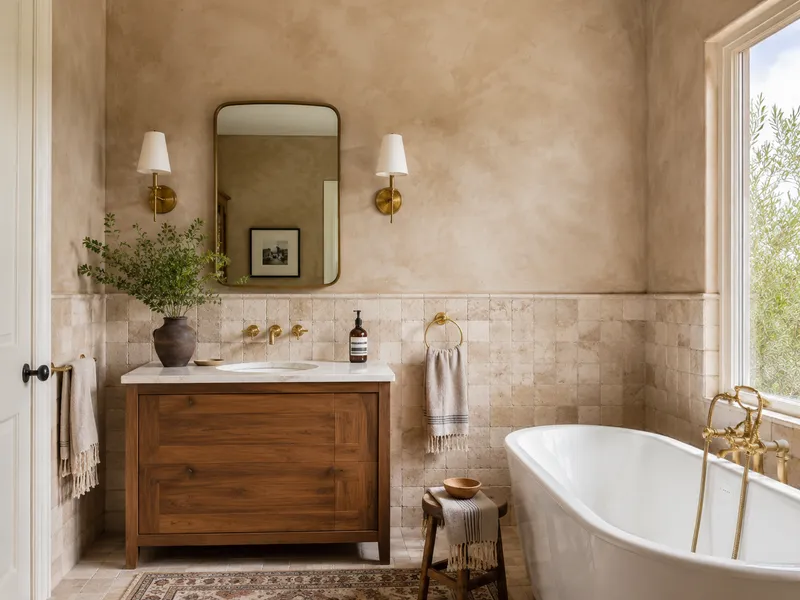

The real decision is simple: clay on the “dry” bathroom walls can be fantastic—calmer light, better air feel, and a soft, tactile surface. Inside a daily-use shower, though, ordinary clay is a terrible idea unless you’re using a fully engineered wet-area system and following it to the letter. In my book, clay wins for the room you dry off in; lime or tile wins for the place you stand under running water.
Let’s put clay-based bathroom kits next to lime-based finishes and modern backer-board systems, so you can decide where each belongs—and where it absolutely doesn’t.
| Metric | Clay-based bathroom wall finish kit (natural clay plaster & clay paint) | Lime-based bathroom wall finish (lime plaster & lime paint) | Tile / plaster over backer board (substrate performance) |
|---|---|---|---|
| Durability | Clayworks Smooth Finishes: appropriate for interior bathrooms but not wet or shower areas [1][2] | ICN natural hydraulic lime plaster: W0 water-absorption class (EN 1015-18) [3] | Hardie Backer cement board: lifetime performance without degradation after exposure to water in interior wet and high-moisture areas [4]; ceramic wall tile: life expectancy of a lifetime [5] |
| Moisture / water resistance | Clayworks Smooth & Tonal Finishes: appropriate for bathrooms but not wet or shower areas [1][2]; AURO clay paints: splash-water resistant for bathrooms and kitchens [6][7][8] | ICN natural hydraulic lime plaster: W0 water-absorption classification [3]; AURO Chalk paint: breathable, wipe-resistant [9] | PermaBASE Foam Tile Backer: passes ANSI A118.10 waterproofness [10]; PermaBASE UltraBacker cement board: <8% water absorption (ASTM C473) [11] |
| VOC emission level (g/L) | Stucco Italiano LimeClay: <1 g/L VOC [12]; Clayworks Smooth Finishes: low VOCs with VOC Emissions Certificates [13]; AURO COLOURS FOR LIFE Clay paint: very low-emission per AgBB [14] | AURO Chalk paint: emission-free [15]; AURO Ecolith lime paint: <1 g/L VOC and no formaldehyde or VOC emissions [16][17] | Not established |
| R-value / thermal resistance | Clayworks Smooth Finishes thermal conductivity: 0.84 W/mK [18] | ICN natural hydraulic lime plaster thermal conductivity: 0.47 W/mK [19] | Prova Board-Plus: thermal conductivity 0.034 W/mK, R-value 4.3 per inch [20] |
| Maintenance interval (years) | Not established | Waterproof lime stucco: wax topcoat every 3 years [21] | Ceramic wall tile: life expectancy of a lifetime before major replacement [5] |
| Cost per unit (materials + install) | Natural clay plaster installation: $9–$11 per sq ft (Phoenix, installed) [22] (~$97–$118 per m²) | Not established | Not established |
Clay-based bathroom wall finish kit (natural clay plaster & clay paints)

A good clay-based bathroom wall finish kit is what people are usually dreaming of when they say “I want a calm, natural bathroom.” Clay-based wall plasters like Clayworks-type plasters are explicitly described as suitable for bathrooms, but with a hard stop: they are not for wet or shower areas [1][2]. That wording is crucial. It means: lovely on the walls outside the shower, a liability where the water actually hits.
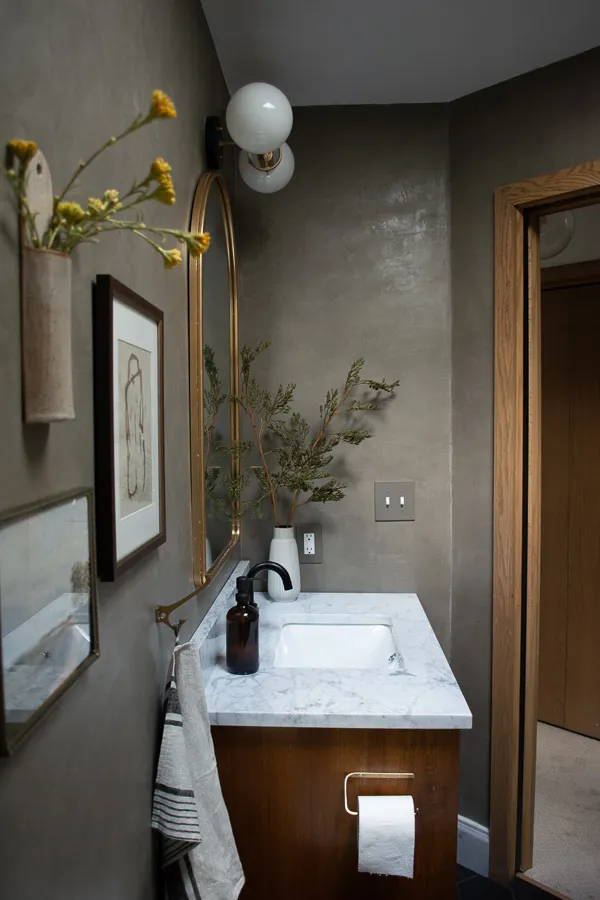
Think of clay as a high-end, tactile wall finish that happens to like humidity. AURO’s clay paints are splash-water resistant and suitable for bathrooms and kitchens [6][7][8], which is manufacturer-speak for “fine with steam and the odd droplet, not a daily soaking.” Natural clay plaster for bathrooms also takes advantage of moisture buffering—Clayworks plasters have a moisture buffer value of 1.28 [23] and a water-vapour diffusion resistance factor of μ 5/10 for a comparable clay topcoat [24], plus Stucco Italiano LimeClay shows very good vapour permeability with an sd value of about 0.04 m [25]. These are vapour numbers. They help the room breathe; they do not make the wall waterproof.

On the VOC side, clay kits are strong performers. Stucco Italiano LimeClay is under 1 g/L VOC [12], Clayworks Smooth Finishes are low-VOC with VOC Emissions Certificates [13], and AURO’s clay paint is assessed as very low-emission under the AgBB scheme [14]. If you’re chasing genuinely clean indoor air, clay is one of the few “eco” materials that actually delivers on that promise instead of just using it as a marketing line.
Living with clay is mostly about respecting its limits. Treat it like a premium wall paint with soul, not like tile. It will shrug off humidity and light splashes if the bathroom is ventilated and the substrate stays dry. But turn the shower head on it every morning and you will see creep damage—darkened patches, soft corners, powder on your fingers—long before you expected to. The manufacturer warning that it’s “appropriate for bathrooms but not wet or shower areas” [1][2] is there because they’ve seen those failures. So have I.
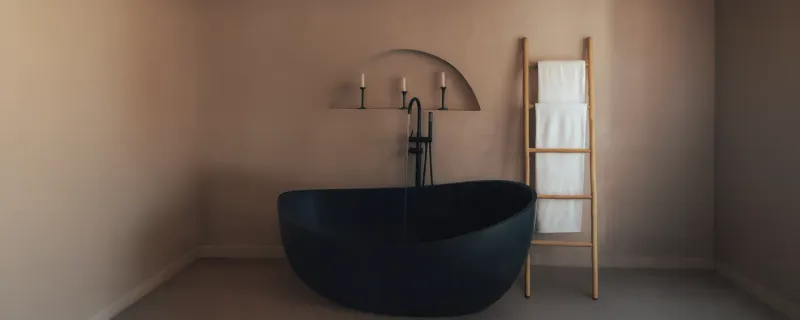
Installation over drywall isn’t mysterious, but it’s not “slap it on and hope” either. Clayworks is clear that gypsum boards and several common substrates must be primed with their own wall primer [26][27]. In practice, that means you’re not skipping the prep: primer, possibly a backing coat, then multiple thin plaster layers. They quote 2–3 hours between coats and about 24 hours for the full finish to dry before normal use [28][29]. AURO’s clay paint is reworkable after 4–6 hours [30]. Those are usable DIY numbers, but only if you can keep the room out of heavy use and the humidity under control while it dries.

Costs: one solid data point puts natural clay plaster at $9–$11 per sq ft installed in Phoenix [22], roughly $97–$118 per m². That’s firmly in “premium wall finish” territory—more than a basic paint job, but comparable to a quality decorative plaster or mid-range tile installation. Always verify local pricing and labour; that figure is regional, not a national standard.
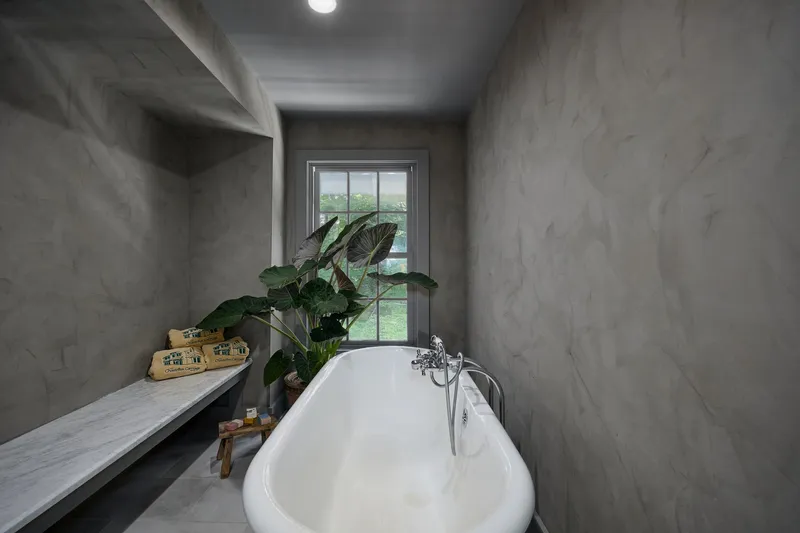
Where clay is a joy: feature walls, vanity walls, and the toilet wall in a bathroom with a fan that actually gets used. Where it’s a headache: around the shower head, on a tub surround kids treat like a splash zone, or in any bathroom that spends hours every day as a steam cave. No kit will save clay from bad ventilation and constant liquid water.
Lime-based bathroom wall finishes (lime plaster & lime paints)
If the contest is “clay finish vs lime plaster in wet areas,” lime wins every single time when water is physically landing on the wall. That doesn’t make lime immortal in a shower, but its chemistry is simply more comfortable with moisture than clay’s.
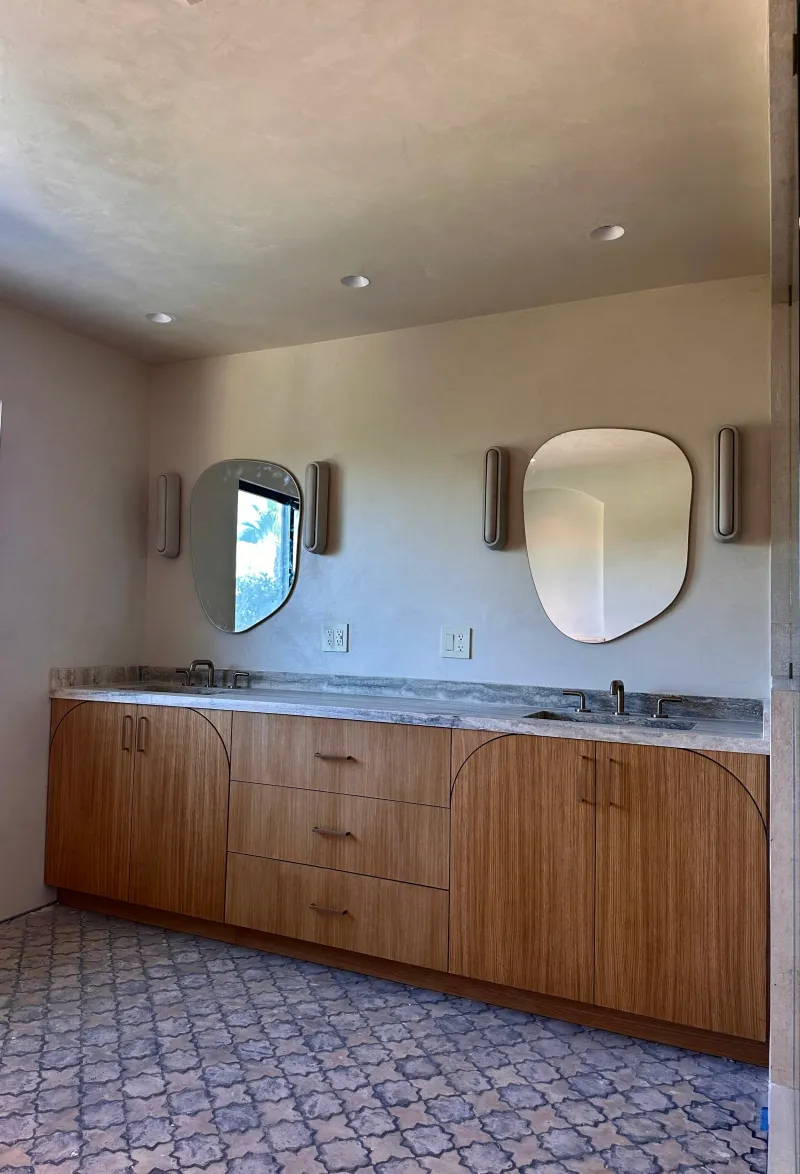
ICN natural hydraulic lime plaster, for example, carries a W0 water-absorption classification under EN 1015-18 [3]. W0 is a defined capillary water-absorption class—still absorbent, but tested and quantified. It also has a better thermal conductivity figure than the clay plaster at 0.47 W/mK [19] compared with Clayworks’ 0.84 W/mK [18], which tells you it’s less of a cold sink than dense clay, though both are far from insulation.
Lime paints fill in the picture. AURO Chalk paint is breathable, odour-absorbing, and wipe-resistant [9], highly breathable with an sd value under 0.05 m [31]. AURO Ecolith interior lime paint is highly vapour permeable (sd value class 1) [32] and has less than 1 g/L VOC [16] with no formaldehyde or VOC emissions [17], plus Cradle to Cradle GOLD certification [33]. That’s extremely clean chemistry combined with high vapour openness—exactly what you want on a bathroom wall that has to dry out between showers.
Maintenance is more predictable but also more formalised than with clay. For waterproof lime stucco, one manufacturer recommends a full layer of wax every three years to maintain waterproofing [21]. That’s the trade: a finish that can live in more aggressive moisture, but only if you keep up with a maintenance schedule. In the real world, almost nobody puts a reminder in their calendar to “rewax the shower,” and that’s where problems start.
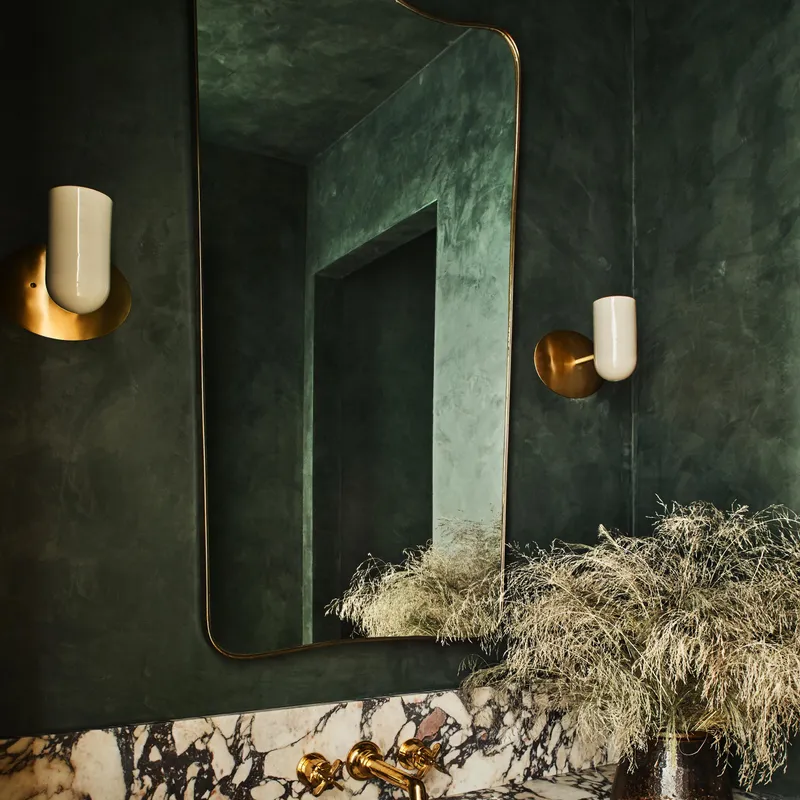
Lime’s failure mode under abuse is also well documented: expose standard lime plaster to constant saturation and you’re looking at efflorescence, structural breakdown, and surfaces that can support mould and mildew growth [34]. So lime is “more tolerant,” not “invincible.” You still need a compliant waterproof substrate, proper tanking, and a wet-area design that actually fits your building code. Never rely on any decorative plaster—clay or lime—as your waterproofing layer.
Where I like lime: as a robust, vapour-open finish in humid bathrooms, on shower-adjacent walls, and in showers when it’s part of a proven, detailed system (tadelakt, lime stucco + wax, etc.) and the client understands the maintenance. Clay handles the dry walls; lime takes the punishment zones.
Tile and backer-board assemblies (what’s behind or instead of the clay)
You don’t have to love tile to respect it. The reason tiles dominate showers is brutally simple: when done correctly, they last. The National Association of Home Builders gives ceramic wall tile a life expectancy of a lifetime [5]. That’s boring, reliable performance—exactly what you want where water hits every day.
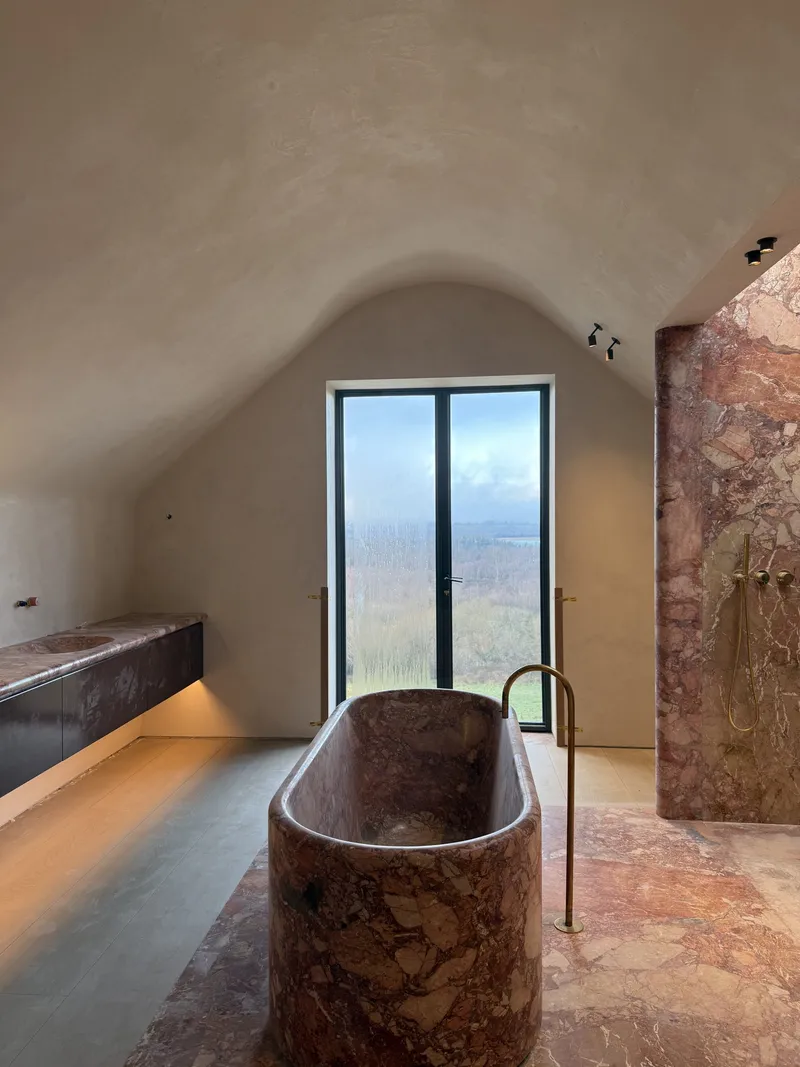
Behind almost every successful plaster or tile wet area is an unglamorous board doing the hard work. James Hardie’s Hardie Backer cement board is described as offering lifetime performance without degradation after exposure to water in interior wet and high-moisture areas [4]. PermaBASE Foam Tile Backer actually passes the ANSI A118.10 waterproofness standard [10], while their UltraBacker cement board keeps water absorption under 8% under ASTM C473 [11]. These are the hidden numbers that let you sleep at night.
On comfort, a foam-core board like Prova Board-Plus brings a surprising bonus: a thermal conductivity of 0.034 W/mK and an R-value of 4.3 per inch [20]. That’s real insulation compared to the essentially non-insulating mineral plasters. A tiled shower over a high-R backer feels less icy on winter mornings than tile over a cold masonry wall.
So where does this leave your clay-based bathroom wall finish kit? Usually, riding on top of something like gypsum in the dry zones, and stopping politely where cement or foam backer and tile (or lime stucco) take over in the wet zones. The backer boards and tiles are not “sexy,” but they are the reason your walls don’t rot. Clay is the visible layer; these are the structural adults in the room.
Which one should you choose?
Here’s the blunt version, organised by how you’re actually likely to use the room.
Budget-conscious renovation on existing drywall
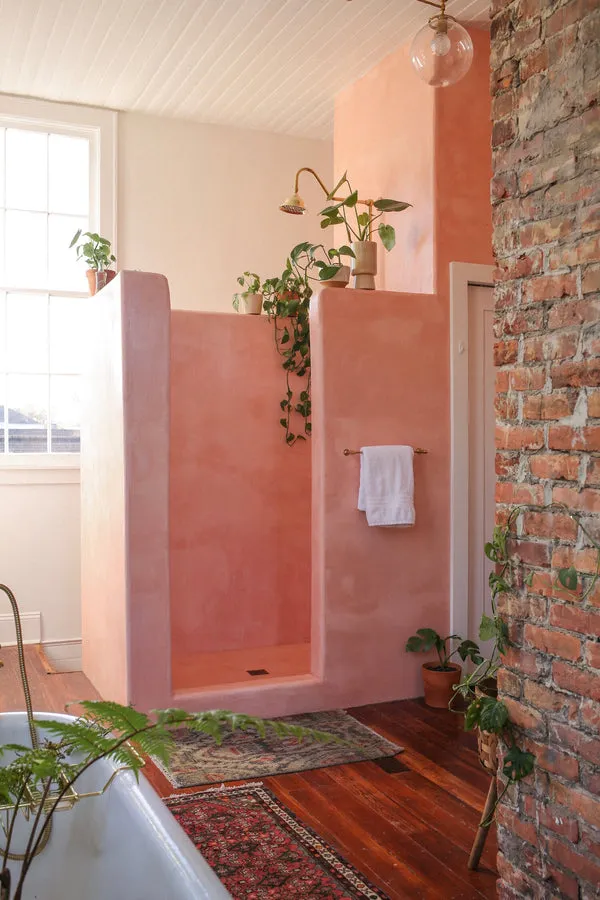
If your bathroom layout isn’t changing and your shower is already tiled, a clay-based bathroom wall finish kit is the upgrade that makes the rest of the room feel new without touching the plumbing. Use natural clay plaster or clay paint on the dry walls—over suitable primer as required [26][27]—and stop it cleanly at the tile edge. At $9–$11 per sq ft installed in one market [22], it’s not cheap, but it’s a targeted spend that changes what you see and feel every day.
Family bathroom, daily showers, kids and chaos
Here, the priority is “surfaces that still exist in ten years.” Tile or a properly detailed lime-based wet-area finish over a waterproof backer board wins in the shower. Backer boards like Hardie Backer and PermaBASE Foam are rated for wet and high-moisture service [4][10][11], and ceramic wall tile has a lifetime life expectancy [5]. Use clay on the upper and outer walls if you want, but keep it out of the splash zones. Don’t gamble family-bathroom duty on a delicate finish.
Design-led ensuite, good ventilation, grown-up users
This is where a clay-based bathroom wall finish kit earns its reputation. Clay on all non-wet walls gives you low VOCs [12][13][14], soft light, and better humidity buffering [24][25][23]. In the shower, step over to a lime-based system—tadelakt or waxed lime stucco—with the accepted three-year wax cycle if applicable [21] and a proper wet-area substrate behind it [4][10]. Clay for the mood, lime (or tile) for the water. That mix gives you both beauty and durability.
DIY weekend project
Clay wins on DIY-friendliness—Clayworks quotes 2–3 hours between coats and 24 hours to full dry [28][29], and AURO clay paint is reworkable after 4–6 hours [30]. But keep your ambition realistic: DIY on the dry walls only. Showers demand proper backer boards, tanking, and obsessive junction detailing [4][10][11], which is not a casual weekend skillset. Use your enthusiasm where the risk is low.
Rental or low-maintenance property
Renters don’t baby finishes. If you need something that shrugs off abuse with minimal maintenance, tile over a suitable backer board is the honest answer: lifetime-rated ceramic wall tile [5] and substrate products designed for permanent wet exposure [4][10][11]. Clay and lime can absolutely work, but only with users who understand “gentle cleaning” and, in lime’s case, a three-year wax routine for waterproof stucco [21]. That’s rarely a landlord’s reality.
Key facts
Show all 13 rows ▾Hide table ▴
| What it covers | Value | Source |
|---|---|---|
| Clay plaster suitability in bathrooms | Clayworks Smooth Finishes Natural Clay Plasters are appropriate for bathrooms, but not wet or shower areas | [1][2] |
| Clay paint splash resistance | AURO COLOURS FOR LIFE Clay paint is resistant to splash water and suitable for bathrooms and kitchens | [6][7][8] |
| Clay VOC and emissions | Stucco Italiano LimeClay <1 g/L VOC; Clayworks Smooth Finishes low VOC with emissions certificates; AURO Clay paint very low-emission (AgBB) | [12][13][14] |
| Lime VOC and emissions | AURO Chalk paint emission-free; AURO Ecolith lime paint <1 g/L VOC, no formaldehyde or VOC emissions, Cradle to Cradle GOLD | [15][16][33][17] |
| Clay and lime vapour / thermal performance | Clay Topcoat μ 5/10; LimeClay sd ≈0.04 m; Clayworks thermal conductivity 0.84 W/mK; ICN natural hydraulic lime thermal conductivity 0.47 W/mK | [24][25][18][19] |
| Clay plaster drying / working time | Clayworks: 2–3 hours between layers, 24 hours total dry; AURO Clay paint reworkable after 4–6 hours | [28][29][30] |
| Lime paint recoating time | AURO Ecolith interior lime paint recoatable after ~4 hours | [35] |
| Lime stucco waterproofing maintenance | Waxed waterproof lime stucco: full wax layer every 3 years | [21] |
| Clay plaster over drywall – primer requirement | Clayworks Wall Primer required over gypsum plasterboard, masonry, blockwork, wood fibre/wool boards; other substrates may need backing coat | [26][27] |
| Backer board waterproofness and durability | Hardie Backer: lifetime performance in wet/high-moisture areas; PermaBASE Foam passes ANSI A118.10; UltraBacker <8% water absorption | [4][10][11] |
| Backer board thermal performance | Prova Board-Plus thermal conductivity 0.034 W/mK, R-value 4.3 per inch | [20] |
| Tile service life | Ceramic wall tile life expectancy: lifetime | [5] |
| Clay plaster installed cost (example) | Natural clay plaster $9–$11 per sq ft installed (Phoenix) | [22] |
Quick answers
Is a clay-based bathroom wall finish kit suitable for shower walls?
No—standard clay-based bathroom wall finish kits like Clayworks Smooth Finishes are appropriate for bathrooms but explicitly not for wet or shower areas [1][2]. Use them on dry or splash-controlled walls only, and choose a tested wet-area system (lime, tile, or a proprietary kit over a waterproof backer) for the shower. Always confirm with the specific manufacturer and your local code before committing.
How moisture-resistant is natural clay plaster in a bathroom?
Natural clay finishes are moisture-tolerant in humidity and light splash but not designed for continuous wetting. Clayworks Smooth & Tonal Finishes are described as appropriate for interior bathrooms but not wet or shower areas [1], while AURO clay paints are resistant to splash water and suitable for bathrooms and kitchens [6][7][8]. That means “good with steam and occasional splashes,” not “waterproof.”
What VOC levels can I expect from a clay-based bathroom wall finish kit?
Clay-based systems are very low in VOCs: Stucco Italiano LimeClay is under 1 g/L VOC [12], Clayworks Smooth Finishes are low VOC with emissions certificates [13], and AURO COLOURS FOR LIFE Clay paint is classed as very low-emission under the AgBB scheme [14]. For anyone sensitive to indoor air quality, this is a genuine advantage over many conventional paints and coatings.
How does clay compare to lime plaster for eco-friendly bathroom walls?
Both clay and lime finishes offer low emissions, but lime paints can reach “emission-free” territory: AURO Chalk paint is emission-free [15], and AURO Ecolith lime paint has <1 g/L VOC with no formaldehyde or VOC emissions and Cradle to Cradle GOLD certification [16][33][17]. Clay excels on dry walls with strong vapour openness and low VOCs [12][13][14][24][25], while lime is usually the better choice where moisture exposure is higher.
What does a clay-based bathroom wall finish kit cost compared to other options?
One documented figure puts natural clay plaster installation at $9–$11 per sq ft including labour in Phoenix [22]. That’s a premium over basic paint and in the same ballpark as quality decorative plaster or mid-range tile; you should verify pricing with local installers, as costs vary by region and scope.
How long do tile-and-backer-board shower walls last compared to clay or lime finishes?
Ceramic wall tile assemblies are reported to have a life expectancy of a lifetime [5], and cement and foam backer boards such as Hardie Backer and PermaBASE Foam are designed for permanent service in wet and high-moisture areas [4][10][11]. Clay and lime can last well on bathroom walls outside the direct wet zone, but they are not documented as lifetime wet-area finishes and should never replace a proper waterproofed substrate.
Sources
Facts last verified 2026-10-25.
- Clayworks Smooth & Tonal Finishes are appropriate for interior bathrooms but not wet or shower areas. — Clayworks, retrieved 2026-10-25.
Appropriate for bathrooms, but not wet or shower areas.
- Clayworks Smooth Finishes Natural Clay Plasters are suitable for interior walls and ceilings and fixed furniture, and are appropriate for bathrooms, but not wet or shower areas. — Clayworks, retrieved 2026-10-25.
Suitable for interior walls and ceilings and fixed furniture. Appropriate for bathrooms, but not wet or shower areas.
- ICN natural hydraulic lime plaster has a W0 water-absorption classification under EN 1015-18. — TecnoCanapa, retrieved 2026-10-25.
– Water absorption by capillarity: W0 – EN 1015-18
- James Hardie states that Hardie Backer cement board offers lifetime performance without degradation after exposure to water in interior wet and high-moisture areas. — James Hardie, retrieved 2026-10-25.
Even after exposure to water, Hardie® Backer Board will retain its strength and shape, offering lifetime performance without degradation.
- The National Association of Home Builders reports that ceramic tile used on walls, ceilings, and other finishes has a life expectancy of a lifetime. — National Association of Home Builders, retrieved 2026-10-25.
Ceramic Tile Lifetime
- AURO COLOURS FOR LIFE Clay paint (535) is resistant to splash water and is highly vapor permeable with an sd value of less than 0.015 m, ensuring a moisture-regulating effect for interior wall surfaces. — AURO, retrieved 2026-10-25.
The consistently ecological living space paint is suitable for mineral and organic interior wall surfaces. It is resistant to splash water and can be painted in the bathroom and kit-chen. Due to its h…
- AURO High-grade clay paint (331) is resistant to splash water, making it suitable for use in bathrooms and kitchens, and has high vapor diffusion openness with an sd value of less than 0.015 m, which is moisture-regulating. — AURO, retrieved 2026-10-25.
Ready-to-use clay paint without preservatives. It is suitable for all substrates of interior wall surfaces. As it is resistant to splash water, it can also be painted in the bathroom and kitchen.
- AURO COLOURS FOR LIFE Clay paint (535) is resistant to splash water, making it suitable for use in bathrooms and kitchens. — AURO, retrieved 2026-10-25.
It is resistant to splash water and can be painted in the bathroom and kit-chen.
- AURO Chalk paint (326) is breathable, odour-absorbing, and wipe-resistant, making it ideal for rooms with large fluctuations in humidity and temperature such as kitchens, cellars, bathrooms, and laundry rooms. — AURO, retrieved 2026-10-25.
Traditional interior wall paint based on slaked lime: wipe-resistant, breathable, odour-absorbing and emission-free. Ideally suited for rooms with large fluctuations in humidity and temperature such a…
- PermaBASE Foam Tile Backer passes ANSI A118.10 for waterproofness. — National Gypsum, retrieved 2026-10-25.
Passes ANSI A118.10 for waterproofness.
- PermaBASE UltraBacker cement board has a water-absorption rating of less than 8% under ASTM C473. — National Gypsum, retrieved 2026-10-25.
Features lowest water-absorption rating of <8% (ASTM C473).
- Stucco Italiano LimeClay contains less than 1 g/L of VOC. — Stucco Italiano, retrieved 2026-10-25.
This product contains less than 1 g/l of VOC.
- Clayworks Smooth Finishes Natural Clay Plasters have low VOCs and no off-gassing, with Health Product Declaration & VOC Emissions Certificates available. — Clayworks, retrieved 2026-10-25.
Natural, low VOCs, formaldehydes and no polymers or oils. Absorbs toxins, regulates humidity. No off-gassing. Health Product Declaration & VOC Emissions Certificates.
- AURO COLOURS FOR LIFE Clay paint (535) is very low-emission according to the AgBB assessment scheme, due to the use of the biogenic binder REPLEBIN®. — AURO, retrieved 2026-10-25.
The use of the biogenic binder REPLEBIN® makes the paint very low-emission according to the AgBB assessment scheme.
- AURO Chalk paint (326) is emission-free. — AURO, retrieved 2026-10-25.
Traditional interior wall paint based on slaked lime: wipe-resistant, breathable, odour-absorbing and emission-free.
- AURO Ecolith interior No. 341 lime paint has a VOC content of less than 1 g/l. — AURO, retrieved 2026-10-25.
EU-VOC limit value according to 2004/42/EGII A (aWb): 30 g/l; product VOC: < 1 g/l.
- AURO Ecolith interior No. 341 lime paint has no formaldehyde or VOC emissions. — AURO, retrieved 2026-10-25.
No formaldehyde or VOC emissions.
- Clayworks Smooth Finishes Natural Clay Plasters have a thermal conductivity of 0.84 W/mK. — Clayworks, retrieved 2026-10-25.
Thermal conductivity: 0.84 W/mK
- ICN natural hydraulic lime plaster has a thermal conductivity of 0.47 W/mK at P=50% and a water-vapour permeability coefficient of 15. — TecnoCanapa, retrieved 2026-10-25.
– Coefficient of permeability to water vapour: 15 – EN 1015-19 – Thermal conductivity: 0,47 W/mK (average value from prospectus; P=50%) – EN 1745, A.12
- Prova Board-Plus has a thermal conductivity of 0.034 W/mK and an R-value of 4.3 per inch. — Ceramed, retrieved 2026-10-25.
|**Thermal conductivity**|0.034 W/mK — R-value 4.3 per inch|
- Artisan Stucco Mortars recommends applying a full layer of wax to waterproof lime stucco every three years. — Artisan Stucco Mortars, retrieved 2026-10-25.
To keep your Waterproof lime stucco in perfect condition, apply a full layer of wax every three years.
- Natural clay plaster installation costs $9–$11 per square foot in Phoenix, including installation. — Norem Contracting, retrieved 2026-10-25.
Natural clay plaster (American Clay and similar)|$9–$11 per sq ft, installed|Coat count and wall condition set the price.
- Clayworks Smooth Finishes Natural Clay Plasters have a moisture buffer value of 1.28. — Clayworks, retrieved 2026-10-25.
Moisture buffer value: 1.28
- Clay Topcoat Fine Plaster has a water-vapour diffusion resistance factor of μ 5/10 under standard laboratory conditions. — Sevarex, retrieved 2026-10-25.
Water vapour diffusion res. μ 5/10 (table value) The values are valid under standard conditions [T = (23 ± 2) ° C / Relative humidity: (55 ± 5)%] and refer to laboratory samples that can differ depe…
- Stucco Italiano LimeClay has a vapour permeability equivalent to an SD value of approximately 0.04 m under DIN 52 615. — Stucco Italiano, retrieved 2026-10-25.
Vapour Permeability SD ~ 0,04 m (DIN 52 615)
- Clayworks clay plaster can be applied directly to gypsum backing board when the board is suitably primed, while other substrates may require a backing coat. — Clayworks, retrieved 2026-10-25.
Can be applied directly onto Gypsum backing board suitably primed. Other substrates may require a backing coat.
- Clayworks Wall Primer is required when applying Clayworks Smooth Finishes Natural Clay Plasters onto gypsum plasterboard, masonry, blockwork, wood fibre board & wood wool carrier board, or directly onto Gypsum backing board. Other substrates may require a backing coat. — Clayworks, retrieved 2026-10-25.
Most commonly applied directly onto gypsum plasterboard, masonry, blockwork, wood fibre board & wood wool carrier board. Can be applied directly onto Gypsum backing board suitably primed. Other substr…
- Clayworks clay plaster requires 2–3 hours between layers and approximately 24 hours for the entire finish to dry before normal use. — Clayworks, retrieved 2026-10-25.
2-3 hrs is between each layer. 24 hours for the entire finish to dry.
- Clayworks Smooth Finishes Natural Clay Plasters require 2-3 hours drying time between each layer and 24 hours for the entire finish to dry. — Clayworks, retrieved 2026-10-25.
Drying times: 2-3 hrs is between each layer. 24 hours for the entire finish to dry.
- AURO COLOURS FOR LIFE Clay paint (535) is reworkable after 4-6 hours. — AURO, retrieved 2026-10-25.
Reworkable after 4 – 6 hours
- AURO Chalk paint (326) is highly breathable with an sd value of less than 0.05 m. — AURO, retrieved 2026-10-25.
Highly breathable (sd value <0,05m)
- AURO Ecolith interior No. 341 lime paint is highly moisture-vapour permeable with an sd value class 1. — AURO, retrieved 2026-10-25.
Highly moisture-vapour permeable (sd value class 1); non-flammable.
- AURO Ecolith interior No. 341 lime paint is Cradle to Cradle certified GOLD. — AURO, retrieved 2026-10-25.
Cradle to Cradle certifiedô GOLD
- Standard lime plaster exposed to constant saturation can develop efflorescence and structural breakdown, while its porosity can support mold and mildew growth. — Engineer Fix, retrieved 2026-10-25.
Constant saturation leads to efflorescence (the migration of soluble salts to the surface) and structural breakdown. Furthermore, the porosity of these materials creates an ideal environment for the p…
- AURO Ecolith interior No. 341 lime paint is recoatable after approximately 4 hours, depending on temperature, air, and substrate humidity. — AURO, retrieved 2026-10-25.
Recoatable after approx. 4 hours, depending on temperature, air and substrate humidity.