


You’re standing in a glassy conference room that “got acoustic treatment last year.” The walls are covered in laser-cut acoustic felt, the quote wasn’t cheap, and yet your Teams call still sounds like you’re in a tiled stairwell. Or you’re planning a home studio and torn between decorative PET felt panels and mineral wool frames that look more like construction than décor.
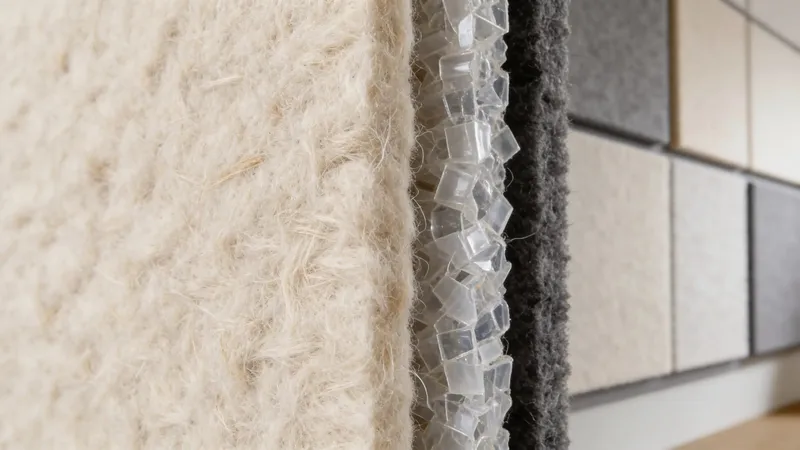
Here’s the blunt truth about acoustic felt vs mineral wool panels: neither one will soundproof a room, but mineral wool actually fixes echo and clarity, while felt mostly gives you a nicer-looking wall and mild absorption. If you care about performance first—studios, serious meeting rooms, honestly noisy offices—mineral wool wins. Felt only “wins” when looks, light weight, and easy handling are your top priority and you accept that the acoustic fix will be modest.
| Metric | Acoustic felt panels (polyester / PET) | Mineral wool acoustic panels |
|---|---|---|
| Durability | No abrasion / compression durability classification reported for polyester felt wall panels[1] | Not established |
| Moisture / water resistance | Not established | Not established |
| VOC emission level (g/L) | Not established | GREENGUARD certified for indoor-air quality and VOC product-emission standards[2] |
| R-value / thermal resistance | Not established | R-3.7 per inch (ASTM C518, 75°F) for mineral wool insulation[3] |
| Maintenance interval (years) | Regular cleaning and inspection recommended; routine dust removal and checks for dents, scratches, or loose edges[4] | Not established |
| Cost per unit (m²) | Material only: $43.06–$75.35 per m² for 1 in PET felt wall panels[5] | Material only: $86.11–$161.46 per m² for mineral wool acoustic panels[6] |
| Cost per unit (sq ft) | Material only: $4.00–$7.00 per sq ft for 1 in PET felt wall panels[5] | Material only: $8.00–$15.00 per sq ft for mineral wool acoustic panels[6] |
Acoustic felt panels – what you really get
Acoustic felt (usually PET) is what designers reach for when the office needs to “look acoustic.” It cuts nicely, takes colour well, and you can turn it into feature walls, pinboards, ceiling baffles, and branded shapes without fogging the room with dust or needing heavy fixings. For offices, conference rooms, and classrooms, it’s a handy way to tame some flutter echo and harshness without making the room look like a studio.

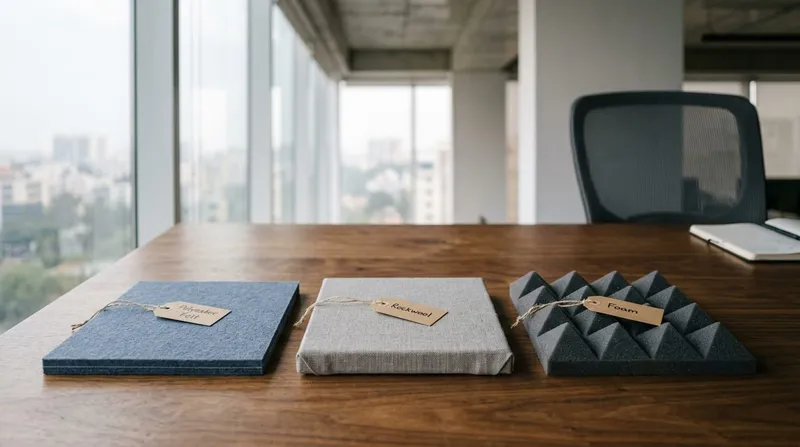
On paper, felt isn’t useless acoustically. Polyester acoustic wall panels tested under ASTM C423 come in with NRC values between 0.75 and 0.90[7], which means they do absorb a good chunk of incident sound over the tested frequency range. Ceiling baffles and clouds built from polyester acoustic felt report NRC values from 0.40 up to 0.95 when tested to ASTM C423‑17 with an A-mount[8]. So yes, decent absorption is possible.
The catch: those lab numbers assume a specific thickness, mounting, and exposed area. In real projects, I keep walking into rooms where a thin layer of decorative felt has been dotted around and everyone wonders why it still rings. You can have an NRC 0.90 panel[7] and still have a bad room if you don’t have enough square footage covered or any depth or air gap to pull the performance down into more useful frequencies.
Durability testing is another blind spot. The documentation for polyester felt wall panels that we actually have in front of us includes acoustic tests but not an abrasion, compression, or handling durability classification[1]. In other words, nobody’s published the “how many chair backs can scrape this before it looks tired” number. We do know that manufacturers recommend treating them gently: soft-cloth or vacuum cleaning to remove dust, keeping them away from excessive moisture, and routinely inspecting for dents, scratches, and loose edges that affect both appearance and absorption[4][9]. That tells you a lot—these are finish materials, not indestructible wall armor.
In higher-traffic zones, some PET products (like PET Eco Felt) are specifically recommended because they “will not damage easily,” and makers advice placing them out of direct impact to minimise bumps and scratches[10]. That’s honest marketing: they’re improving robustness, but they’re still not crash-proof. If your chairs, trolleys, or kids bang into the walls, felt will show it; once panels are visibly damaged, their acoustic performance can degrade as well[9].
Felt’s fire story is mixed but not hopeless. Several polyester-felt acoustic panels carry ASTM E84 Class A flame-spread ratings[11][12], which is the bar many commercial interiors need to clear for large-area wall or ceiling finishes. But that’s product-specific and assembly-specific: one range achieves Class A because its manufacturing adds a proportion of new material[11], another is tested as a particular PET felt system[12]. You cannot assume any random “acoustic felt” you find online is automatically compliant for your ceiling or escape route. For code-sensitive jobs, you need the actual test report for the exact product and configuration you’re planning to use—and you should confirm with your local building official or fire consultant.
Living with felt is mostly about surfaces and expectations. Maintenance is straightforward—vacuum or wipe with a soft cloth, check for damage, avoid soaking or harsh cleaning[4]. The bigger issue is that “low maintenance” doesn’t mean invisible maintenance: dust on horizontal felt baffles, grubby marks where people lean, edges catching the vacuum head. The panels that are right behind chairs or along corridors will age much faster than a high wall band above eye level.
From a performance point of view, felt is garnish, not the main course. If you’re fitting out an office where the main problem is general chatter and light echo, you can do a lot with a properly designed felt ceiling and some wall coverage. But if you’re trying to fix a truly loud, reverberant room, or you need real control for microphones, felt by itself is the wrong backbone. It looks “acoustic,” and that’s why it gets oversold.
Mineral wool acoustic panels – the workhorse
Mineral wool is what acoustics pros reach for when they actually need to change how a room sounds—home studios, mixing rooms, cinemas, serious conference rooms, and any office where the client complains about echo every meeting. It’s not glamorous. It’s heavy, fibrous, and wants a frame and facing. But this is the stuff that actually does the heavy lifting.

One big advantage over felt is that mineral wool behaves as both an acoustic and thermal material. Mineral wool insulation tested under ASTM C518 comes in with a thermal resistance of R‑3.7 per inch at 75°F[3]. That R‑value means that a 4 in (102 mm) panel gives you serious thermal resistance as well as acoustic absorption[3]. So if you’re lining exterior walls in a studio or a chilly meeting room, mineral wool is doing two jobs while felt is doing one at best.
On the indoor-air side, at least one major mineral-wool line used for sound and fire blocking is GREENGUARD certified for indoor-air quality and VOC product emissions[2]. Certification like that doesn’t magically make a room healthy, but it does tell you the product has passed recognised emission tests. Again, you still need to verify the specific product and rating for your project with local regulations in mind, but it’s a strong point in mineral wool’s favour vs untested cheap panels.
What you won’t find in flashy brochures—but any studio builder knows—is how forgiving mineral wool is in the acoustics sense when you use enough of it and give it some depth. You frame it, wrap it in acoustically transparent fabric, leave a deliberate air gap to the wall, and the result is broadband absorption that actually reaches into the lower midrange rather than only shaving the top end. That’s exactly what home studios and demanding conference rooms are missing when they rely on thin felt tiles.
Downsides? Plenty. Mineral wool acoustic panels are more expensive on a per-square-foot material basis: $8.00–$15.00 per sq ft[6], versus $4.00–$7.00 per sq ft for 1 in PET felt[5]. In metric, that’s roughly $86.11–$161.46 per m² for mineral wool[6] against $43.06–$75.35 per m² for felt[5]. And that’s before you factor in more demanding fixings, framing, and fabrics. But here’s the harsh bit: you usually need fewer square feet of mineral wool to get the same or better acoustic result. Pay more per panel, install fewer panels, and actually solve the problem once.
The maintenance story is simple: treat mineral-wool panels like furniture-grade fabric-wrapped elements. Gentle vacuuming, careful spot cleaning, no soaking. If you damage the fabric, you’re into re-wrapping or replacing the panel, not just touching up paint. They also project farther off the wall, so you’ll notice them physically in narrow rooms and corridors.
From a building-science angle, mineral wool brings one more non-acoustic advantage: fire and heat resistance. While our specific facts here focus on R‑value[3] and VOC certification[2], mineral wool generally plays well in assemblies that need fire performance and thermal insulation. For any project intersecting building codes, rated partitions, or ceilings, you should still get the actual fire-test documentation for the panel system and clear it with your local code consultant—but mineral wool is usually on the “acceptable” side of that conversation.
In everyday use, the only people who complain about properly designed mineral wool panels are the ones who didn’t like the aesthetics or weren’t warned about the projection. The people who talk or record in the room? They’re the ones you’ll hear saying “this finally sounds under control.” That’s why, for me, mineral wool is the backbone. Felt is what you add after the serious work is done.
Which one should you choose?
Here’s where acoustic felt vs mineral wool panels stops being a theoretical debate and turns into “what are you actually building, and who has to live with it?”

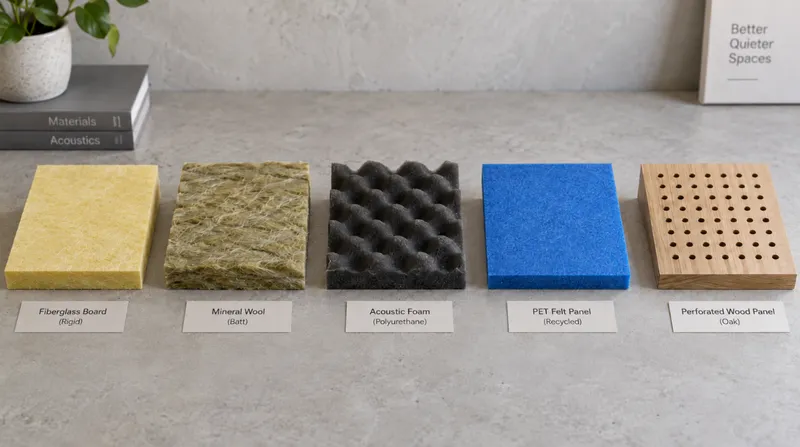
Open-plan office or coworking floor
If your main goal is to visually soften a hard office and shave some chatter, acoustic felt is a practical starting point. It’s lighter, cheaper per sq ft[5], and easier to integrate as screens, clouds, and branding. But don’t kid yourself: if the office is truly loud, mineral-wool clouds and wall absorbers should be the backbone, with felt used sparingly as the design layer.
Conference rooms and glass boxes
For conference rooms, I lean strongly to mineral wool as the primary absorber, especially on at least one solid wall and possibly the ceiling. A couple of fabric-wrapped mineral-wool panels will do more for call clarity than an entire feature wall of thin felt. Use felt only if you’ve already got enough real absorption and you’re now polishing the look.
Home studios, voiceover booths, podcast rooms
Here the “acoustic felt vs mineral wool panels” question isn’t close: mineral wool wins every time. You need thickness, air gaps, and broadband panels; decorative felt is what people install first and then rip down when they hear their recordings. Use mineral wool around reflection points, corners, and behind the desk; keep felt for noticeboards or light reflection control at best.
Budget renovation where price really matters
On sticker price alone, felt looks kinder at $4.00–$7.00 per sq ft[5] vs $8.00–$15.00 per sq ft for mineral wool[6]. But that’s per square foot, not per usable decibel. If you only have the budget to treat a small portion of the room, spend it on fewer, thicker mineral-wool panels and live with a plainer look. It’s better to actually fix one side of the room than to sprinkle felt everywhere and still hate your meetings.
Ceilings and large areas
For suspended ceilings, clouds, and baffles, felt is lighter, easier to hang, and simpler around dodgy substrates. Mineral wool needs real structure and coordination, but when you walk into a room under a proper mineral-wool cloud, your voice tells you instantly it was worth the trouble. For any ceiling that truly has to work acoustically, mineral wool is my default; felt is the compromise when weight, fire documentation, or install logistics block you.
Rooms that genuinely need sound isolation
Neither material is the answer. Acoustic felt and mineral-wool panels help inside the room by reducing echo; they do not substitute for mass, airtight construction, or detailing against flanking. If you need to stop sound passing through walls or ceilings, you’re into a full isolation design. Talk to an acoustical consultant and your local building official before you spend heavily on interior panels and expect “soundproofing.”
Whichever way you lean, confirm specific fire ratings, VOC certifications, and installation requirements with the manufacturer and a local professional. Cost, fire, and code constraints change by region; don’t rely on generic data for sign-off.
Key facts
Show all 12 rows ▾Hide table ▴
| What it covers | Value | Source |
|---|---|---|
| NRC range for polyester acoustic felt wall panels | 0.75–0.90 (ASTM C423)[7] | Armstrong Ceilings |
| NRC range for polyester acoustic felt ceiling baffles/clouds | 0.40–0.95 (ASTM C423‑17, A‑mount)[8] | Second Skin Audio |
| Durability testing for polyester felt wall panels | No abrasion/compression/handling classification reported[1] | Armstrong Ceilings |
| Felt wall-panel maintenance guidance | Regular soft-cloth/vacuum cleaning; avoid moisture; inspect for dents, scratches, loose edges[4] | DecoSoundPanel |
| Fire rating for selected polyester felt acoustic panels | ASTM E84 Class A flame-spread rating[11][12] | MPS Acoustics |
| Mineral wool thermal resistance | R‑3.7 per inch at 75°F (ASTM C518)[3] | Johns Manville |
| Mineral wool VOC / indoor-air certification | GREENGUARD certified for indoor-air quality and product emissions[2] | Johns Manville |
| PET felt wall-panel material cost (1 in) | $4.00–$7.00 per sq ft ($43.06–$75.35 per m²) material only[5] | AcousPlan |
| PET felt wall-panel installed cost (1 in) | $10–$18 per sq ft installed[13] | AcousPlan |
| Mineral wool acoustic panel material cost | $8.00–$15.00 per sq ft ($86.11–$161.46 per m²) material only[6] | Yuheng WPC |
| Felt in high-traffic areas | PET Eco Felt recommended as harder to damage; placing panels out of reach minimises bumps/scratches[10] | DecoSoundPanel |
| Effect of damaged acoustic panels | Wear, dents, scratches, or loose edges can reduce sound absorption and harm appearance[9] | DecoSoundPanel |
Quick answers
Is mineral wool better than acoustic felt for office “soundproofing”?
Mineral wool is better than acoustic felt at reducing echo and improving speech clarity, but neither one actually soundproofs an office; both mainly absorb sound inside the room rather than blocking transmission. Mineral wool panels give you more broadband absorption per panel, while felt mostly improves the look and offers moderate absorption based on thickness and mounting.
How much do acoustic felt panels cost compared with mineral wool per square foot?
Acoustic felt wall panels around 1 in (25 mm) thick typically cost $4.00–$7.00 per sq ft for material only[5], while mineral wool acoustic panels run about $8.00–$15.00 per sq ft[6]. Installed costs for felt panels are about $10–$18 per sq ft including labour and accessories[13]. Always verify current pricing locally before budgeting; labour rates and supply chains vary.
How effective are acoustic felt panels at absorbing sound?
Polyester acoustic wall panels show NRC values between 0.75 and 0.90 in ASTM C423 tests[7], and polyester felt ceiling baffles or clouds report NRC values from 0.40 to 0.95 under ASTM C423‑17 A‑mount testing[8]. In practice, you only get this level of performance with the tested thickness, mounting, and coverage, so thin decorative tiles scattered on a wall will not match those lab numbers.
Do mineral wool panels help with insulation as well as acoustics?
Yes, mineral wool insulation used in acoustic panels has a thermal resistance of R‑3.7 per inch at 75°F under ASTM C518[3]. That means a few inches of mineral-wool panel can significantly improve both acoustic absorption and thermal performance of a wall or ceiling, which felt panels alone do not provide.
Are acoustic felt panels durable enough for high-traffic offices?
Manufacturers recommend regularly vacuuming or gently cleaning polyester acoustic felt panels and inspecting them for dents, scratches, and loose edges[4], and note that damage can reduce both absorption and appearance[9]. More durable variants like PET Eco Felt are suggested for high-traffic areas and should be placed out of direct impact zones to minimise bumps and scratches[10].
Are acoustic felt and mineral wool panels safe for indoor air?
Some mineral-wool acoustic products, such as Johns Manville Sound & Fire Block Batts, are GREENGUARD certified for indoor-air quality and VOC emissions[2]. For felt, fire testing shows that certain polyester acoustic panels achieve ASTM E84 Class A flame-spread ratings[11][12], but VOC data are not established in the facts above. For any project, you should request specific emission and fire-test documentation for the exact product and confirm with local code and health requirements.
Sources
Facts last verified 2026-11-05.
- The cited polyester felt wall-panel documentation reports acoustic testing but does not provide an abrasion, compression, or handling durability classification. — Armstrong Ceilings, retrieved 2026-11-05.
FeltWorks 1" acoustical panels provide a wide range of sound absorption, from NRC 0.75 to 0.90, based on installation method used, tested per ASTM C423 and mounted in accordance with ASTM E795.
- Johns Manville Mineral Wool Sound & Fire Block Batts are GREENGUARD certified for indoor-air quality and VOC product-emission standards. — Johns Manville, retrieved 2026-11-05.
This certification is proof that the product meets the GREENGUARD Environmental Institute’s indoor air quality standards and product emission standards for VOCs.
- Johns Manville mineral wool insulation has an R-value of 3.7 per inch at 75°F under ASTM C518. — Johns Manville, retrieved 2026-11-05.
R-Value/Inch (per ASTM C518): 3.7 (hr•ft2•°F)/Btu
- To maintain optimal performance and longevity, polyester acoustic felt wall panels should be regularly cleaned with a soft cloth or vacuum with a brush attachment to remove dust and dirt, kept away from excessive moisture, routinely inspected for damage like dents, scratches, or loose edges, and protected from physical damage in high-traffic areas by using durable panels like PET Eco Felt or placing them out of reach. — DecoSoundPanel, retrieved 2026-11-05.
Regular Cleaning: Dust and debris can accumulate on the surface of acoustic panels over time, affecting their sound-absorbing capabilities. Use a soft cloth or a vacuum cleaner with a brush attachment…
- PET felt wall panels with a 1-inch thickness are listed at $4.00–$7.00 per square foot for material in a U.S. acoustic-treatment cost guide. — AcousPlan, retrieved 2026-11-05.
|PET felt wall panel (1")|$4.00–$7.00|$10–$18|0.55–0.75|
- Mineral wool acoustic panels are listed at approximately $8–$15 per square foot for material in a cost comparison guide. — Yuheng WPC, retrieved 2026-11-05.
|Mineral wool panels|$8 to $15|$50 to $100|Raw boards from ~$8 to $12 per m²|15 to 20 years|
- Polyester acoustic wall panels have a typical NRC range of 0.75 to 0.90, tested according to ASTM C423. — Armstrong Ceilings, retrieved 2026-11-05.
FeltWorks 1" acoustical panels provide a wide range of sound absorption, from NRC 0.75 to 0.90, based on installation method used, tested per ASTM C423 and mounted in accordance with ASTM E795.
- Polyester acoustic ceiling baffles or clouds have a reported NRC range of 0.40 to 0.95 when measured using ASTM C423-17 with A-mount testing. — Second Skin Audio, retrieved 2026-11-05.
Acoustical Performance|ASM C423-17 (A Mount)|0.40 to 0.95 NRC Rating|
- Damaged acoustic panels, showing signs of wear, tear, dents, scratches, or loose edges, can affect their sound absorption capabilities and appearance. — DecoSoundPanel, retrieved 2026-11-05.
Check for Damage: Routinely inspect the panels for any signs of wear, tear, or physical damage. Look for dents, scratches, or loose edges. Damaged panels can affect their sound absorption capabilities…
- Polyester acoustic felt panels, like PET Eco Felt, are recommended for high-traffic areas because they will not damage easily, and placing them out of reach can minimize damage from accidental bumps or scratches. — DecoSoundPanel, retrieved 2026-11-05.
Preventative Measures: Consider taking preventive measures to protect your acoustic wall panels from potential physical damage. For high-traffic areas, such as hallways or classrooms, consider only us…
- MPS Prism polyester felt acoustic wall panels have an ASTM E84 Class A flame-spread rating, with the rating permanently achieved by infusing 40% new material into the panel. — MPS Acoustics, retrieved 2026-11-05.
Fire Rating ASTM E84 Class A Fire Spread rating is permanently achieved by infusing 40% new material into the panel.
- MPS Lens PET felt acoustic panels have an ASTM E84 Class A fire rating. — MPS Acoustics, retrieved 2026-11-05.
Fire Rating ASTM E84 Class A
- PET felt wall panels with a 1-inch thickness are listed at $10–$18 per square foot installed in a U.S. acoustic-treatment cost guide. — AcousPlan, retrieved 2026-11-05.
|PET felt wall panel (1")|$4.00–$7.00|$10–$18|0.55–0.75|